You know that little stab of frustration when you post something thoughtful, helpful, and genuinely useful... and nothing happens?
No inquiries.
No booked calls.
Maybe 7 likes from people who already know you.
So you post again tomorrow. And the next day. And the next.
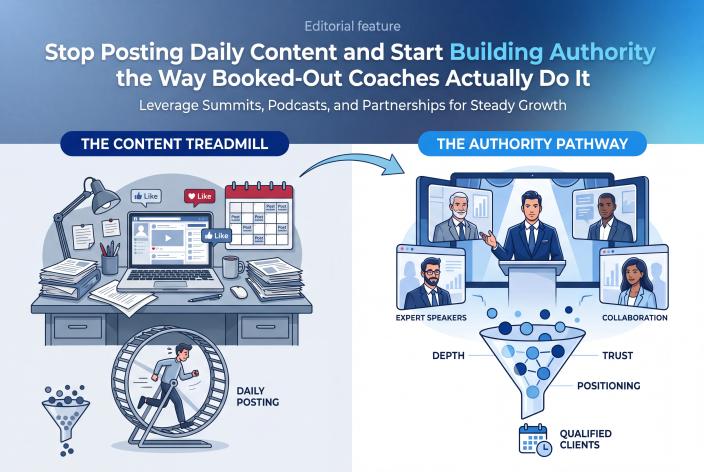
That’s the content treadmill. It keeps you moving, but it doesn’t always move your business.
And if you’re a coach who already knows your work gets results, that’s maddening. You’re not trying to become an influencer for the sake of attention. You want right-fit clients who see your value, trust your process, and book a conversation because they’re ready for help.
So let’s talk about what booked-out coaches actually build.
They build authority.
And authority is created very differently than daily content.
Why consistent content can still leave your calendar empty
Let me be clear.
Content matters.
Your ideas need to be visible. Your market needs to hear your voice. Your prospects need enough exposure to understand how you think.
But daily posting by itself often creates the illusion of momentum.
Why?
Because social content is usually:
- Fast moving
- Low commitment
- Easy to consume and forget
- Seen by a small slice of your audience
- Disconnected from a real buyer journey
You can spend 90 minutes polishing a post, publish it, get a quick dopamine hit, and still have no clear path from reader to prospect to booked call.
That’s the part most coaches feel but don’t always name.
The post may be good. The problem is the pathway behind it is weak.
You see, authority doesn’t come from being seen once a day. Authority comes from being recognized, associated with trusted people, and experienced as a guide before the sales conversation.
That requires a system.
Authority grows faster when you borrow trust through association
Here’s a powerful shift.
You don’t have to build every ounce of credibility alone.
One of the fastest ways to become more trusted in your niche is to create association with other trusted experts, speakers, partners, and platforms.
This is why summits and collaborations are so powerful.
When you host a virtual summit, you’re not only sharing your own ideas. You’re creating a platform. In Virtual Summits training, summits are described as a way to establish authority, create yourself as a niche influencer or expert, generate ongoing leads, and build a platform around your message.
That platform gives you something daily content rarely gives you.
Positioning.
You become the person gathering the conversation in your niche.
That changes how people see you.
The Expert Leverage strategy
There’s a specific speaker recruitment strategy called Expert Leverage.
The idea is simple. Get 1 or 2 high-level influencers to commit first, then use their names and participation to attract other quality speakers.
Why does this work?
Because you’re leveraging the authority, credibility, and audience of that expert. And the other speakers benefit from the same association.
For coaches, this is huge.
Imagine you’re a health coach helping women in their 40s reverse burnout. You host a summit with 12 experts around energy, hormones, nervous system regulation, sleep, and strength.
Now your market sees you in the center of that conversation.
You’re no longer just another coach posting tips. You’re the host of a focused authority event with credible voices gathered around a meaningful problem.
That’s a different level of trust.
A specific theme beats a broad personal brand
One reason daily content becomes exhausting is that coaches try to be interesting every day.
That’s a heavy burden.
Authority gets easier when your market knows exactly what you stand for.
A strong summit, podcast series, or collaboration campaign needs a specific theme. Speaker recruitment guidance from Virtual Summits emphasizes that a super on-point theme and topic, along with specificity in who you reach out to, can dramatically improve speaker conversions.
The same principle applies to clients.
Specificity makes you easier to understand.
Here are weak authority themes:
- Wellness for busy people
- Mindset coaching for success
- Business growth for entrepreneurs
- Financial freedom for everyone
Here are stronger authority themes:
- Burnout recovery for high-achieving women over 40
- Sales confidence for introverted coaches selling premium programs
- Wealth habits for couples preparing for retirement
- Leadership communication for first-time executives
See the difference?
Your market can feel the fit.
And when people feel the fit, they lean in.
Followers and buyers are different people
This is where many coaches get trapped.
They mistake audience response for buyer intent.
A person who likes your post may enjoy your perspective. A person who registers for a focused summit, listens to a 45-minute interview, joins your workshop, replies to your nurture email, or books a call has shown a deeper level of intent.
Here’s a simple way to look at it.
| Signal | What it usually means | Buyer value |
|---|---|---|
| Likes a post | Light interest or agreement | Low |
| Comments occasionally | Some engagement | Low to medium |
| Downloads a guide | Curious about a problem | Medium |
| Registers for a niche summit | Actively interested in the topic | Medium to high |
| Attends multiple sessions | Investing time and attention | High |
| Replies to follow-up | Entering a relationship | High |
| Books a call | Ready for a direct conversation | Very high |
The goal is not to collect more casual followers.
The goal is to create more qualified conversations.
That means your visibility needs a capture path, a nurture path, and a conversation path.
This is where many coaching businesses finally start to feel calmer. Their marketing stops depending on whether today’s post performs and starts depending on assets that keep building trust.
Why podcasts and summits beat social media for real authority
Social media is useful for visibility.
Podcasts and summits are stronger for authority.
Why?
Because they create depth.
A social post gives someone a quick impression. A podcast interview or summit session gives them time with your thinking, your voice, your questions, and your point of view.
That matters.
Strong authority interviews pull useful strategies from experts, including summit hosts, speakers, coaches, consultants, and marketers. That’s authority-building content because it gives your audience substance.
A podcast can do this beautifully.
You invite smart people into focused conversations. You ask better questions than your audience would know to ask. You connect the dots. Over time, listeners begin to associate you with the category.
A summit does this with even more momentum.
Virtual Summits training describes summits as engines for 3 things:
- Conversation, getting your message out to the world
- Collaboration, creating strategic partnerships with other influencers
- Empowerment, inspiring your audience to take action that solves a problem
That’s exactly what a coach needs.
You need your message moving.
You need partners expanding your reach.
And you need prospects taking meaningful next steps.
Your summit should feed the journey after the event
A summit by itself can create attention.
The real growth comes from the journey after someone registers.
Virtual Summits training calls this the customer journey or post-summit profit strategy. It’s the relationship path that moves someone from cold prospect to warm lead, then to customer, and eventually to raving fan.
This is the piece many coaches miss.
They run a workshop, webinar, summit, challenge, or podcast campaign, then let the energy fade.
The better move is to design the follow-up before the event ever goes live.
That includes:
- Registration confirmation emails
- Reminder emails and texts
- Session follow-up
- A simple next-step offer
- A nurture sequence for people who are interested but not ready
- Calendar booking links for qualified prospects
- CRM tracking so no one disappears into a spreadsheet
And yes, this is where done-for-you implementation becomes valuable.
You should be focused on your message, your interviews, your client work, and your sales conversations. You shouldn’t have to spend your evenings duct-taping landing pages, automations, calendars, email tags, and reminder flows together.
That’s the kind of system we help build at EventRaptor and Virtual Summits.
How to become recognizable without being everywhere
You don’t need to be on every platform.
You need to be consistently associated with a specific problem, a specific audience, and a specific path forward.
Here’s a simple authority map you can use.
1. Choose the problem you want to be known for
Pick something your ideal clients already feel.
Examples:
- “I’m exhausted but I can’t slow down.”
- “I can sell when I get the right person on a call, but I don’t get enough calls.”
- “I’ve saved money, but I don’t know how to make retirement feel safe.”
Good authority starts with language your market recognizes.
2. Build one flagship authority stage
This could be:
- A virtual summit
- A podcast series
- A partner workshop
- A monthly expert panel
- A focused interview series
A summit is especially strong when you want to build partnerships, grow your list, and create visible authority quickly.
3. Create a clear path from attention to conversation
Every authority stage needs a next step.
That might be a diagnostic call, a strategy session, a webinar, a private invitation, or a free plan call.
The key is simple. Don’t leave interested people wondering what to do next.
4. Follow up like a real human
Automation can protect the relationship when it’s written well.
It helps people receive the right message at the right time, without you relying on memory, mood, or a quiet afternoon that never comes.
A 30-day authority reset for coaches
Want to get off the daily content treadmill?
Start here.
For the next 30 days:
- Choose 1 niche problem you want to become known for.
- List 20 possible collaborators who speak to the same audience from different angles.
- Create 1 focused event or interview theme that feels specific and useful.
- Invite 5 potential anchor experts first to create early credibility.
- Build the registration and follow-up path before promotion begins.
- Create 3 to 5 pieces of social content from the authority stage instead of inventing new content every day.
- Invite qualified attendees into a clear next step, such as a call, workshop, or diagnostic.
Now your content has a job.
It points back to authority. It feeds a system. It supports relationships.
That’s a very different feeling than waking up every morning wondering what to post.
The next step if you want authority that turns into clients
If your coaching works but client flow still feels inconsistent, the answer probably isn’t more daily content.
You need a stronger authority path.
That may include a summit, podcast strategy, collaboration campaign, funnel, CRM, follow-up, and a clear booking process that turns attention into qualified conversations.
And you don’t have to build all of that alone.
If you’d like help mapping what this could look like for your business, Book your Client Attraction Planning Call.
On the call, we’ll look at your current visibility, offer, audience, authority opportunities, and follow-up path. Then we’ll talk through what a personalized client attraction system could look like for you.
Because the goal is not to post harder.
The goal is to become known, trusted, and easier to choose.