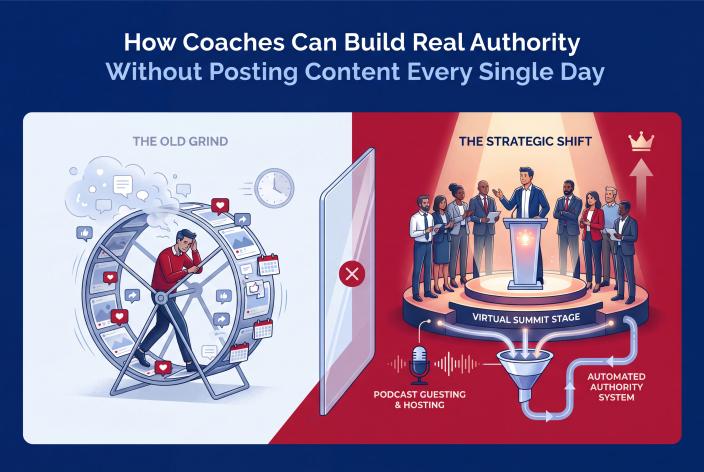
You can build real authority without posting every day by speaking on other people's stages. That means summits, podcasts, live streams and workshops, where a host introduces you to an audience that already trusts them. Bring one strong talk, a free gift made for that audience and a short follow-up sequence, and each appearance keeps working long after the event closes.
I'm writing this for coaches, therapists, healing practitioners and anyone else running an expert-led service business. You're good at the work and you've helped people, but clients still arrive in bursts. You'd also like a way to be seen that doesn't eat every evening.
I'm an extreme introvert. Speaking for four minutes at a monthly company meeting used to terrify me, so I won't pretend stages come easily to everyone. I've still watched what they do. Over five years, speaking and hosting our own events brought Jennie and me more than $300,000 in sales.
Key Takeaways
- Choose one problem you solve well and build a single signature talk around it, then reuse and adapt it for every stage you accept.
- Look for stages through Speaker Connections, the EventRaptor speaker directory, and the podcasts and summits your ideal clients already follow.
- Approach hosts as a peer, with a specific talk idea and an honest promise about how you'll help promote.
- Close every talk with a free gift built for that audience, so attendees join your email list.
- Put each stage's opt-ins in their own segment and follow up with emails that mention where they met you.
Why One Good Guest Spot Can Outweigh a Month of Posts
A daily post asks a stranger to trust you cold, in a feed full of other people asking for the same thing.
A summit attendee is in a very different place. They registered for the topic, they chose to show up, and they meet you next to other experts they may already know and respect. Some of that trust rubs off on you. Nobody's pressuring them either, so they relax and listen. People who would scroll past your post will often sit through a 30-minute talk.
The credit stays with you after the event too. "Speaker on the [Name] Summit" belongs on your website, your bio and your next pitch. Each one tells a prospect that another host looked at your work and gave you their stage.
For therapists and practitioners, this kind of visibility can fit professional ethics better than most marketing. You're educating the public alongside respected peers, which is the core idea behind virtual summits for therapists and healing practitioners. That also tends to open doors to professional referral relationships.
Where to Find Stages Your Ideal Clients Already Attend
You need fewer stages than you'd think, as long as they're the right ones. Here are some good places to start:
- Speaker Connections. This is a free networking event on Zoom where speakers looking for stages meet the hosts who have them. It was Jennie's idea and she's run it since February 2022. It meets on the first and third Tuesday of each month for about two hours, and usually 70 to 110 speakers and hosts attend.
- The EventRaptor speaker directory. More than 3,800 speakers are listed there because they want to be invited to events. If you add a speaker profile that names the problem you speak on, hosts building a lineup can find you.
- Podcasts, summits and live streams your ideal clients already mention. Ask people in your community what they listen to and which events they've registered for.
- Peers who already host. A colleague with a podcast or a small workshop series is often the easiest first yes.
A Quick Checklist Before You Say Yes
- The audience matches the people you serve, not just your general field
- You can offer a free gift or opt-in link on your speaker page
- The promotion you're asked to do is something you can honestly deliver
- The host has a date, a plan and some track record (speakers sometimes record interviews for summits that never launch)
- The format suits you, whether that's an interview, a presentation or a mix
- For licensed practitioners, your bio and talk description follow your licensing board's advertising rules
Pitching a Host Without Feeling Salesy
Start by asking the host why they're running the event. Chris Cameron made this point on a podcast about summit speaking. Once you know what the host is trying to achieve, you can tell quickly whether you're a fit, and if you aren't, nobody's time gets wasted.
Sophia Clark described something similar about reaching out to well-known speakers for her own summit. The conversations fell flat when she was pitchy. When she went to people as a peer, with a shared reason for the event, they lit up. That works just as well in the other direction, when you're the one asking for the stage.
Hosts also carry a frustration you can solve. Plenty of speakers agree to promote a summit and then never do. If you'll send even one email or a couple of social posts, say so, and then follow through.
A simple pitch looks like this:
- Register for or listen to the host's last event so you understand the audience.
- Send a short, personal note with one talk title tied to their theme. Keep it to a single title.
- Say plainly what you'll do to help promote it.
- Have your bio, headshot, talk description and free gift link ready, so saying yes costs them nothing.
A Signature Talk That Makes the Next Step Obvious
Most summits won't let speakers sell, and that's fine. Your job is to teach one thing so well that the right people want more of you. I've written a separate guide on building a signature talk that makes your coaching offer feel like the natural next step, so here's the short version.
Name a problem your audience recognizes. Teach one shift that helps right away. Show briefly what becomes possible with deeper support. Then point to a free gift that continues the lesson.
When practitioner Carol Lourie was asked on a podcast where speakers should send people at the end of a talk, she said a relevant, valuable free gift beats sending them to social media. The gift captures an email address and starts your follow-up sequence, while a social follow is "just a two second moment". She also warned that you need to check whether that sequence actually gets opened and converts.
One result shows what a clear next step can do. When we produced Lucy Bedewi's Out-Earn Your Man summit in September 2021, she booked 4 discovery calls right after she presented, and all 4 became clients. That talk was on her own stage, and it brought in $10K in sales. This is one person's result, and it doesn't predict what another speaker will see.
For example, a couples therapist might teach how to calm the argument that keeps repeating and offer a printable conversation guide at the end. The talk stays educational. It isn't therapy, it makes no promises about outcomes, and it never uses stories from therapy clients.
Following Up With People Who Met You on Someone Else's Stage
This is the step speakers skip, and it's where the clients come from.
Rose Jubb, a stylist who spoke on and sponsored summits, said that looking back she'd have asked more about the audience and tailored her free gift to them. She'd also have put those opt-ins on a separate list, so her emails could say "wasn't that great on that summit" and not land in her general newsletter. People are busy. A week after the event, many won't remember where they found you unless you remind them.
Here's a simple sequence:
- Tag each opt-in with the stage they came from.
- Send a welcome email that names the host and the talk.
- Over the next week or two, send a few short emails that build on what you taught.
- Invite the people who keep reading to a conversation or your next small event.
- Thank the host and share how their audience responded.
I've said for years that "build it and they will come" is a myth. In my experience, a good follow-up process might turn 10 to 15% of the people who join through a summit into clients. That's my experience, not a promise, and without the follow-up it's usually close to none. If you'd like to make this repeatable across several hosts, my guide to building a partner-powered client pipeline walks through tracking and tagging in more detail.
What EventRaptor Takes Off Your Plate as a Speaker and Later as a Host
When you speak on a summit that runs on EventRaptor, the admin stays light. You apply, sign the speaker agreement and upload your details inside the platform, so there's no long email thread. Your speaker page is built from your profile. You get your own promoter link, and you can see the leaderboard, so you know your promotion is being counted.
Guest speaking often leads to hosting. By my second summit in January 2021, more than half of the 37 speakers had approached me. When you're ready to run your own stage, start with a small micro event that builds authority without a full summit, or go bigger. Jennie and I have run 13 summits of our own and over 40 summits for clients. Our done-for-you team handles speaker recruitment, pages, reminders and promoter links. Every registrant syncs into GHL/CRMRaptor with tags, so your follow-up can start the same day.
Frequently Asked Questions
Do I Need a Big Audience to Get Invited to Speak on Summits?
No. Hosts care most about whether you'll serve their audience well and whether you'll help promote, even modestly. A clear talk topic, a professional bio and an honest promotion promise go a long way. Free events like Speaker Connections are a practical place to meet hosts before your audience is large.
What Should I Offer at the End of a Summit Talk If I Can't Sell?
Offer a free gift that continues the lesson you just taught, like a checklist, a short guide or a worksheet. It should be specific to that audience and lead into an email sequence you've tested. That way the attendee joins your list, and a social follow is easy to forget.
Is Guest Speaking on Summits Appropriate for Therapists?
It can be, as long as your talk is public education and not therapy. Avoid clinical claims or promised outcomes, never use stories from therapy clients, and check your licensing board's advertising rules for your bio and talk description. Many practitioners find teaching on a peer's stage feels more comfortable than conventional marketing.
How Do I Find Summits That Are Looking for Speakers?
Create a speaker profile in the EventRaptor speaker directory, where more than 3,800 speakers are listed for hosts to find. Join Speaker Connections, which meets on Zoom on the first and third Tuesday of each month. Then ask your own community which podcasts and summits they follow, and approach those hosts directly.
Your Next Step
This week, write down the one problem you most want to be known for solving. Draft a talk title around it and pick a free gift that continues the lesson. Then come along to a Speaker Connections session and start a few conversations with hosts.
If you'd like help working out which stages fit your practice and how to turn opt-ins into booked conversations, Book your Client Attraction Planning Call. We'll look at your talk, your follow-up, and whether speaking, hosting or both makes sense for you next.