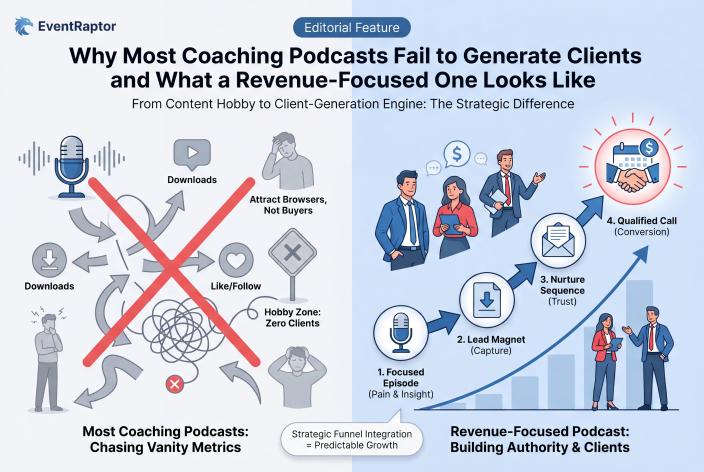
You launched a podcast. You bought the microphone. You learned how to edit audio. You published 30, 40, maybe 60 episodes.
And you got... downloads. Maybe some nice comments. A handful of new followers on Instagram.
But clients? Revenue? The silence is deafening.
You're not alone. Thousands of coaches start podcasts every year hoping it will become their client attraction engine. Most end up with a hobby that eats five to ten hours a week and produces exactly zero booked calls.
So what's going wrong? And what does a podcast that actually generates revenue look like?
Let's break it down.
The Core Problem With Most Coaching Podcasts
Here's the truth. Most coaching podcasts are built like media companies, not like businesses.
They chase downloads. They obsess over rankings. They pick topics designed to attract the widest possible audience. And they forget one critical thing: a podcast is a marketing tool, not the product itself.
When you design a show around "what would get the most listens," you attract curious browsers. When you design a show around "what would make my ideal client realize they need help right now," you attract buyers.
That's the difference. And it changes everything about how you choose topics, structure episodes, and guide listeners toward a next step.
Think about it this way. If someone listens to your episode on "5 Morning Habits for a Better Life," they might think, "That was nice." If someone listens to your episode on "Why Your Coaching Business Stalls at $5K Months and the System That Fixes It," they're leaning forward in their chair thinking, "That's me. What do I do next?"
One episode entertains. The other one qualifies.
Choose Topics That Speak to Your Buyer's Pain
The strongest way to turn your podcast into a revenue tool is to stop picking topics for a general audience and start picking topics for the person who is a real fit for your deeper work.
Ask yourself these questions before every episode:
- Does this topic address a specific frustration my ideal client is experiencing right now? Things like leads going quiet, sales calls with unqualified prospects, or spending hours on content that doesn't convert.
- Will this episode make the listener aware of a problem they didn't fully understand before? Awareness is the first step toward buying.
- Does the topic naturally connect to the transformation I deliver? If you help coaches build client attraction systems, your episodes should orbit that world.
Here's a simple filter. If the episode topic could apply to literally anyone, it's too broad. If it makes a specific type of person feel like you're reading their mind, you've nailed it.
Your podcast episodes are essentially public coaching sessions for your ideal client. Each one should leave the listener thinking, "This person understands my situation better than I do."
A Podcast Cannot Stand Alone as a Lead Source
This is where a lot of coaches get stuck. They treat the podcast like a complete marketing strategy. Record episodes, publish them, and wait for clients to appear.
But a podcast by itself is a nurturing tool. It builds trust over time. It deepens relationships. It positions you as the authority. What it doesn't do well on its own is capture leads and move them into a structured sales conversation.
Your podcast needs to live inside a larger funnel. Think of it as one piece of a system, not the whole system.
Here's how the pieces fit together:
| Funnel Stage | What It Does | Example |
|---|---|---|
| Attract | Brings new listeners in | Guest appearances, social clips, summit partnerships |
| Nurture | Builds trust and authority | Your podcast episodes |
| Capture | Gets them on your list | Lead magnet mentioned in every episode |
| Convert | Books a qualified call | Email sequence that leads to your calendar |
Without the capture and convert stages, your podcast is just broadcasting into the void. You're building trust with people you have no way to follow up with.
Every single episode should include a clear, simple path from "I just listened" to "I'm on your email list." That's where the real relationship begins.
Structure Every Episode to Lead Listeners Forward
The best revenue-generating podcasts follow a structure that feels natural to the listener but is strategically designed to move them toward action.
Here's a framework that works:
-
Open with the pain. Start every episode by naming the specific frustration your listener is feeling. Make them feel seen in the first 60 seconds. "If you've been posting content every day and still not booking qualified calls, this episode is for you."
-
Teach one valuable insight. Give them a genuine golden nugget they can use right away. This builds trust and demonstrates your expertise. You want them walking away thinking, "If the free stuff is this good, what would the paid experience be like?"
-
Reveal the gap. Show them what they're still missing. The insight you shared is powerful, but it's one piece of a bigger puzzle. "This strategy works brilliantly, but only when it's connected to a nurture sequence and a booking system. Without those pieces, the leads go cold."
-
Invite the next step. Every episode should end with a specific call to action. Not "check out my website." Something concrete. "I put together a guide that maps out this system step by step. Grab it at [link]. It will help you see how these pieces connect for your business."
That's it. Pain, insight, gap, invitation. When you follow this structure consistently, your podcast becomes a conversion engine that warms people up and moves them into your world.
Your Podcast as a Partnership Engine
Here's something most coaches completely overlook. Your podcast is one of the most powerful networking tools you'll ever have.
When you invite someone to be a guest on your show, you're opening a door to a real relationship. And those relationships lead to summit speaking invitations, joint venture partnerships, cross-promotions, and referrals.
Think about it. When you reach out to a fellow coach or expert and say, "I'd love to feature you on my podcast," the answer is almost always yes. They get exposure to your audience. You get great content. And both of you build a relationship that can turn into something much bigger.
Your podcast can also become the entry point for recruiting summit speakers. You interview someone on the show, build rapport, and then invite them to speak at your virtual summit. The speaker already knows your voice and your point of view. The conversation is easier.
And when those speakers promote your summit to their audience? That's when your list grows fast.
So your podcast isn't just a content channel. It's a relationship-building machine that feeds your summits, your partnerships, and your referral network.
What a Simple Podcast-to-Call Funnel Looks Like
Let's put this all together. Here's what a straightforward, effective podcast funnel looks like from end to end:
-
The Episode. You publish a focused episode that speaks directly to your ideal client's pain. You teach something valuable. You mention your lead magnet two or three times throughout the episode.
-
The Lead Magnet. The listener clicks the link in your show notes and downloads a free resource. A checklist, a short guide, a framework. Something useful and directly connected to the episode topic. Now they're on your email list.
-
The Nurture Sequence. Over the next five to seven days, they receive a short email series. Each email delivers more value, shares a quick story or insight, and gently introduces the idea that you help people solve the exact problem they're dealing with.
-
The Invitation. The final email in the sequence invites them to book a qualified conversation. By this point, they've listened to your podcast, consumed your lead magnet, read your emails, and they understand what you do. They show up to that call with more context and a clearer reason to talk.
That's the whole system. Podcast to lead magnet to email sequence to booked call.
Simple? Yes. But most coaches never build it. They stop at step one and wonder why the downloads aren't turning into dollars.
The Real Question
You already know your coaching changes lives. The question is whether your podcast is set up to connect you with the people whose lives you're meant to change.
If your show has been running for months without generating real business conversations, the problem isn't your content quality or your voice or your editing. The problem is structural. And structural problems have structural solutions.
We build these systems for coaches every day. The podcasts, the funnels, the email sequences, the summit strategies that turn listeners into leads and leads into clients. All done for you, so you can focus on what you do best: coaching.
If you want help turning your podcast, content, or borrowed audience strategy into qualified conversations, Book your Client Attraction Planning Call. We’ll look at where your current path is breaking and what kind of funnel, CRM, follow-up, or event strategy could support your coaching business next.