Why Speaking Converts Better Than Everything Else You're Doing
Here's the uncomfortable truth. You're probably spending hours on content creation, social media posting, and email sequences. And you know what? Most of that effort isn't booking calls.
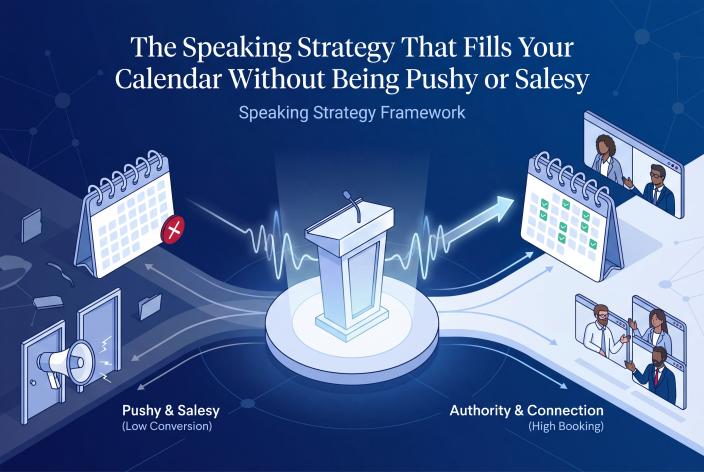
Speaking is different. When you're on stage, even a virtual stage, something shifts. People listen differently. They perceive you as the authority. And when you deliver real value without the hard sell, they actually want to talk to you afterward.
The pattern behind this is simple. A strong speaking opportunity gives prospects time with your voice, your framework, and your way of thinking before they ever land on your calendar. That creates a very different sales conversation than a cold click from a random post.
The Three-Part Talk Structure That Actually Converts
Most coaches approach their talk like it's a performance. They memorize slides, deliver information, and hope something sticks.
But conversion happens when you follow a structure. And the structure is simpler than you think.
Part One: The Problem and Emotional Hook
You start by naming the exact problem your ideal client is facing. Not vaguely. Specifically.
Instead of "Many coaches struggle with client acquisition," you say something like, "You've built an incredible coaching program. You know it changes lives. But your calendar stays half-empty because the wrong people are finding you, or nobody's finding you at all. And every month you're wondering if this is going to work."
Notice what just happened. You didn't lecture. You described their reality back to them. They felt seen.
This is where emotion enters. People don't move on logic alone. They move on how you make them feel. When you name their frustration, their fear, their late-night worry, you've created the opening.
Now you have permission to teach.
Part Two: The Framework and Actionable Insights
This is where you deliver the goods. You share your methodology, your framework, your approach. You give them golden nuggets they can implement right now.
But here's the key. You're not solving their entire problem in this talk. You're solving the immediate blocker that stops them from taking action.
Let's say your offer is a $5,000 coaching program that helps coaches build a predictable client pipeline. The blocker isn't "I don't know how to build a pipeline." The blocker is usually something like, "I don't believe I can do this myself," or "I don't know where to start," or "I've tried things before and they didn't work."
So your talk addresses that specific blocker. You teach a framework. You share a case study. You give them the first step they can take today. You build their belief that this is possible.
By the end of this section, they should feel like, "Oh, I could actually do this."
Part Three: The Invitation Without the Pressure
Here's where most coaches mess up. They either don't invite at all, or they push too hard.
The right way is subtle. It's natural. It's an extension of what you just taught.
You say something like, "Now, some of you are going to take this framework and run with it. You're going to implement it this week. And I'm genuinely excited for you. But I also know that some of you are going to get stuck. You're going to hit a wall. You're going to wonder if you're doing it right. And that's where a conversation with me can help."
Notice you didn't say, "Buy my program." You didn't say, "Sign up now." You said, "A conversation with me can help."
That's the invitation. You're inviting them into a conversation, not a transaction. And that's what people actually want. They want to talk to someone who understands their situation and can guide them.
You then give them the link. Simple. No pressure. No countdown timer. Just, "If that sounds helpful, here's where you can book a time."
The Positioning That Attracts the Right People
Here's something most coaches miss. Your talk isn't just about what you teach. It's about who you're teaching to.
When you're specific about your ideal client, you naturally repel the wrong people. And that's the goal.
If you say, "This is for coaches who are already signing clients but want to scale to premium pricing," you've just filtered out the person who has zero clients and is looking for a quick fix. Good.
If you say, "This works if you're willing to invest time in building systems," you've filtered out the person looking for a magic button. Even better.
The right positioning does the filtering for you. And when the right people hear your talk, they feel like it was made for them. Because it was.
This is where your ideal audience profile becomes crucial. You know their pain points. You know their objections. You know what they're afraid of. And you address all of that in your talk without ever saying, "I know you're afraid of X."
You just weave it in. You answer their unspoken questions. You build the case that this is possible for them specifically.
From One Speaking Slot to a Repeatable System
Here's the thing about speaking. One talk isn't a strategy. It's an event.
A strategy is when you take that one talk and turn it into a repeatable system that books calls for months.
How do you do that?
First, you record everything. You record the talk. You record the Q&A. You record the chat. You capture testimonials. You take screenshots of people saying how valuable it was.
Second, you repurpose it. That one 45-minute talk becomes a lead magnet. It becomes a YouTube video. It becomes social media clips. It becomes email sequences. It becomes case studies.
Third, you use it to get more speaking slots. When you reach out to summit hosts or podcast producers, you say, "I've spoken at X events and here's the feedback I got." You show them the video. You show them the testimonials.
Suddenly you're not a coach hoping to get booked. You're a coach who's in demand.
And each speaking slot feeds the next one. Each talk adds to your authority. Each audience you reach adds to your list. And each person who books a call after your talk adds to your case studies.
One talk becomes ten. Ten talks become a reputation. A reputation becomes a full calendar.
The Subtle Art of the Follow-Up
After your talk, you don't disappear. But you also don't spam.
You send a thank you email. You mention something specific from the event. You offer a resource related to what you taught. And you remind them that if they want to talk, the link is in your signature.
Then you wait.
Some people will book immediately. Some will watch the recording later and book. Some will sit on it for weeks and then book because they finally tried your framework and hit a wall.
The key is you're not chasing. You're available. You're helpful. And you're patient.
The people who book after your talk aren't tire kickers. They've already experienced your value. They've heard you teach. They've seen your framework. They're coming to you because they want to go deeper, not because you convinced them to.
That's the difference between speaking-generated leads and ad-generated leads. Speaking-generated leads are pre-sold. They've already decided you know your stuff. Now they just want to figure out if working together makes sense.
The Real Reason Speaking Works
At the end of the day, speaking works because it's the fastest path to authority.
You can post content for months and build a small following. Or you can speak once and reach an audience of hundreds of people who are already interested in what you teach.
You can run ads and pay for attention. Or you can speak and earn attention by being associated with other experts.
You can send cold emails and hope for replies. Or you can speak and let people come to you because they want to.
Speaking isn't just a lead generation tactic. It's a positioning tactic. It's how you go from being one of many coaches to being the coach people think of when they need your specific expertise.
And when you combine speaking with the right framework, the right positioning, and the right follow-up, you don't just fill your calendar. You fill it with the right people. People who value your work. People who are ready to invest. People who actually become your best clients.
That's worth showing up for.
Ready to Book More Calls?
Speaking is powerful. But it's even more powerful when you have a system behind it.
If you want help turning speaking, summits, workshops, or partner stages into a clearer path to qualified conversations, Book your Client Attraction Planning Call. We’ll look at where you are now, what you want your audience to understand before the call, and what kind of authority and follow-up system could support that.
The speaking opportunities are out there. The question is, are you ready to step on stage and own them?