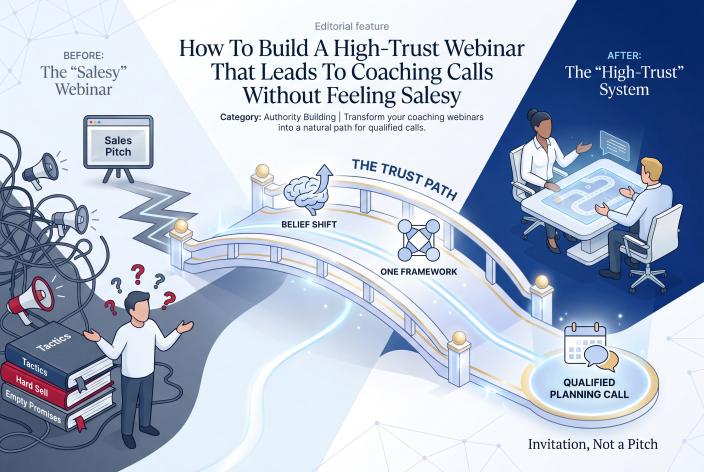
If you've ever hosted a webinar and walked away thinking, "That was useful, but it didn't create enough calls," you're not alone.
A lot of coaches know how to teach. That's rarely the problem.
The harder part is building a webinar that helps the right people see themselves clearly, understand the cost of staying where they are, trust your approach, and feel ready to continue the conversation.
That takes more than a good slide deck.
It takes a trust path.
Your webinar should give people a real win. It should also help them understand why their current way of getting clients, improving health, changing habits, leading teams, building wealth, or solving their specific problem has felt harder than it should.
And when the invitation comes, it shouldn't feel like a hard turn into a pitch.
It should feel like the next honest step.
Start With The Belief Shift Your Webinar Needs To Create
Before you write your title, outline your slides, or choose your teaching points, ask one question:
What does my right-fit prospect need to believe by the end of this webinar?
This is where many webinars get fuzzy.
They teach tips. They share stories. They explain concepts. But they don't move the audience from their current belief to a better one.
For a coach, that belief shift might sound like:
- "I don't need more discipline. I need a better environment and support system."
- "My team isn't resisting leadership. They don't yet trust the change path."
- "My client flow isn't inconsistent because I'm bad at coaching. I don't have a trust and follow-up system behind my visibility."
- "My prospects aren't unmotivated. They're overwhelmed and need a clearer first step."
See the difference?
The webinar becomes more than information. It becomes a guided change in how the prospect understands their problem.
Use A Simple Before And After Belief Map
Here's a practical way to build it.
Create a 2-column map before you outline the webinar:
| Current Belief | New Belief |
|---|---|
| "I need more leads." | "I need a clearer path from visibility to trust to conversation." |
| "Automation will make my follow-up feel cold." | "Good follow-up can make relationships feel more timely and personal." |
| "A webinar has to close people on the spot." | "A webinar can qualify the right people into a planning conversation." |
| "My audience isn't big enough." | "Focused visibility, partner leverage, and follow-up can work together." |
You don't need 12 belief shifts.
You need 1 strong belief shift that makes your offer feel relevant.
For this article, let's use the coaching business example.
The webinar belief shift could be:
"Your client flow becomes more consistent when authority, capture, nurture, follow-up, and sales conversations work together."
That shift naturally supports a call to action for a Client Attraction Planning Call because the audience now understands that their problem may be somewhere in the system, not just in one tactic.
Teach One Useful Framework Instead Of Emptying Your Brain
Coaches love to give value.
That's a strength. It's also where webinars can get heavy.
When you try to teach everything you know, the audience leaves impressed but mentally full. They may like you, but they don't know what to do next.
A high-trust webinar gives people one clear framework they can remember and use.
Think of the framework as a lens.
It helps your prospect diagnose their situation faster than they could before.
Build The Framework Around The Problem They Already Feel
If your audience is trying to get more coaching clients, don't start with software, funnels, or advanced event strategy.
Start with the pain they already recognize:
- Leads arrive in bursts, then disappear.
- Referrals help, but they aren't predictable.
- Content takes time and doesn't reliably create calls.
- Follow-up happens manually, late, or not at all.
- Tools feel disconnected.
- Sales calls include too many people who aren't ready.
Then give them a simple framework.
For example:
The Authority To Conversation Framework
A simple coaching webinar could teach 5 stages:
-
Authority
Become known for a specific problem, audience, or transformation. -
Attention
Use content, partnerships, webinars, summits, workshops, podcasts, or referrals to create visibility. -
Capture
Give interested people a clear way to raise their hand and join your world. -
Nurture
Build trust through useful follow-up, reminders, stories, examples, and education. -
Conversation
Invite qualified prospects into the next step when they understand the value and relevance of your work.
That framework is useful without becoming overwhelming.
It helps the audience locate the gap.
Some will realize they have attention but weak capture. Others will see that their follow-up is too scattered. Others may discover that they keep asking for sales calls before enough trust has been built.
That's when the webinar starts doing real work.
Give The Audience A Small Win They Can Feel
A high-trust webinar should not just explain your philosophy.
Give people something they can use before the webinar ends.
For a client attraction webinar, you could ask them to score themselves from 1 to 5 on each stage:
- Authority
- Attention
- Capture
- Nurture
- Conversation
Then ask:
Where is the biggest drop-off right now?
This creates a quiet moment of recognition.
Maybe they have strong authority with past clients, but not enough current visibility. Maybe their webinar registrations are decent, but their no-show follow-up is weak. Maybe they have leads sitting in a CRM, but no meaningful nurture path.
That self-diagnosis matters.
People trust you more when you help them see the truth without making them feel foolish.
Keep The Teaching Focused
Here are a few rules that help:
- Teach 1 framework, not 5.
- Give 1 short exercise, not a workbook full of homework.
- Use plain language before naming tools.
- Make every teaching point connect back to the belief shift.
- Leave room for the next step.
You don't need to prove you're brilliant by teaching everything.
You build more trust when your audience feels clearer after 45 minutes than they did before they arrived.
Place The Invitation Where It Feels Like A Continuation
Now let's talk about the part many coaches dread.
The invitation.
If you wait until the final 3 minutes and suddenly shift from teaching to selling, people feel the gear change.
A calmer approach works better.
Seed the idea of the next step throughout the webinar.
You can do this without pressure.
Mention The Planning Call Early
Near the beginning, say something simple:
"By the end of this session, you'll be able to identify where your client attraction system is getting stuck. And if you'd like help mapping what that could look like in your business, I'll show you how to book a Client Attraction Planning Call near the end."
That's it.
No hype. No long pitch. No income promise.
You have told them what is coming, so the invitation won't feel like a surprise.
Invite After The Diagnostic Exercise
The strongest place to make the main invitation is after the audience has diagnosed their gap.
For example:
"If you just scored yourself and realized the issue isn't one small tweak, but the way your authority, funnel, CRM, follow-up, and sales path fit together, this is exactly what we can look at on a Client Attraction Planning Call."
Then make the offer clear:
Book your Client Attraction Planning Call
On that call, the focus is practical. Look at where client flow is getting stuck, what you're trying to sell, how prospects currently find you, and what kind of authority, webinar, summit, funnel, CRM, or follow-up system could make sense next.
Repeat The Invitation In The Q&A
During Q&A, answer questions generously.
Then, when a question becomes personal to someone's business, use the call as the natural next step:
"That's hard to answer responsibly without seeing your offer, audience, and current follow-up. That's a good one to bring to a Client Attraction Planning Call."
This protects the trust of the room.
You aren't pretending that every person needs the same advice.
Make The Webinar Part Of A Bigger Authority Asset
A webinar can create calls, yes.
But it becomes much stronger when it sits inside a broader authority system.
That means the webinar should connect to:
- Your positioning
- Your follow-up emails
- Your CRM tags and notes
- Your future content
- Your sales call process
- Your partner or speaker strategy
- Your next webinar, summit, workshop, or event
This is where many coaches lose momentum.
They teach a good webinar, send 1 replay email, and move on.
But interest is warm right after someone registers, attends, clicks, asks a question, or watches the replay. That attention needs to be captured, organized, and followed up with.
EventRaptor is designed for this kind of authority-building event journey. It helps manage registrations, event pages, attendee data, reminders, speaker or partner promotion, follow-up emails, and reporting in one organized system. It can also connect event activity to CRM workflows, so the webinar or summit does not live in a separate pile of spreadsheets and inboxes.
GHL/CRMRaptor supports the CRM layer around that journey, including contact records, tags, calendars, funnels, workflows, automation, and follow-up. Together, EventRaptor and GHL/CRMRaptor help connect the event activity to the relationship path that follows.
That's the practical goal.
Visibility creates attention. The system helps you keep the relationship moving.
Map Follow-Up Before You Go Live
Follow-up should never be an afterthought.
When people register for your webinar, they are telling you something.
They have enough interest to raise their hand.
Some will attend live. Some will miss it. Some will click your planning call link but not book. Some will watch quietly and need more nurturing.
Each group needs a slightly different follow-up path.
Follow-Up For Attendees
Attendees gave you time and attention. Respect that.
A simple attendee sequence could look like this:
| Timing | Email Purpose | Message Angle |
|---|---|---|
| Same Day | Thank Them And Share The Replay | "Here's the replay and the framework we covered." |
| Next Day | Reinforce The Core Belief Shift | "Where is your biggest gap right now?" |
| 2 Days Later | Invite The Planning Call | "If you want help mapping this to your business, book your call." |
| 4 Days Later | Handle A Common Objection | "You don't need a huge audience before you build the trust path." |
| 6 Days Later | Give A Practical Next Step | "Score your authority, capture, nurture, and conversation path." |
Keep the tone personal and grounded.
Don't treat every attendee like they are ready to buy today. Some are. Some need more clarity.
Your job is to keep the door open and make the next step obvious.
Use the exact call to action when appropriate:
Book your Client Attraction Planning Call
Follow-Up For No-Shows
No-shows are not failures.
They may have had a client session, a family issue, a calendar conflict, or simply missed the reminder.
So don't scold them.
Make it easy to re-engage.
A simple no-show sequence could look like this:
| Timing | Email Purpose | Message Angle |
|---|---|---|
| Same Day | Send Replay | "We missed you live, but here's the session." |
| Next Day | Pull Out The Big Idea | "The most important part starts with identifying the gap." |
| 3 Days Later | Share The Diagnostic | "Score your current client attraction path." |
| 5 Days Later | Invite The Planning Call | "If you want help making sense of your score, book a call." |
The no-show path should be shorter and simpler than the attendee path.
They didn't experience the live teaching, so your first job is to get them back into the content.
Follow-Up For High-Intent Clickers
High-intent clickers are people who click the planning call link, pricing page, application, replay timestamp, or another action-based link but don't complete the next step.
This group deserves careful follow-up.
Not aggressive follow-up. Careful follow-up.
A simple sequence could include:
| Timing | Email Purpose | Message Angle |
|---|---|---|
| Within 24 Hours | Acknowledge Interest | "I saw you were looking at the next step. Here's what the call is for." |
| 2 Days Later | Reduce Uncertainty | "The call is a planning conversation, not a pressure pitch." |
| 4 Days Later | Help Them Decide Fit | "This is useful if you have a real offer and want a clearer client attraction system." |
| 7 Days Later | Reinvite Calmly | "If this is still on your mind, you can book here." |
This is where CRM tagging and workflows help.
When someone clicks a high-intent link, that behavior can trigger a more relevant follow-up path. The message can speak to where they are in the journey instead of sending the same generic email to everyone.
Good automation protects relationships when it makes follow-up timely, relevant, and easier to trust.
Keep The Sales Call Invitation Honest
Your webinar should never imply that booking a call guarantees clients, revenue, or a perfect business system.
A better invitation is specific and responsible.
Say what the call is for:
- Looking at where client flow is getting stuck
- Understanding the offer and audience
- Reviewing the current visibility and follow-up path
- Identifying whether the gap is authority, positioning, funnel, CRM, webinar strategy, summit strategy, or implementation
- Mapping what kind of client attraction system could make sense next
That kind of invitation attracts more thoughtful prospects.
It also filters out people who want magic.
The right-fit coach hears that and thinks, "Good. I don't need another vague promise. I need someone to help me see what to build next."
Use A Simple Webinar Structure
Here's a clean structure you can adapt:
-
Promise The Outcome
Tell them what they will understand or be able to do by the end. -
Name The Real Problem
Describe the pattern they are living with in plain language. -
Introduce The Belief Shift
Show them a more useful way to understand the problem. -
Teach The Framework
Walk through the 4 to 6 stages or principles. -
Run A Diagnostic Exercise
Help them locate their own gap. -
Show The Next Step
Explain what changes when the system is built properly. -
Invite The Planning Call
Make the call relevant to the gap they just diagnosed. -
Answer Questions
Teach generously and invite personal strategy questions to the call.
This structure feels calm because the invitation grows out of the teaching.
Make The Tech Serve The Trust Path
Tools matter, but only when they support the strategy.
For a high-trust webinar, your event and follow-up setup should help you answer practical questions:
- Who registered?
- Who attended?
- Who missed it?
- Who clicked the planning call link?
- Who needs the replay?
- Who should receive a different follow-up path?
- Which partners or promoters helped create registrations?
- What needs to happen after the webinar ends?
EventRaptor can support the event side of this, including registration management, event pages, reminders, attendee data, promoter tracking, and follow-up workflows.
GHL/CRMRaptor can support the CRM and follow-up side, including tags, calendars, funnels, workflows, and automation.
The point is not to add more moving parts.
The point is to stop losing warm interest because the moving parts are scattered.
Build Trust Before You Ask For The Call
A webinar that leads to coaching calls without feeling salesy is built on clarity.
Clear problem.
Clear belief shift.
Clear framework.
Clear diagnostic.
Clear invitation.
When those pieces are in place, you don't have to push as hard. The audience can feel the logic of the next step.
They came in wanting help. You helped them see the real gap. Now you're offering a practical planning conversation to look at that gap in their own business.
That's a much better experience for everyone.
If you want help applying this to your own coaching business, Book your Client Attraction Planning Call. We'll look at where your client flow is getting stuck and what kind of webinar, summit, funnel, CRM, follow-up, or implementation path could make sense next.