If you've ever been invited onto a podcast, you know the little rush that comes with it.
Someone sees your expertise. You get to speak to a new audience. You get a credibility boost. And for 30 to 60 minutes, you're in front of people who may never have found you otherwise.
That's useful.
But here's the question that matters for your coaching business:
What happens after the episode goes live?
If the answer is, "I hope some listeners check me out," you're leaving too much to chance.
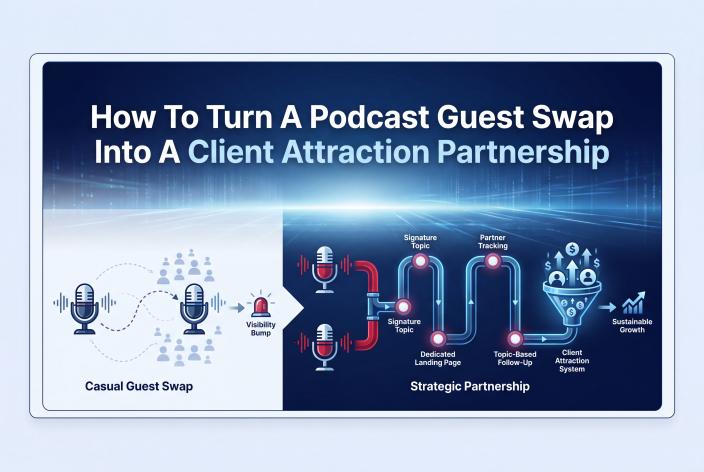
A podcast guest swap can become much more than a visibility moment. It can become a client attraction partnership when you connect the appearance to a clear topic, a dedicated landing page, partner tracking, and follow-up that keeps the relationship moving.
You don't need to turn every podcast appearance into a hard pitch. You do need a path.
Start With The Right Podcast Partner
A good guest swap starts before anyone opens a calendar link.
The best podcast partner is not always the person with the biggest audience. For a coach, the better question is simple:
Does this audience include people who are likely to care about the problem my offer solves?
If you're a leadership coach for new executives, a general entrepreneurship podcast may give you exposure. But a podcast for first-time managers, HR leaders, or high-performing professionals stepping into bigger roles could give you better-fit attention.
Look for alignment in 4 places:
-
Audience Fit
Who listens to the show? Are they the type of person you help, or are they connected to that person? -
Problem Fit
Does the show regularly discuss the pain, desire, or transition your coaching offer addresses? -
Trust Fit
Does the host have a relationship with the audience that feels warm and credible? -
Partner Fit
Would you feel good introducing this host to your audience too?
That last one matters. A guest swap is a relationship. You appear on their show, and they appear on yours. Or you promote each other through interviews, workshops, summits, newsletters, or other authority-building stages.
When the fit is strong, the audience borrows trust from the host. That trust gives your message a better chance of landing.
Prepare A Signature Topic That Creates One Clear Belief Shift
A podcast appearance should not be a wandering tour of everything you know.
That's where many experts lose people. They have so much wisdom that the conversation becomes broad, thoughtful, and forgettable.
A stronger approach is to choose one signature topic that creates one clear belief shift.
For example:
| Coaching Niche | Broad Topic | Stronger Signature Topic |
|---|---|---|
| Health Coach | Better habits | Why high achievers keep breaking their health promises and how to rebuild trust with your body |
| Business Coach | Growing your business | How to stop relying on referrals and build a steady path to qualified conversations |
| Relationship Coach | Communication | The hidden pattern that makes good people feel unheard in hard conversations |
| Wealth Coach | Money mindset | How capable professionals stay stuck in reactive money decisions and what to change first |
See the difference?
The stronger topic gives the listener a new lens. It helps them diagnose their own situation. It also naturally points toward your work without needing to sell aggressively.
A simple signature topic framework looks like this:
- The problem your audience already feels
- The mistaken assumption that keeps them stuck
- The new way to understand the problem
- A practical first step they can take
- A clear invitation to go deeper
For a coach, this is powerful because your sales process usually depends on trust. The listener needs to think, "This person understands me. They see something I haven't been able to name. I want to hear more."
That's the job of the topic.
Build A Dedicated Landing Page For Each Partner Appearance
Please don't send every listener to your homepage.
Your homepage has too many jobs. It has to explain who you are, what you do, who you serve, what you offer, and where people can go next. A podcast listener arrives with a much more specific context.
They just heard you talk about one topic.
So give them a page that continues that conversation.
A dedicated landing page can be simple. It might include:
- A headline tied to the podcast topic
- A short note for listeners of that specific show
- A useful lead magnet, checklist, workshop, replay, or assessment
- A few bullets that reinforce the belief shift from the episode
- A clear next step, such as joining your list, registering for a workshop, or booking a call if they're ready
For example, if you talked about inconsistent client flow on a podcast for coaches, your page might offer a "Client Attraction Pathway Checklist" that helps listeners identify whether their gap is positioning, visibility, follow-up, or conversion.
That gives the listener a reason to act now while the conversation is fresh.
And it gives you a cleaner way to understand where interest came from.
This is where a podcast guest swap starts to behave more like an event-style registration path. The listener hears you on a trusted platform, visits a dedicated page, raises their hand, and enters a follow-up journey connected to the topic that attracted them.
That path is much stronger than hoping they remember your name later.
Track Which Partners Create Real Movement
Visibility feels good. But visibility without tracking can fool you.
One podcast might create a nice social media bump and no meaningful follow-up. Another might send fewer people but produce warmer conversations. Without tracking, you're guessing.
At minimum, track each partner appearance with:
- A dedicated URL
- A source tag in your CRM
- A simple lead magnet or registration form
- A follow-up sequence tied to the topic
- A way to see whether leads became booked calls or sales conversations
You don't need to make this complicated.
You do need to know which relationships create movement.
A simple tracking table could look like this:
| Partner | Topic | Page URL | Leads | Replies | Calls Booked | Notes |
|---|---|---|---|---|---|---|
| Podcast A | Client Flow | /podcast-a | Track In CRM | Track In CRM | Track In CRM | Warm audience, good fit |
| Podcast B | Offer Clarity | /podcast-b | Track In CRM | Track In CRM | Track In CRM | Good host relationship |
| Podcast C | Follow-Up | /podcast-c | Track In CRM | Track In CRM | Track In CRM | Strong nurture opportunity |
The point is not to obsess over numbers after every single appearance. The point is to learn.
Which audiences respond?
Which topics create replies?
Which partners deserve a deeper collaboration, such as a workshop, summit session, newsletter swap, or recurring event?
EventRaptor's broader event growth approach is built around this kind of thinking. Authority-building events and speaker-led campaigns work better when registration, partner tracking, attendee data, CRM updates, and follow-up are connected. EventRaptor supports partner-powered growth with promoter links, attribution, reporting, registration management, attendee data, and CRM-connected workflows, while GHL/CRMRaptor can support the CRM, funnel, calendar, workflow, and follow-up side.
The lesson applies even if you're starting with something as simple as podcast swaps:
Track the relationship, not just the appearance.
Follow Up Based On The Topic That Brought Them In
This is where the real opportunity often lives.
A podcast listener who opts in after hearing you talk about burnout should not receive the same first few emails as someone who came in through a conversation about pricing, leadership, or relationship repair.
They entered through a specific doorway.
Follow up through that doorway.
Your first few emails can do 4 jobs:
-
Reconnect The Listener To The Episode
Remind them what they heard and why it matters. -
Deepen The Belief Shift
Give them another useful insight that builds on the topic. -
Help Them Diagnose Their Situation
Offer a simple checklist, reflection, or decision point. -
Invite The Right Next Step
If they're ready for help, make it easy to book a conversation or attend a deeper training.
Here's a simple follow-up structure:
- Email 1: "Thanks for listening, here's the resource I mentioned"
- Email 2: "The pattern I see most often with this problem"
- Email 3: "A practical way to tell where you're stuck"
- Email 4: "When you're ready for support, here's the next step"
Good automation does not make this colder. It makes your follow-up more timely and consistent.
That's important because most coaches don't lose opportunities only because the listener wasn't interested. They lose opportunities because the next step wasn't clear, the follow-up was delayed, or the listener was never guided from interest into trust.
Turn One Swap Into A Deeper Partnership
A podcast guest swap can be the first step in a bigger relationship.
If the first appearance creates good engagement, don't stop there.
Look for ways to build together:
- Co-host a workshop
- Invite the partner into a virtual summit
- Create a shared resource for both audiences
- Run a panel conversation
- Swap newsletter features
- Invite each other into private communities
- Build a mini event around a shared theme
This is where partnership becomes leverage.
You are no longer trying to create all the visibility yourself. You're building trust through aligned relationships with people who already have the attention of your right-fit audience.
And when you connect that visibility to a capture and follow-up system, the relationship can keep producing value after the first interview disappears from the feed.
A Simple Podcast Guest Swap System For Coaches
Here's the practical version.
Before the appearance:
- Choose partners whose audience matches your offer.
- Agree on a topic that creates one clear belief shift.
- Build a dedicated landing page for that appearance.
- Create a lead magnet or registration path tied to the topic.
- Set up CRM tags, source tracking, and follow-up.
During the appearance:
- Teach generously.
- Use stories and examples that help listeners self-identify.
- Mention the next step naturally.
- Make the URL easy to remember.
- Keep the invitation specific to the topic.
After the appearance:
- Watch which listeners opt in, reply, register, or book.
- Follow up based on the topic that brought them in.
- Thank the host and share useful engagement notes.
- Discuss a deeper collaboration if the fit is strong.
- Keep nurturing the leads who are interested but not ready yet.
This is how a simple podcast swap becomes part of your client attraction system.
The Real Win Is Trust You Can Continue
A podcast guest swap is not just about getting heard.
It's about borrowing trust, creating a useful belief shift, capturing interest, and continuing the conversation while the listener still remembers why they cared.
That is the difference between visibility that fades and visibility that feeds your pipeline.
If you want this to work, think beyond the episode. Build the page. Track the partner. Tag the lead. Follow up around the topic. Invite the next step clearly.
And if you want help mapping this kind of authority-building and follow-up system around your coaching business, Book your Client Attraction Planning Call.
On the call, we'll look at where your client flow is getting stuck and what kind of podcast, summit, funnel, CRM, follow-up, or partnership strategy could make sense next.