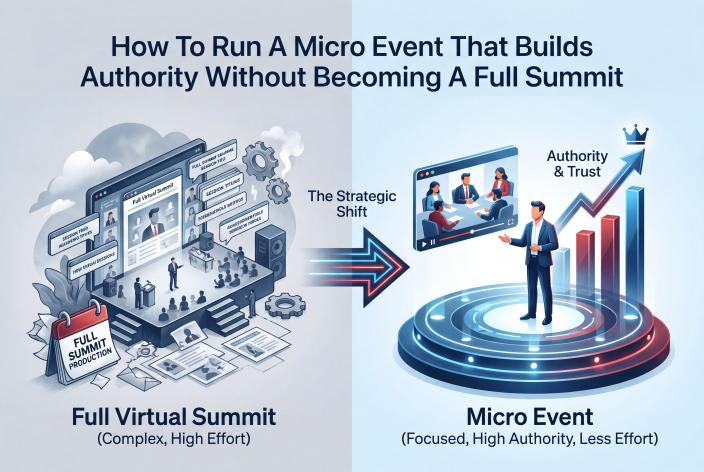
If you've been thinking about running a virtual summit but the idea feels too big right now, you're not alone.
A full summit can be powerful. It can build authority, grow your audience, create speaker relationships, and give your market a reason to pay attention.
But sometimes you don't need the full production first.
Sometimes the smarter move is a smaller event with a sharper purpose.
A panel. A clinic. A roundtable. A mini workshop. A partner Q&A.
These smaller formats can help you get visible, start conversations, test a topic, build trust, and create useful follow-up without turning your calendar into a giant event production machine.
That's what I mean by a micro event.
What A Micro Event Really Is
A micro event is a focused virtual event designed around one clear audience, one clear problem, and one useful next step.
It usually has fewer moving parts than a full summit. It may involve 1 speaker, a few guests, a small panel, or an invited group discussion.
The point is simple.
You bring the right people together around a topic your prospects already care about. Then you guide the experience so attendees leave with more clarity and a stronger reason to trust you.
A micro event can be:
- A 60 minute expert panel
- A small group roundtable
- A mini workshop
- A client attraction clinic
- A partner Q&A session
- A recurring monthly training
- A focused speaker-led campaign
And here's the good news.
EventRaptor isn't only for large summits. It can support meetings, workshops, giveaways, recurring events, and speaker-led campaigns, depending on your audience, offer, and growth strategy. Its purpose is to help organize the event journey, including registration, pages, speakers, reminders, partner tracking, attendee management, CRM updates, follow-up, and reporting.
So if a summit feels like too much right now, a micro event can still give you the authority-building benefit of being seen as the person who leads the conversation.
When A Micro Event Makes Sense For A Growing Coach
A micro event makes sense when you have something valuable to say, but you don't yet need the scale or complexity of a full summit.
It can be especially useful if you're in one of these situations:
- You want to test a topic before building a larger campaign around it
- You want to create warmer conversations with a small, focused audience
- You have partners or colleagues who could help bring the right people into the room
- You want more authority without managing 20 or 30 speaker relationships
- You want reusable content from one well-run event
- You want to see whether your audience responds to a specific problem or promise
- You need a better reason to invite people into your world than another generic lead magnet
You see, many coaches already know visibility matters.
The harder part is turning that visibility into a managed path.
Someone sees the event. They register. They get reminders. They attend. They engage. They receive follow-up. They get invited into the next useful step.
That path matters.
Because without it, even a good event becomes a nice moment that fades by next week.
Which Micro Event Format Should You Choose
Different formats create different kinds of authority.
So before you pick the event type, get clear about what you want the event to do.
Do you want to borrow authority from partners? Educate prospects? Create sales conversations? Build peer relationships? Test your message?
Here's a simple way to think about it.
| Micro Event Format | Best For | Why It Works | Watch For |
|---|---|---|---|
| Expert Panel | Building borrowed authority and partner visibility | You host the conversation and stand beside other credible voices | Keep the topic tight so it doesn't become scattered |
| Client Attraction Clinic | Creating qualified conversations | You diagnose real problems and show how you think | Set clear boundaries so it doesn't turn into free private coaching for everyone |
| Roundtable | Building relationships and market insight | You gather a focused group to discuss a shared problem | Invite carefully so the room has real relevance |
| Mini Workshop | Teaching your method and building trust | You help attendees solve one piece of the bigger problem | Keep the promise small enough to deliver in the time available |
| Partner Q&A | Reaching a related audience | A partner brings people who already trust them | Make sure the topic connects naturally to your offer |
Here's a tip.
If you're newer to events, start with the format that gives you the most direct feedback.
For many coaches, that means a clinic, roundtable, or mini workshop.
Why?
Because you can hear the language people use. You can see where they get stuck. You can notice which parts of your message land and which parts need work.
That's valuable market feedback.
And it can shape your next webinar, summit, funnel, sales page, follow-up sequence, or offer conversation.
How A Small Event Builds Authority
A micro event builds authority because it changes how people experience you.
Instead of only seeing another post in the feed, they see you leading a useful conversation.
Instead of reading a short tip, they hear how you think.
Instead of wondering whether you understand their problem, they experience your ability to frame it clearly.
That matters for coaches.
Your prospects are not only buying information. They are looking for trust, safety, clarity, and confidence.
A strong micro event helps create those things in a concentrated way.
It can also create several assets at once:
- A registration list of people interested in the topic
- A replay you can reuse with future prospects
- Short clips or content ideas from the discussion
- Partner relationships with speakers or co-hosts
- Better language for your future messaging
- Follow-up opportunities with people who raised their hand
- A stronger authority position around one specific problem
And when you connect the event to a CRM and follow-up path, the event becomes more than a calendar item.
It becomes part of your client attraction system.
The Simple Setup For A Strong Micro Event
A micro event does not need to be complicated.
But it does need to be intentional.
Here are the core pieces.
Choose One Audience And One Problem
Please don't start with the event title.
Start with the person.
Who is this for?
What problem are they actively trying to solve?
What would make them say, "I should attend that"?
For example, a business coach might run a clinic for consultants who are getting referrals but not enough consistent sales calls.
A health coach might run a mini workshop for busy professionals who keep falling off their wellness plan when work gets stressful.
A leadership coach might run a roundtable for new executives who are struggling to lead former peers.
Specificity gives the event energy.
It also makes the follow-up easier because everyone came in through the same problem door.
Pick The Format That Matches The Goal
A panel is great when you want partner leverage and credibility.
A workshop is better when you want people to experience your teaching.
A clinic is useful when you want attendees to see your diagnostic ability.
A roundtable works well when you want deeper relationship building with a smaller group.
Don't overbuild the first one.
Choose the smallest format that can create the kind of trust you want.
Create A Clear Registration Path
Your registration page should answer a few basic questions quickly:
- Who is this for?
- What problem will we focus on?
- What will attendees walk away understanding better?
- Who is hosting or speaking?
- When is it happening?
- What happens after someone registers?
This is where many coaches make the event feel vague.
They write broad copy because they don't want to leave anyone out.
But broad copy usually creates weak commitment.
A micro event works best when the right person feels like the topic was built for them.
Send Useful Reminders
Reminders are not just logistics.
They are part of the trust-building experience.
A good reminder can:
- Confirm the time and access details
- Reinforce why the session matters
- Tell attendees what to bring or think about
- Set expectations for participation
- Increase confidence that the event will be worth attending
EventRaptor supports event emails, reminders, attendee dashboards, calendar details, and follow-up communications. That matters because the attendee experience starts before the event and continues after it.
Design The Attendee Experience
Think through the room before people arrive.
What should they see first?
How will you open?
Will people participate in chat?
Will there be Q&A?
Will you give a worksheet, framework, or simple diagnostic?
What is the natural next step after the session?
A polished experience does not require overproduction. It requires clarity.
People should know where to go, what is happening, and why they are there.
That's how a small event can feel professional without feeling stiff.
The Follow-Up Path Is Where The Event Becomes A Pipeline
This is where many coaches lose momentum.
They run the event. It goes well. People say nice things.
Then the follow-up depends on memory, mood, and spare time.
That is a fragile way to grow.
A stronger micro event has a follow-up path planned before the event happens.
At minimum, decide what happens for:
- People who registered but did not attend
- People who attended and engaged
- People who asked a strong question
- People who clicked or responded after the event
- People who may be ready for a conversation
The follow-up does not need to be aggressive.
In fact, for coaches, it should feel like continued guidance.
You might send:
- A replay email
- A short recap of the main takeaways
- A worksheet or checklist
- A related case story, if you have one you can use truthfully
- An invitation to reply with their situation
- An invitation to book a planning call if they want help applying the ideas
This is much easier when registration, attendee data, CRM tags, calendars, and follow-up workflows are connected.
EventRaptor can handle the virtual event management side, while GHL/CRMRaptor supports the CRM, funnel, calendar, workflow, and follow-up side. Together, they help connect the event activity to the client acquisition path instead of leaving it scattered across tools.
A Simple Micro Event Plan You Can Use
Here is a practical structure for your first micro event.
Step 1 Choose The Audience
Pick a specific group of people you already understand.
For example:
- Coaches with inconsistent referrals
- Wellness professionals preparing to launch a group program
- Consultants who are strong at delivery but weak at follow-up
- Executives moving into a new leadership role
Step 2 Choose The Problem
Pick one problem that creates urgency and interest.
Examples:
- Why qualified prospects disappear after the first call
- How to turn referrals into a steadier client attraction path
- How to build trust before the sales conversation
- How to choose the right first offer for a new niche
Step 3 Choose The Format
Match the format to your goal.
If you want market feedback, run a clinic.
If you want partner reach, run a panel.
If you want to teach your method, run a mini workshop.
If you want deeper conversation, run a roundtable.
Step 4 Build The Registration And Reminder Flow
Create the page, thank-you message, confirmation email, calendar details, and reminders.
Keep it simple.
Make sure the attendee always knows what happens next.
Step 5 Plan The Event Flow
A simple 60 minute structure could look like this:
- 5 minutes to welcome people and frame the problem
- 10 minutes to teach the core idea
- 25 minutes for panel discussion, coaching, Q&A, or guided exercises
- 10 minutes to summarize the takeaways
- 10 minutes to invite next steps and explain follow-up
Adjust the timing based on the format.
The main idea is to lead the room with confidence.
Step 6 Follow Up While Interest Is Warm
Send the replay or recap quickly.
Then continue the conversation based on attendee behavior and fit.
The event should not end when the Zoom room closes.
The real value often shows up in the days after, when people are thinking, replying, asking questions, and deciding whether they want support.
What To Measure After Your Micro Event
You don't need a giant analytics dashboard to learn from a small event.
But you do need to look at what happened.
Ask:
- Which partners or channels brought registrations?
- Who attended live?
- Who engaged during the session?
- What questions came up repeatedly?
- Which parts of the topic created the most interest?
- Who clicked, replied, or booked a next step?
- What would you change before running it again?
EventRaptor helps hosts see event data such as registrations, promoter performance, attendee data, email status, task completion, and event health. That kind of visibility helps you make better decisions instead of trying to reconstruct everything from memory and spreadsheets.
Remember, the goal of your first micro event is not perfection.
The goal is a cleaner signal.
Did the topic attract the right people?
Did the format help them trust you?
Did the follow-up create real conversations?
Those answers are gold.
Your Micro Event Should Fit Your Business
A micro event can be a smart first step if you want to build authority without committing to a full summit right away.
But the format matters.
A panel, clinic, roundtable, workshop, and partner Q&A each create a different kind of trust. The right choice depends on your audience, your offer, your relationship network, your sales process, and the kind of client conversations you want to create next.
So don't pick the event that sounds the most impressive.
Pick the event your best prospects are most likely to attend, trust, and respond to.
Then build the path around it:
- Clear topic
- Focused registration page
- Helpful reminders
- Smooth attendee experience
- Useful follow-up
- CRM-connected next steps
- A simple way to measure what worked
That's how a small event becomes more than a one-time marketing activity.
It becomes an authority-building asset that helps the right people know, trust, and remember you.
And when you're ready, it can become the foundation for a larger summit, webinar series, partner campaign, or full client attraction system.
If you want help choosing the right first event format for your coaching business, Book your Client Attraction Planning Call. We'll look at where your client flow is getting stuck, what kind of authority-building event makes sense, and how the registration, CRM, follow-up, and conversion path could fit together.