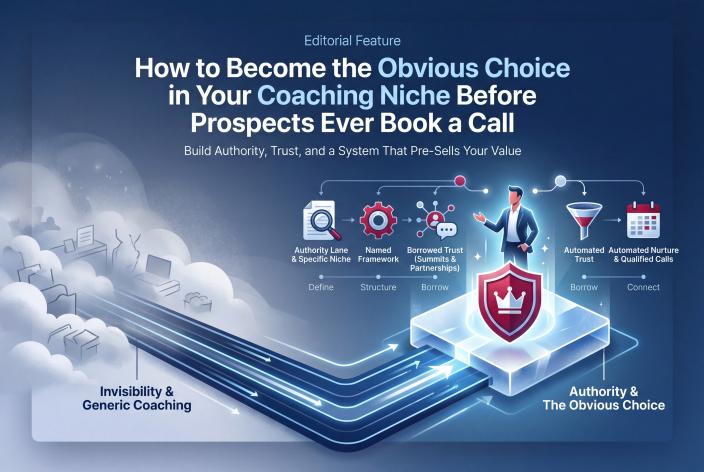
You can be excellent at what you do and still feel strangely invisible.
That is one of the most frustrating stages in a coaching business.
You have helped clients. You can lead a strong conversation. You know your work creates value. But prospects still compare you with everyone else, ask basic questions on calls, hesitate on price, or disappear after saying, "This sounds great. Let me think about it."
So what is missing?
Usually, the issue is that prospects are meeting you too late in the trust-building process.
They are booking a call before they fully understand your point of view, your process, your proof, your standards, or the problem you are known for solving.
That means the sales call has to carry too much weight.
A better path is to build enough authority before the call that the right prospect arrives already thinking, "This person gets me. This is the conversation I need to have."
Let me explain how to do that.
Start by choosing the problem you want to be known for solving
Authority needs a lane.
If your public message says you help with clarity, confidence, leadership, mindset, wellness, purpose, communication, performance, relationships, and life transitions, prospects have to work too hard to understand when to call you.
And busy people do not do that work for you.
They remember the coach who is clearly associated with a specific problem, moment, audience, or outcome.
So begin here:
- What painful problem do your best clients have before they find you?
- What do they usually misunderstand about that problem?
- What are they already trying that is not giving them the result they want?
- What kind of person is most ready for your help?
- What change can you reliably guide them through?
This does not mean you can only help with one tiny thing forever.
It means your authority needs a front door.
A leadership coach might become known for helping newly promoted executives lead without burning out.
A health coach might become known for helping high-performing women rebuild energy after years of stress.
A business coach might become known for helping expert service providers turn referrals into a repeatable client acquisition system.
See the difference?
The market can remember that.
And when the right person hears it, they can recognize themselves quickly.
Your authority lane should pass 3 tests
Use this simple filter:
- Is it specific enough to be memorable?
- Is it painful enough that prospects want help now?
- Is it connected to a result you can actually help create?
If you cannot answer those 3 questions clearly, your visibility will probably feel scattered no matter how much content you publish.
Turn your coaching process into a named framework
Prospects trust what they can understand.
That is why a named framework is so powerful.
A framework turns your coaching from a private method in your head into a clear path prospects can see, remember, and repeat.
You probably already have a process. You may not call it one yet.
Look at your best client work. What stages do people move through?
Maybe they go from:
- Confusion to clarity
- Overwhelm to structure
- Self-doubt to grounded decision making
- Random marketing activity to a working client attraction system
- Reactive leadership to calm authority
Your framework gives language to that journey.
For example, a coach who helps consultants get clients might create a framework like:
- Define the authority lane
- Sharpen the core offer
- Build borrowed-audience visibility
- Capture and nurture leads
- Convert qualified conversations
That is simple. That is repeatable. That is much easier to trust than "I help you grow your business."
A named framework also gives you content for:
- Podcast interviews
- Summit sessions
- Partner workshops
- Opt-in pages
- Email sequences
- Booking pages
- Speaker bios
- Sales conversations
You are no longer explaining from scratch every time. You are reinforcing the same clear path in every touchpoint.
And that repetition matters.
People often need to hear your point of view more than once before they are ready to act.
Borrow trust from aligned audiences
You do not need to wait until you have a huge audience to build authority.
You can borrow trust from people who already serve the audience you want to reach.
This is where podcasts, partner workshops, summits, panels, guest sessions, and collaborative campaigns become so useful.
When someone invites you onto their stage, even a small one, you are being introduced with a layer of credibility. Their audience is more likely to listen because you are not arriving as a random stranger in the feed.
Virtual summits are especially strong here because they combine several authority signals at once:
- You are associated with other experts
- You create useful educational content
- You build strategic relationships with speakers and partners
- You give prospects time to experience your thinking
- You create a reason for follow-up after the event
Summits have long been used as a collaborative marketing strategy because they help hosts start conversations, build relationships with partners, and guide attendees into a next step after trust has been created.
That last part matters.
A summit should not be treated as a single calendar event that ends when the final session is over.
It can become a relationship-building asset, a content asset, a list-building asset, and a pipeline asset.
The same is true for podcast guesting and partner workshops.
The goal is not just to be seen. The goal is to be seen in the right context, teaching the right topic, to the right audience, with a clear next step.
Choose stages that reinforce your lane
Before you say yes to a guest opportunity, ask:
- Does this audience contain people I can truly help?
- Does this topic reinforce the problem I want to be known for solving?
- Will I be able to share my framework or point of view clearly?
- Is there a natural next step for people who want more help?
A random visibility opportunity may feel flattering. A strategic one builds recognition.
Build authority signals into every touchpoint
Authority is not only created in big moments.
It is reinforced in small ones.
Your opt-in page. Your email welcome sequence. Your speaker bio. Your calendar page. Your confirmation email. Your reminder messages. Your post-event follow-up.
Every touchpoint teaches the prospect how to see you.
So ask yourself, what is your current system teaching them?
If your booking page only says "schedule a call," it may be missing an opportunity to frame the conversation.
If your speaker bio lists credentials but does not state the problem you solve, it may sound impressive without being memorable.
If your opt-in page offers a generic freebie, it may attract curious people instead of qualified prospects.
If your email follow-up goes quiet after the event, warm attention cools quickly.
Here are a few authority signals to include across your system:
- A clear statement of who you help and what problem you help them solve
- Your named framework or method
- Specific language that reflects your best clients' real pains
- Relevant credibility, such as experience, client types, certifications, published work, events, or partnerships
- A point of view that helps prospects diagnose their situation differently
- A next step that fits their stage of readiness
Notice something important.
This is not about puffing yourself up.
It is about helping right-fit prospects understand why your work is relevant to them.
Good authority feels clarifying, not performative.
Create a path from visibility to a qualified planning conversation
Visibility without a path creates leakage.
Someone hears you on a podcast, likes what you said, visits your site, skims around, and leaves.
Someone attends your summit session, feels inspired, saves the replay, then gets busy.
Someone joins your workshop, asks a good question, then never hears from you in a way that connects the dots.
This is where many coaches lose momentum.
They think the issue is that the visibility did not work. Often, the visibility created attention, but the system did not capture, nurture, and guide that attention.
A simple authority-to-conversation path looks like this:
- Visibility through a podcast, summit, workshop, guest session, or partner campaign
- Lead capture through a relevant opt-in, registration, assessment, or planning resource
- Nurture through emails, reminders, stories, content, and useful follow-up
- Qualification through questions, tags, forms, behavior, or replies
- Conversation through a planning call or consultation for the right people
That path does not need to be complicated.
But it does need to exist.
And it needs to be connected.
Connect your event visibility to your CRM and follow-up
This is where the technology starts to matter.
A summit, workshop, or collaborative campaign has a lot of moving parts. Speakers. Registrations. Pages. Reminders. Attendee data. Session links. Replays. Offers. Follow-up. Booking links. CRM records. Tags. Calendar activity.
Trying to manage all of that manually gets messy fast.
EventRaptor helps manage the virtual event side of the strategy, including event pages, registrations, speaker and session organization, reminder workflows, attendee data, promoter tracking, and event operations.
GHL/CRMRaptor supports the CRM and follow-up side, including contact records, tags, funnels, calendars, workflows, automation, and follow-up.
Together, they help connect the authority-building activity to the conversion system behind it.
So instead of running a summit and ending up with a spreadsheet you mean to follow up with later, you can build a cleaner path.
For example:
- A prospect registers for your event
- Their topic interest is captured
- They receive reminders before the session
- They attend or engage with a relevant session
- They are tagged based on interest or action
- They receive follow-up connected to that topic
- They are invited into a planning conversation when it makes sense
That kind of follow-up feels more personal because it is more relevant.
And for a coach, relevance is everything.
You do not need automation that blasts everyone with the same generic message. You need a system that helps the right people receive the right follow-up at the right time.
That protects relationships.
It also protects your energy.
Make your booking page part of the authority system
A booking page is not just a calendar link.
It is often the final touchpoint before a prospect decides whether the conversation feels worth their time.
So make it work harder.
Your booking page should answer:
- Who is this call for?
- What kind of problem will we look at?
- What should the prospect expect?
- What should they prepare?
- What makes this conversation different from a generic sales pitch?
For a coach selling a meaningful service, the goal is a qualified conversation.
That means the booking page should gently filter.
It can say who the call is best suited for. It can ask useful pre-call questions. It can remind prospects of the core problem you solve. It can point back to your framework.
By the time the prospect books, they should already feel oriented.
That one shift can improve the quality of your sales conversations because you are no longer starting at zero.
A simple authority audit for your coaching business
Want a practical exercise?
Review your current client attraction path and score yourself on these questions:
- Can a new prospect tell within a few seconds what problem you are known for solving?
- Do you have a named framework or clear process?
- Are you borrowing trust through aligned podcasts, partners, summits, workshops, or guest sessions?
- Do your opt-in pages, speaker bios, emails, and booking pages repeat the same authority message?
- Is there a clear next step after someone hears you speak or attends your event?
- Are leads being tagged, nurtured, and followed up with based on interest?
- Does your calendar mostly attract people who understand your value before the call?
If you answered "no" to several of those, that is useful information.
It means you may not need to become louder. You may need a clearer authority path behind the visibility you already have or can create.
The sales call should not have to do all the trust building
When prospects arrive cold, skeptical, or confused, you end up spending the call educating, proving, explaining, and reassuring.
That gets tiring.
When your authority system is working, the call feels different.
The prospect has heard your point of view. They understand the problem more clearly. They have seen your framework. They have experienced your teaching. They have received thoughtful follow-up. They know why the conversation matters.
That is a calmer way to grow.
And it is much more aligned for coaches who care about trust.
The next stage of your business may not require you to become a louder marketer. It may require you to become easier to recognize, easier to trust, and easier to choose.
That comes from the system around your visibility.
If you want help mapping that system for your coaching business, Book your Client Attraction Planning Call.
On the call, we will look at where your client flow is getting stuck, what authority assets you already have, and whether a summit, workshop, funnel, CRM, follow-up system, or done-for-you implementation path makes sense next.