If you can help people but your audience still doesn't understand why they should work with you now, your signature talk can do a lot of heavy lifting.
A good talk does more than share tips.
It helps the right person think, "Oh, this is why I've been stuck. This is the path I need. And this coach understands my problem better than I do."
That's when your offer starts to feel like the next logical step.
Not because you pressured anyone.
Because you helped them see.
And for coaches, that matters. Your work is personal. Your reputation matters. You don't want to turn every podcast, summit session, webinar, or partner event into a hard pitch.
But you also don't want to teach for 45 minutes, get applause, and watch interested people disappear because there was no clear next step.
So let's walk through how to build a signature talk that teaches generously, builds authority, and guides right-fit prospects toward a conversation.
Start With The Belief Shift Your Audience Needs
Before you outline your talk, answer this question:
What does your audience need to believe by the end?
Most coaches start with, "What should I teach?"
That's useful, but it's not the first move.
Your talk should create a shift in how your ideal client sees their problem, themselves, and the path forward.
For example, if you're a business coach helping consultants build premium offers, your audience may begin with this belief:
"I need more leads."
By the end, you may want them to believe:
"I need a clearer authority position, a stronger offer pathway, and better follow-up behind my visibility."
That belief shift changes everything.
Now your coaching offer makes sense because it sits on the other side of the problem they just recognized.
Use This Simple Belief Shift Map
Before writing slides, fill in these 4 blanks:
- Right now, my audience thinks the problem is __________.
- The more useful diagnosis is __________.
- They have been trying __________, which creates __________.
- By the end of my talk, I want them to see __________.
Here's an example for a relationship coach:
- Right now, my audience thinks the problem is finding the right communication script.
- The more useful diagnosis is that they don't understand their conflict pattern yet.
- They have been trying to fix arguments in the moment, which creates more pressure and defensiveness.
- By the end of my talk, I want them to see that conflict becomes easier to change when they can identify the pattern before it escalates.
That's a talk with a point.
And when your talk has a point, your offer doesn't feel randomly attached at the end.
It feels connected.
Build The Talk Around Your Signature Framework
Your signature talk should not be a pile of good advice.
It should be built around the way you think.
That usually means you need a signature framework.
A framework is the simple structure your audience can remember after the talk is over. It gives them language for their problem. It helps them explain the gap. It also shows them that you have a real method, not just a collection of opinions.
A strong framework usually has 3 to 5 parts.
Not because 3 to 5 is magic. Because your audience needs something simple enough to hold in their head while they are listening.
A Practical Signature Talk Structure
Use this structure when you're preparing for summits, podcasts, webinars, workshops, or partner events:
-
Name The Visible Problem Start with what your audience already feels. Inconsistent clients. Low energy. Conflict at home. Money stress. Leadership pressure. Health habits that won't stick.
-
Reveal The Deeper Pattern Help them see what is really driving the problem. This is where your authority begins to build. You are not just repeating what they already know. You are helping them diagnose.
-
Introduce Your Framework Give the problem a structure. Name your stages, pillars, principles, or steps. Keep the language plain enough that someone could repeat it to a friend.
-
Teach One Useful Piece Deeply Give them a real win. Not the whole paid process. One meaningful piece they can apply.
-
Show The Path Forward Explain what usually needs to happen next if they want support applying this to their own situation.
-
Invite Them Into A Clear Next Step Use calm, positive language. Tell them who the next step is for and what will happen there.
This is the difference between a talk that gets compliments and a talk that creates qualified conversations.
Teach Generously Without Solving The Whole Paid Problem
This is where many coaches get stuck.
You want to be generous. Good.
You also don't want to give away so much that your audience feels satisfied but takes no action.
The answer is to teach in a way that creates clarity, momentum, and trust.
Your free talk should help the listener understand the problem better and take one useful step. Your paid coaching should help them apply the full process to their real life, business, relationship, health, leadership role, or financial situation.
What To Teach In The Talk
Teach things like:
- The hidden pattern behind the problem
- The common mistakes that keep people stuck
- A simple diagnostic checklist
- A decision framework
- The first step in your process
- A case-neutral example of how the framework works
- A question they can use to evaluate their current situation
For example, if you help coaches build client attraction systems, your talk might teach the "Visibility To Trust To Conversation" pathway.
You can explain that visibility alone does not create consistent client flow unless there is a way to capture attention, nurture trust, follow up, and invite the right people into a conversation.
That teaching is useful.
But the paid work may include clarifying their offer, shaping their authority position, building the summit or webinar strategy, setting up pages, connecting CRM follow-up, and improving the sales path.
See the difference?
The talk gives them sight.
The offer helps them build.
What To Save For The Paid Work
You usually save these for your coaching program, intensive, implementation package, or planning process:
- Personalized diagnosis
- Custom strategy
- Offer refinement
- Messaging decisions
- Detailed implementation
- Accountability
- Review and feedback
- Troubleshooting
- Sales process improvement
Your talk should make people think, "I understand the path better now. I can also see why I don't want to figure this out alone."
That's healthy.
That's respectful.
And that's very different from withholding basic value just to force a sale.
Make The Talk Feel Like A Journey
A strong signature talk has movement.
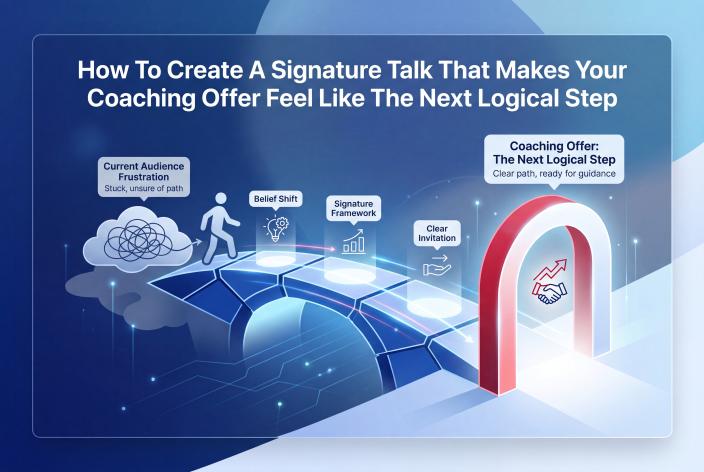
It begins with the audience's current frustration. It ends with a clearer path.
Here is a simple way to think about it:
| Talk Section | Audience Experience | Your Role |
|---|---|---|
| Opening | "That's exactly what I'm dealing with." | Show you understand the lived problem |
| Diagnosis | "I hadn't thought about it that way." | Reframe the issue with insight |
| Framework | "Now I can see the pieces." | Give them structure |
| Teaching | "I can use this." | Create a meaningful win |
| Invitation | "This may be the help I need." | Offer the next step clearly |
You are not dragging them to a pitch.
You are guiding them through a useful realization.
That's why the opening matters so much.
Don't start with your credentials for 10 minutes. Start with the problem in their words.
Try opening lines like:
- "If you can sell when the right person is on the call, but you don't get enough of those calls, this session is for you."
- "If you've been posting, networking, and waiting for referrals, but client flow still feels unpredictable, I want to show you the missing path."
- "If your expertise is real but the market isn't responding yet, the issue may be how your value is being translated into trust."
Those openings meet the listener where they are.
Then you earn the right to teach.
Use Stories And Examples Without Inventing Proof
Stories help people understand your framework.
But be careful.
If you're using client examples, only share what you have permission to share. Don't add numbers, outcomes, or details that are not yours to share.
You can also use hypothetical examples clearly.
For example:
"Imagine a wellness coach who gets plenty of kind comments on social media, but very few booked calls. The first instinct may be to post more. But when she looks closer, she realizes there is no clear path from her content to a useful resource, no nurture sequence, and no invitation into a conversation. Her visibility is real, but the follow-up path is missing."
That works because it's clearly an example.
It helps the audience see themselves without pretending to be a case study.
For summit sessions or workshops, you can go even more practical. Some workshop-style sessions run longer than a standard presentation, and the strongest ones help attendees create something during the session rather than just listen. If you're teaching a signature talk workshop, for instance, you might have attendees draft their belief shift, outline their framework, or write their invitation language before they leave.
When people create something during the session, the experience feels more valuable.
And they get a taste of how you guide.
Create A Clear Invitation Into The Next Step
Now let's talk about the part many coaches make awkward.
The CTA.
If you've taught well, your invitation does not need to feel pushy. It should feel like the natural continuation of the conversation.
The key is to be specific about who it's for and what will happen next.
For VirtualSummits.com and EventRaptor content, the primary article CTA is:
Book your Client Attraction Planning Call
That is the exact language to use.
Not a vague "learn more."
Not a generic "hop on a call."
A planning call.
That matters because the reader is not just buying information. They are trying to figure out what kind of client attraction system makes sense for their coaching business.
Soft CTA Language You Can Use
Here are several ways to invite people into the call without pressure:
- "If this helped you see where your client attraction path is getting stuck, the next step is to Book your Client Attraction Planning Call."
- "On the call, we'll look at your offer, audience, visibility, follow-up, and what kind of client attraction system could make sense next. Book your Client Attraction Planning Call."
- "If you're ready to turn your visibility into more qualified conversations, Book your Client Attraction Planning Call and we'll map the next practical step."
- "If you want help applying this to your coaching business, Book your Client Attraction Planning Call. We'll look at whether a summit, webinar, funnel, CRM, or follow-up system fits where you are now."
Notice the tone.
Clear. Helpful. Specific.
No hype.
No guarantees.
No strange pressure.
Connect Your Signature Talk To Your Client Attraction System
Your signature talk becomes more powerful when it is connected to the rest of your growth system.
Think about where the talk will live:
- Virtual summits
- Podcast interviews
- Webinars
- Partner workshops
- Guest trainings
- LinkedIn Lives
- Private community sessions
- Sales events
Each one can build authority.
But the talk should not be left floating by itself.
You want a path behind it:
- The listener hears you teach.
- They register, opt in, or request a resource.
- They receive useful follow-up while the topic is still warm.
- They are invited into the right next step.
- Qualified prospects can book a conversation.
This is where many coaches lose momentum.
They deliver a strong session, then the follow-up depends on memory, mood, or a messy spreadsheet.
A more mature system keeps the relationship moving.
EventRaptor helps manage the virtual event side, including event pages, registration, speakers, schedules, attendee data, reminders, partner tracking, and follow-up paths. GHL/CRMRaptor supports the CRM, funnel, calendar, workflow, automation, and follow-up side.
Together, that creates a cleaner path from event attention to organized follow-up to qualified conversations.
The talk gets attention.
The system helps you keep the conversation alive.
Use This Signature Talk Outline
Here is a simple outline you can adapt for your next summit session, podcast interview, webinar, or partner training.
Opening With The Lived Problem
"If you're [specific audience] and you've been dealing with [specific frustration], you're not alone. The challenge usually shows up as [visible symptom], but the pattern underneath is often [deeper diagnosis]."
The Belief Shift
"By the end of this session, I want you to see [new belief]. Once you see that, the next steps become much clearer."
Your Framework
"I use a simple framework called [framework name]. It has [number] parts: [part 1], [part 2], [part 3], and [part 4 if needed]."
The Teaching Section
"Let's focus on [one part of the framework], because this is where many people get stuck first. Here's how to evaluate where you are now."
Then give a checklist, short exercise, or decision filter.
The Application Moment
"Take a minute and write down where this is showing up for you. Is the issue [option 1], [option 2], or [option 3]?"
This makes the talk interactive, even if people are watching later.
The Path Forward
"If you want to apply this fully, the next step is to look at your actual situation. Your audience, offer, visibility, follow-up, and sales process all matter."
The Invitation
"If you want help mapping this out for your coaching business, Book your Client Attraction Planning Call. On the call, we'll look at where your client flow is getting stuck and what kind of system could make sense next."
Simple.
Human.
Clear.
Final Takeaway
Your signature talk is not just a presentation.
It is one of your strongest authority assets.
When you build it around a clear belief shift, a memorable framework, useful teaching, and a calm invitation, your offer begins to feel like the next natural step for the right person.
And that is the real goal.
Not more applause.
More trust before the sales call.
More qualified conversations.
A clearer path for people who already need the work you do.
If you want help turning your message, talk, summit, webinar, funnel, CRM, and follow-up into a more consistent client attraction system, Book your Client Attraction Planning Call. We'll look at where your current path is getting stuck and what would make sense to build next.