If you're a good coach, you probably care about how your follow-up feels.
You don't want people getting cold, robotic emails that sound like they came from a faceless marketing machine. You don't want to pressure people. And you definitely don't want a prospect thinking, "Wow, this doesn't sound like them at all."
So what happens?
Many coaches do everything manually.
They personally reply. Personally remind. Personally check in. Personally remember who clicked what, who registered, who missed the call, who watched the replay, who said "maybe later," and who needs a nudge next week.
That works for a while.
Then the business grows, and follow-up starts slipping through the cracks.
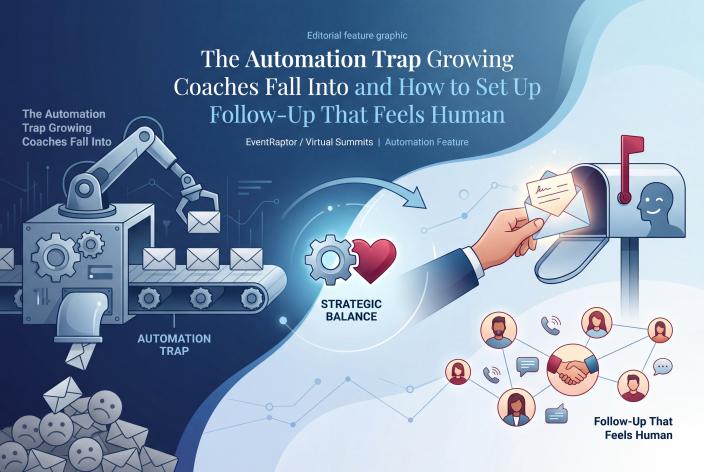
The other trap is just as costly. Some coaches automate everything and remove the human warmth that made people trust them in the first place.
The sweet spot is simple: automate the repetition, personalize the relationship.
Let's talk about how to do that.
Automation should protect the relationship, not replace it
Good automation doesn't make you less human.
It makes you more consistent.
It means the right person gets the right message at the right time, even when you're coaching clients, hosting a workshop, traveling, or taking an actual evening off.
Think about what happens after someone interacts with your business:
- They register for a webinar.
- They download a guide.
- They attend a summit session.
- They click your booking page.
- They reply to an email with a real question.
- They watch several pieces of content but don't book yet.
Each of those moments tells you something.
A manual system depends on you noticing all of it. A smart CRM system catches the signal and helps you respond.
That's the point.
Not more noise. Better timing.
What to automate and what to keep personal
Here's a practical way to think about it.
If the task is repetitive, predictable, and timing-sensitive, automate it.
If the task requires empathy, judgment, or a real conversation, make it personal.
| Follow-up moment | Automate it | Add your personal touch |
|---|---|---|
| Event registration confirmation | Yes | Use your real voice in the copy |
| Webinar or summit reminders | Yes | Mention why the topic matters to them |
| Missed session replay notice | Yes | Make it helpful, not guilt-based |
| Lead magnet delivery | Yes | Add a short personal-feeling intro |
| Booking page visit with no booking | Yes | Send a relevant nudge or question |
| Email reply with frustration or interest | No | Personally respond and invite conversation |
| Sales call follow-up | Partly | Personalize based on what they shared |
| Long-term nurture | Yes | Segment by interest and readiness |
You see the pattern?
Automation handles structure. You handle meaning.
That alone can change the feel of your marketing.
The emails should feel like a conversation
Most automated emails sound bad because they were written like announcements.
"We're excited to announce..."
"Don't miss your chance..."
"This is your final reminder..."
That language can work in some markets, but for coaches and expert-led businesses, it often creates distance.
Your prospects are usually not looking for more hype. They're looking for signs that you understand their problem.
So write your sequence like you're talking to one thoughtful person.
Use a simple rhythm:
- Name what they're likely experiencing.
- Give them one useful idea.
- Connect that idea to the next step.
- Invite a response or action.
For example:
If you registered for the workshop but haven't watched yet, my guess is your week got full fast.
No problem.
The part I'd pay attention to is the section on why referrals dry up even when your coaching is good. That's usually where the client attraction problem becomes clearer.
You can watch it here.
That feels different, doesn't it?
It doesn't beg. It doesn't bark. It guides.
Here's a tip. Before you load any email into your CRM, read it out loud.
If you would feel strange saying it to a real person, rewrite it.
Reminder sequences can book calls without pressure
Reminders are one of the best uses of automation.
But they need to be built around psychology, not panic.
People miss things for normal reasons. They get busy. They forget. They open a tab and lose it. They intend to book and get interrupted.
A good reminder sequence reduces friction.
It helps them remember why they cared in the first place.
For an event, workshop, or summit, your reminders should answer 4 quiet questions in the prospect's mind:
- Why did I sign up for this?
- Is this still worth my time?
- What will I miss if I skip it?
- What should I do next?
This is where automation becomes powerful.
One summit host described having automated emails take care of timing during a multi-day event, while the team focused on speaker coordination, audience nurturing, and live-session details. That matters because during a real event, there are already enough moving parts without manually sending every reminder yourself.
And when follow-up is connected to behavior, it gets even better.
For example:
- Registered but did not attend? Send the replay and highlight the most relevant section.
- Watched but did not book? Send a simple decision-support email.
- Clicked the booking link but did not schedule? Ask if they have a question before choosing a time.
- Attended live and stayed to the end? Invite them to talk while the problem is fresh.
That's not pushy.
That's useful.
Use your CRM to respond to behavior, not blast everyone equally
Your CRM should not be a digital filing cabinet.
It should help you see where people are in the trust journey.
One useful example comes from private audio content. Lindsay Padilla explained how private podcasting can track who is engaging with audio content and send emails if someone hasn't subscribed or downloaded yet. That's the idea you want in your client attraction system.
Not because every coach needs a private podcast.
Because behavior matters.
When someone engages, stalls, clicks, watches, registers, or disappears, your follow-up should adapt.
A simple CRM setup for a coach might track:
- New lead source
- Topic they opted in for
- Event or workshop registration
- Attendance status
- Replay views or key link clicks
- Booking page visits
- Sales call status
- Follow-up stage
- Long-term nurture interest
Then your messages can become more relevant.
Someone interested in leadership coaching should not receive the exact same follow-up as someone interested in burnout recovery unless the deeper problem overlaps.
Someone who attended 3 summit sessions deserves a different message than someone who only downloaded the free checklist 8 months ago.
Specificity feels human.
Generic blasting feels automated, even if you wrote every message by hand.
The moments where personal follow-up matters most
There are moments automation should hand the conversation back to you.
Rose Jubb shared a simple example that coaches should pay attention to. She talked about sending an automated check-in asking how someone was doing in a course. When someone replied that they were stressed and wished it could be done for them, the next move was personal: offer a time, get on the phone, ask good questions, and listen.
That's the model.
Let automation open the door. Then you step through it.
Personal follow-up matters most when someone:
- Replies with a real concern
- Shares frustration or urgency
- Asks about fit
- Clicks several high-intent links
- Misses a booked call
- Completes an application
- Says they need help but feels unsure
At those moments, don't hide behind another sequence.
Send a real reply. Record a short video. Ask a thoughtful question. Invite them into a conversation.
And on the sales call itself, remember Rose's other point: ask great questions, don't talk too much, and when you share the price, be quiet.
That is human selling.
The common mistakes that make automation feel robotic
Let's make this practical.
Here are the mistakes I see most often when coaches start automating follow-up.
Mistake 1: Automating before the message is clear
If your positioning is fuzzy, automation will spread the fuzziness faster.
Before you build a sequence, clarify:
- Who is this for?
- What problem are they trying to solve?
- What do they already believe?
- What do they need to understand before booking?
- What would make the next step feel safe and valuable?
Clear thinking first. Automation second.
Mistake 2: Sending the same message to everyone
This is where coaches lose trust.
A new subscriber, a summit attendee, a past client, and a hot prospect should not all receive the same pitch at the same time.
Segment by behavior and interest.
Even 3 segments can improve the experience:
- New and curious
- Engaged but not ready
- High-intent and considering a call
Now your follow-up can meet people where they are.
Mistake 3: Writing like a marketer instead of a mentor
Your emails should sound like you on a good coaching day.
Calm. Clear. Useful. Direct.
You can still have calls to action. You can still invite people to book. You can still create urgency when it's real.
But your tone should build trust before it asks for movement.
Mistake 4: Forgetting the long-term relationship
A summit, webinar, or workshop should not disappear after the live event ends.
Strong events can become reusable resources, relationship assets, and long-term nurture content. The better frame is to build a resource your community can keep benefiting from, then connect that resource to your follow-up and client acquisition system.
That is how event momentum becomes pipeline.
Mistake 5: Treating the CRM as a tool instead of a strategy
A CRM won't fix a broken client journey by itself.
But when it's set up around your actual sales process, it becomes the place where your strategy stays consistent.
It reminds. Tags. Segments. Triggers. Tracks. Follows up.
So you can stop holding every lead in your head.
A simple human follow-up framework for coaches
If you want to clean this up, start with this 5-part framework.
1. Capture the context
Track where the person came from and what they wanted.
A summit registration, a workshop opt-in, a referral, and a podcast listener may all need different follow-up.
2. Confirm the next step
Send immediate confirmation with one clear action.
No clutter. No 7 links. No confusion.
3. Remind with value
Every reminder should give them a reason to care, not just a reason to click.
Point to the promise, the problem, or the useful insight they'll get.
4. Respond to behavior
Use your CRM to change the follow-up based on what they do.
Clicks, attendance, replies, and bookings are signals.
5. Escalate to personal when intent appears
When someone raises their hand, treat them like a person.
Because they are one.
The real goal is more trust before the sales call
Automation is not there to replace your voice.
It's there to make sure your voice shows up consistently.
The goal is not to send more emails. The goal is to guide more right-fit prospects from attention to trust to conversation.
When follow-up works, prospects arrive warmer. They understand your point of view. They remember why your work matters. They feel less like they're being sold and more like they're being helped toward a clear decision.
That's the kind of client attraction system a growing coaching business needs.
If you’d like help mapping this for your business, Book your Client Attraction Planning Call.
On the call, we'll look at where your current follow-up is leaking trust, where automation can support the relationship, and what a more complete client attraction system could look like for your coaching business.