You already have visibility somewhere.
Maybe you're guesting on podcasts. Maybe you're running workshops. Maybe you're hosting a summit, contributing to giveaways, speaking in partner communities, or showing up in someone else's newsletter.
Good. That attention matters.
But here's where many proven coaches lose momentum. The visibility creates a small burst of interest, then the trail goes cold.
Someone registers. Someone clicks. Someone attends. Someone says, "This was helpful."
Then what?
If the answer is, "They go on my list," that's a start. But it isn't a follow-up map.
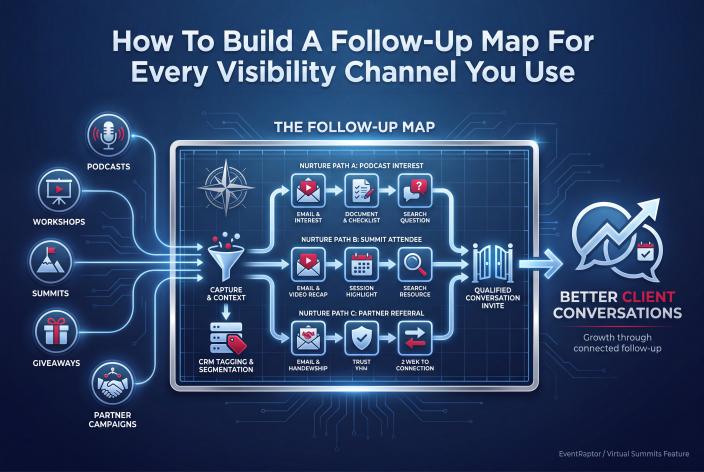
A follow-up map shows what happens after someone notices you. It keeps the context of where they came from, what they cared about, what they did, and what next step makes sense.
And when you build that map for every visibility channel, your marketing starts to feel calmer. Less random. More connected.
Why Visibility Without Follow-Up Feels So Frustrating
Most coaches don't have a visibility problem only.
They have visibility that isn't connected to a clear path.
You show up in useful places. You give value. You teach. You earn trust. But if the next step is vague, the interested people drift away.
That's painful because the attention was real.
A person who heard you on a podcast may be thinking about your work differently than someone who joined your workshop. A summit attendee may need more education. A partner referral may already trust you because of the relationship that introduced them.
They should not all receive the same generic email sequence.
Your follow-up should respect the moment that brought them in.
EventRaptor's core event growth approach is built around this idea: visibility should move into registration, engagement, follow-up, CRM updates, and better sales conversations. Event attention becomes more useful when it feeds an organized path from visibility to trust to conversation.
That same principle works across every channel you use.
Start With The Visibility Channels Already Creating Attention
Before you build anything new, look at what is already happening.
You may have more attention than you realize. It's just scattered.
Make a simple list of your current visibility channels:
- Podcast guest appearances
- Your own podcast or interview series
- Webinars or workshops
- Virtual summits
- Giveaway collaborations
- Partner email promotions
- Referral partners
- Networking groups
- Speaking opportunities
- Social content that gets real replies
- Lead magnets
- Live trainings inside communities
Now ask 3 questions for each channel:
- Who is finding me here?
- What were they interested in when they raised their hand?
- What should happen next if they are a right-fit prospect?
That's the beginning of your map.
You don't need a complicated automation diagram yet. You need clarity.
Because once you know the source, interest, and next step, your CRM can preserve that context instead of treating every new contact like a blank record.
Create A Simple Follow-Up Map For Each Source
A follow-up map does not need to be fancy.
It needs to answer what happens from attention to capture to nurture to conversation.
Use this structure:
| Visibility Source | Capture Point | Context To Save | First Follow-Up | Nurture Angle | Conversation Invite |
|---|---|---|---|---|---|
| Podcast Guest Spot | Resource Page | Podcast Name, Topic, Interest | Thanks For Listening | Expand On The Podcast Topic | Invite To Planning Call Or Relevant Workshop |
| Workshop | Registration Page | Workshop Topic, Attendance, Questions | Replay Or Key Takeaways | Teach Around The Problem They Came To Solve | Invite To A Call When They Want Help Applying It |
| Summit | Event Registration | Summit Theme, Sessions, VIP Status | Welcome And Schedule | Highlight Relevant Sessions And Next Steps | Invite Based On Engagement Or Interest |
| Giveaway | Gift Opt-In | Gift Topic, Contributor Source | Deliver The Gift | Connect Gift To Larger Problem | Invite To Deeper Training Or Conversation |
| Partner Campaign | Partner Link Or Page | Partner Name, Campaign Topic | Acknowledge The Introduction | Build Trust From Shared Context | Invite When Fit Is Clear |
Notice what this does.
It keeps the original moment alive.
Someone who came from a podcast should feel like you remember why they arrived. Someone who attended your workshop should hear more about the topic they chose. Someone who joined a summit should be guided through the event and beyond it.
That's how follow-up starts feeling human, even when automation is helping carry the load.
Use Tags To Preserve Context In GHL/CRMRaptor
This is where your CRM matters.
GHL/CRMRaptor is the place where the follow-up strategy becomes consistent. It can support contact records, tags, custom fields, calendars, funnels, workflows, automation, and follow-up.
But the CRM is only as useful as the context you give it.
A helpful tagging structure might include:
Source Tags
These tell you where the lead came from.
source-podcastsource-workshopsource-summitsource-giveawaysource-partnersource-referral
Topic Tags
These tell you what they cared about.
interest-authority-buildinginterest-client-attractioninterest-follow-upinterest-summit-strategyinterest-crm-automationinterest-offer-clarity
Engagement Tags
These tell you what they did.
registered-workshopattended-livewatched-replayclicked-call-linkrequested-resourcevip-buyerspeaker-applicant
Relationship Tags
These tell you who or what created trust.
partner-jane-smithsummit-speakerreferred-by-clientcommunity-member
Here's a tip.
Don't create 200 tags just because you can.
Create tags you will actually use to make better follow-up decisions.
If a tag won't change the message, timing, segmentation, reporting, or next step, you probably don't need it.
Write Nurture Messages That Match The Original Interest
This is where many follow-up systems go flat.
The person registers for a summit about building authority, then receives a generic newsletter about everything the coach does.
That creates friction.
A better nurture path continues the conversation they already started.
If They Came From A Podcast
They heard your voice. They connected with a specific idea. They may not know your full framework yet.
Your first emails can:
- Thank them for listening
- Reference the topic discussed
- Share one practical next step
- Invite them to reply with what stood out
- Offer a deeper resource connected to that topic
The tone should feel like, "I'm glad you're here. Let's keep going."
If They Joined A Workshop
They gave you more attention. They likely wanted help with a specific problem.
Your follow-up can:
- Send the replay or key takeaways
- Summarize the main shift from the workshop
- Show them how to apply one idea this week
- Invite them to identify where they are stuck
- Offer a planning call when they want help mapping the next step
This works because it builds on their intent.
If They Registered For A Summit
A summit creates multiple signals.
They may register, attend specific sessions, buy VIP access, click speaker links, or engage with follow-up.
EventRaptor supports the event side of this process with registration pages, speaker and session management, attendee dashboards, reminders, promoter tracking, CRM syncing, and follow-up emails. GHL/CRMRaptor can then support the CRM, funnel, calendar, workflow, and nurture side.
Together, the event activity can feed the follow-up system instead of disappearing into spreadsheets and memory.
Your summit follow-up can:
- Welcome them into the event experience
- Point them to the most relevant sessions
- Send reminders while interest is warm
- Follow up after the event with a clear next step
- Segment based on topic, VIP status, clicks, replies, or call interest
Remember, the summit should not end when the last session ends.
It should keep building trust.
If They Came From A Giveaway
Giveaway leads often enter through a specific gift.
That means your nurture should connect the gift to the larger problem you solve.
If your gift is a checklist, don't immediately pitch your entire coaching program. Help them use the checklist. Then show what the checklist reveals.
A simple sequence could be:
- Deliver the gift.
- Explain how to use it.
- Point out the bigger pattern behind the problem.
- Share a useful next step.
- Invite them to a workshop, resource, or planning conversation.
The goal is to turn a quick opt-in into a meaningful relationship.
If They Came From A Partner Campaign
Partner leads arrive with borrowed trust.
Honor that.
Acknowledge the partner or campaign that introduced them. Explain why the topic matters. Give them a clear path to understand your work without assuming they are ready to buy immediately.
The first message can sound like:
"Since you came through [partner or campaign], I wanted to start with the idea we were focused on there..."
Simple. Personal. Contextual.
Build The Map Before You Build More Automations
Automation works best when the thinking is already clear.
Before you create workflows, write down the path in plain English.
For each source, answer:
- What page or form captures the lead?
- What tag gets applied immediately?
- What message should they receive first?
- What should they learn next?
- What action shows higher intent?
- When should they be invited to book a call?
- What happens if they do nothing?
- What happens if they click, reply, attend, or request help?
This prevents the classic CRM problem.
You build a bunch of automation, then realize it doesn't match how prospects actually decide.
A good follow-up map starts with the human journey. The tech supports that journey.
Review Qualified Conversations Instead Of Only Tracking Opt-Ins
Opt-ins are useful.
But they don't tell the whole story.
A giveaway might create many new contacts and very few sales conversations. A podcast appearance might create fewer leads but better-fit calls. A summit session might reveal which topics create the strongest intent. A partner campaign might bring fewer names but more trust.
So review your channels by conversation quality, not only list growth.
Track questions like:
- Which channels bring people who understand the problem?
- Which sources create replies?
- Which topics lead to booked calls?
- Which partners send right-fit prospects?
- Which events create follow-up engagement?
- Which leads show up informed before the sales call?
- Which channels attract people who are not ready or not aligned?
This is how you stop guessing.
You begin to see which visibility channels deserve more attention, which nurture paths need improvement, and which messages are creating genuine movement.
A Practical Follow-Up Map You Can Use This Week
Here's a simple version you can build without overcomplicating it.
Pick 1 visibility channel and complete this:
Channel:
Where did they first notice you?
Capture Point:
What page, form, registration, calendar, or resource collects their information?
Primary Tag:
What tag preserves the source?
Interest Tag:
What topic or problem brought them in?
First Message:
What should they receive immediately?
Nurture Message 1:
What idea should help them understand the problem more clearly?
Nurture Message 2:
What practical step can they take?
Higher Intent Action:
What behavior shows they may be ready for a conversation?
Call Invitation:
When and how will you invite them to talk?
Review Metric:
How will you judge whether this source creates qualified conversations?
Do this for each channel one at a time.
Don't try to rebuild your whole business in a weekend.
Start with the channel already creating the most useful attention. Clean up that path first. Then move to the next one.
How EventRaptor Fits When Events Are Part Of Your Visibility
If summits, workshops, giveaways, webinars, or partner campaigns are part of your strategy, the moving parts can stack up quickly.
You have registration pages, thank-you pages, speaker details, reminders, attendee lists, Zoom links, promoter links, CRM updates, follow-up emails, and reporting.
That can be managed manually once.
But when events become a serious authority-building channel, you need a repeatable process.
EventRaptor helps manage the virtual event side: pages, registrations, speakers, schedules, reminders, attendee data, promoter tracking, and follow-up paths. GHL/CRMRaptor supports the CRM and follow-up infrastructure around it.
That connection matters because the event is only part of the journey.
The real value comes when the person who registered, attended, clicked, replied, or engaged is moved into the right next step while the trust is still warm.
The Bigger Shift For Your Coaching Business
You don't need to treat every podcast, workshop, summit, giveaway, or partner campaign like a separate marketing experiment.
You can turn each one into a doorway.
The follow-up map tells you what happens after the doorway opens.
That's where a more mature client attraction system starts to take shape. Your visibility becomes easier to measure. Your CRM becomes more useful. Your nurture feels more personal. Your sales calls become better informed.
And you stop relying on memory, mood, or manual chasing to keep the relationship moving.
If you want help applying this to your coaching business, Book your Client Attraction Planning Call. On the call, we'll look at where your client flow is getting stuck and what kind of authority, funnel, CRM, follow-up, or event strategy could make sense next.