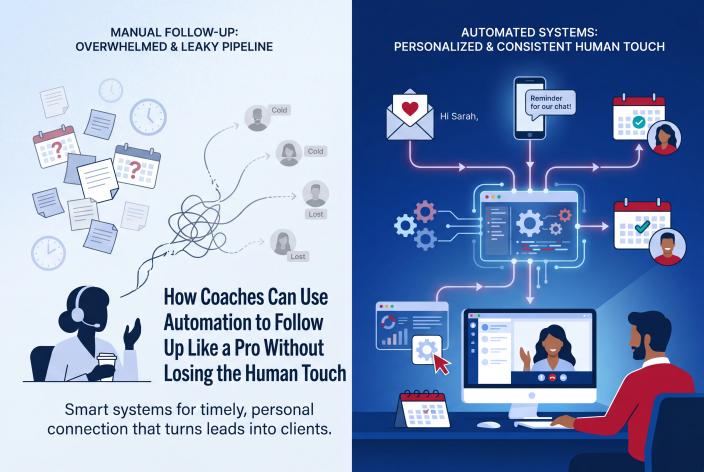
You had a great conversation with a potential client on Tuesday. They were excited. You were excited. You told yourself you'd follow up on Thursday.
Then Thursday came. You had three coaching sessions back to back, a webinar to prep for, and a kid who needed picking up from school. Friday slipped by. Monday arrived and suddenly that warm lead had gone cold.
Sound familiar?
You're not alone. And here's the thing. The problem isn't that you don't care about following up. The problem is that manual follow-up is a system designed to fail.
The Hidden Bottleneck Killing Your Revenue
Most coaches I speak to are genuinely great at what they do. They change lives. They get results for their clients. But when I ask them about their follow-up process, I hear the same thing over and over again.
"I try to keep track in my head." Or, "I have a spreadsheet, but I forget to check it."
Here's the part that should get your attention. Sales often require more follow-up than coaches think. Yet most coaches stop after one or two touches because they are busy, unsure what to say, or afraid of sounding pushy.
That means the majority of your potential revenue is sitting in a list of people who were interested, heard from you once or twice, and then never heard from you again. They didn't say no. They just forgot about you. Because you forgot to follow up.
Manual follow-up is the bottleneck. Every lead you don't nurture is money left on the table. And the longer you rely on memory, sticky notes, or good intentions, the more revenue quietly disappears.
Why Coaches Fear Automation (And Why That Fear Is Misplaced)
When I bring up automation, I can almost see the resistance on people's faces. They picture those spammy email blasts that land in their own inbox. The ones that open with "Dear Valued Customer" and read like they were written by a robot having a bad day.
That fear makes sense. Nobody wants to sound like that.
But here's what separates spammy automation from a well-designed nurture sequence. Spammy automation broadcasts the same generic message to everyone, regardless of where they are in their journey. A smart nurture sequence delivers the right message, to the right person, at the right time, in a voice that sounds like you actually wrote it.
Think of it this way. When you send a personal text to a friend on their birthday, that's a human touch. When your phone reminds you it's their birthday so you remember to send that text, that's automation supporting the human touch.
The automation handles the remembering. You provide the warmth.
Mapping Your Touchpoints Without Overwhelming Anyone
One of the biggest mistakes coaches make when they first set up automation is going from zero communication to ten emails in a week. Your leads don't want to be firehosed. They want to feel seen.
Here's a simple framework for mapping touchpoints across channels:
Email Sequence (The Backbone)
| Timing | Purpose | Tone |
|---|---|---|
| Immediately after opt-in | Welcome and deliver what they signed up for | Warm, grateful, clear |
| Day 2 | Share a quick win or insight related to their challenge | Helpful, conversational |
| Day 4 | Tell a short story about a client transformation | Personal, relatable |
| Day 7 | Address a common objection or misconception | Direct, empathetic |
| Day 10 | Invite them to book a call or attend a live session | Confident, low pressure |
| Day 14 | Follow up with additional value and a soft reminder | Generous, patient |
SMS (The Nudge)
Use SMS sparingly. A well-timed text message can double your show-up rate for booked calls. Send a friendly reminder the day before and 30 minutes before a scheduled call. Keep it short. Keep it human.
Something like: "Hey Sarah, looking forward to our chat tomorrow at 2pm. If anything comes up, just let me know!"
Calendar Reminders (The Safety Net)
Automated calendar invites with built-in reminders at 24 hours and 1 hour before do the heavy lifting. When someone books a call, the system confirms, reminds, and even follows up if they miss it. You never have to chase.
The key is layering these channels so they complement each other rather than repeat the same message three different ways on the same day.
Writing Automation Copy That Sounds Like You
This is where most automation falls apart. The copy reads like a corporate memo instead of a conversation.
Here are a few principles that keep your automated messages sounding human:
- Write like you talk. Read your email out loud. If it sounds like something you'd never actually say to someone sitting across from you at a coffee shop, rewrite it.
- Use their first name. Every modern CRM supports personalization. Use it. "Hi Sarah" lands differently than "Hi there."
- Keep paragraphs short. One to three sentences. That's it. Your reader is scanning on a phone between meetings.
- Ask real questions. "What's the biggest thing holding you back from getting consistent clients right now?" invites a reply. "Click here to learn more" invites a yawn.
- Share something personal. A quick story about your own struggle, a lesson you learned the hard way, even a mention of your morning coffee. These small details signal that a real person wrote this.
One of our clients told me she was terrified her emails would feel "salesy." So we helped her write a five-email welcome sequence in her own voice. After the first week, she had three replies from leads saying things like, "I feel like you're reading my mind." That's what good automation copy does. It creates connection at scale.
The Lead Lifecycle, Automated at Every Stage
Let's walk through what this looks like from the moment someone discovers you to the moment they book a call.
Stage 1: Cold Opt-In. Someone downloads your lead magnet or registers for your virtual summit. The system immediately delivers what they signed up for, tags them in your CRM, and starts the welcome sequence.
Stage 2: Warming Up. Over the next one to two weeks, they receive value-driven emails that educate, build trust, and gently introduce your expertise. SMS confirms any live events they register for.
Stage 3: Engaged Lead. They've opened multiple emails, clicked a link or two, maybe replied to a question. The system recognizes this engagement and triggers a more direct invitation to book a qualified conversation.
Stage 4: Booked Call. Calendar confirmation goes out automatically. Reminders fire at 24 hours and 1 hour before. A short "what to expect" email helps them show up prepared and excited.
Stage 5: Post-Call Nurture. Whether they become a client or need more time, the system keeps the relationship alive. New clients get onboarding sequences. Prospects who aren't ready yet move into a longer-term nurture track.
Every stage runs without you lifting a finger. You show up for the coaching sessions and the sales conversations. The system handles everything in between.
Re-Engaging Leads Who Went Quiet
Every coach has them. The leads who were interested three months ago and then vanished. Most coaches assume those leads are dead. They're usually not.
People get busy. Life happens. They didn't reject you. They just got distracted.
A simple re-engagement sequence can wake up a surprising number of these leads. Here's what works:
- Send a "checking in" email. Keep it casual and short. "Hey, I noticed we haven't connected in a while. I wanted to check in and see how things are going with your business."
- Share something new. A useful resource, a relevant event, or a fresh insight gives them a reason to re-engage. "I thought you might find this approach useful based on what you told me last time."
- Ask a simple question. "Are you still looking to grow your coaching practice this year?" A yes-or-no question lowers the barrier to reply.
The tone matters here. You're reaching out like a friend who hasn't heard from them in a while. Curious, not pushy. Warm, not desperate.
Set this re-engagement sequence to trigger automatically after 30, 60, or 90 days of inactivity. The leads who respond go back into your active nurture. The ones who don't? You tried. And you did it without spending a single minute manually scrolling through a spreadsheet.
Making It All Run Without a Tech Headache
I know what you might be thinking. "This sounds great, Steve, but I'm not a tech person."
You don't have to be.
The right CRM ties everything together. Your landing pages, email sequences, SMS messages, calendar booking, and pipeline tracking all live in one system. When a lead opts in, the automation fires. When they book a call, the reminders send. When they go quiet, the re-engagement triggers.
The key integrations you want in place:
- Landing pages that capture leads and tag them by source
- Email and SMS automation that runs your nurture sequences
- Calendar booking with built-in confirmation and reminders
- Pipeline tracking so you can see exactly where every lead sits
- Engagement scoring that flags your hottest prospects
When these pieces connect properly, the whole system becomes much easier to manage. You can see who's booked for calls, who needs follow-up, and where the relationship should go next.
The Real Human Touch Is Showing Up Consistently
Here's something that might surprise you. Automation doesn't remove the human touch. It makes it possible.
Because when your system handles the remembering, the reminding, and the nurturing, you get to show up fully present for the moments that actually require a human. The sales conversation where you listen deeply. The coaching session where you help someone move forward. The follow-up voice memo you send because you genuinely thought of them.
Those are the moments that build real relationships. And they only happen when you're not buried under a pile of manual tasks you'll never get to.
Your Next Step
If you're reading this and thinking, "I need this in my business, but I have no idea where to start," that's exactly what we help coaches build.
We design and implement the entire follow-up system for you. The sequences, the copy, the integrations, the automation. All of it built around your voice, your offer, and your ideal clients.
Book your Client Attraction Planning Call. We'll look at where your follow-up is leaking trust right now and what kind of personalized system could make sense for your coaching business.