You've Got the List. So Why Aren't They Booking?
You did the work. You ran a webinar, hosted a summit, or launched a challenge. People opted in. Your email list grew. And then... silence.
You send an email. A few people open it. Fewer click. Almost nobody books a call.
Sound familiar?
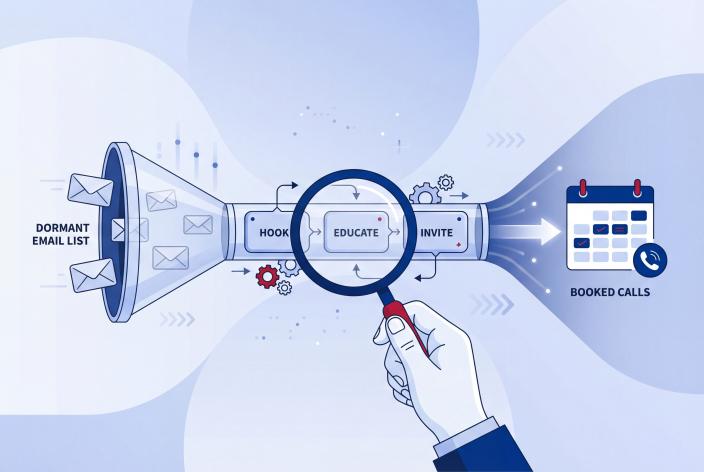
Here's the uncomfortable truth: most coaches have built an email list, but they haven't built an email system. There's a difference. A list is just names and addresses. A system is a sequence of messages designed to move someone from cold interest to hot action, one email at a time.
The good news? You don't need a fancy marketing degree or expensive software to fix this. You need clarity on what actually works, and then the discipline to execute it.
The Anatomy of a Sequence That Actually Books Calls
Let me show you the structure that converts.
A high-converting follow-up sequence has three parts: hook, education, and invitation. Each part serves a specific job. Skip any one of them, and the whole thing falls apart.
Part One: The Hook
Your first email after someone opts in has one job: prove you're not a waste of their inbox space.
This is where most coaches fail. They send a generic welcome email that sounds like a robot wrote it. "Thanks for joining our community! Here are our social links. Check back soon!"
That's not a hook. That's a greeting card.
Here's what actually works: acknowledge their specific pain point and hint that you have a way forward.
Example: "You registered for the summit because you're tired of feast-or-famine client flow. Good news: most coaches don't realize there's one system that fixes this in 90 days or less. I'm going to show you what it is."
See the difference? You're not selling. You're pointing at the problem they came to solve and saying, "I see you. And I've got something for you."
Open the email with a question or a bold statement. Make them feel seen. Then, deliver on the promise immediately.
Part Two: The Education Emails
Now you've got their attention. This is where you build trust and remove the blocks that stop them from booking a call.
Send 3 to 5 emails over the next 7 to 14 days. Each one should teach something valuable and address one of the objections holding them back.
Common coaching objections sound like this:
"I don't have time to implement another system."
"I don't have enough of a list yet."
"I've tried this before and it didn't work for me."
"I can't afford to hire help right now."
Each of these is a reason they won't book. So each email should gently dismantle one of them.
Example email: "Why you don't need a huge list to book your first high-ticket client." That's the subject line. The body explains that authority and positioning matter more than volume. You share a quick case study. You end with, "If you want to see how this works in your specific situation, let's talk."
Notice: you're teaching. You're not pitching. But the teaching is chosen specifically to answer their doubt.
This is where psychology comes in. You're using what researchers call "pacing and leading." You pace with their current belief ("Most coaches think they need 10,000 subscribers to succeed"). Then you lead them to a new one ("But the coaches who book premium clients focus on quality, not volume").
When you do this well, the objection dissolves. And they're ready to move.
Part Three: The Invitation
By email 4 or 5, you've shown them how you think. You've answered their biggest fears. Now you ask for the call.
Make it simple. Make it clear. Make it about them, not you.
"Ready to see how this could work in your business? Let's spend 30 minutes mapping out a plan. No pitch. Just clarity."
That's it. A calendar link. A clear ask. No fluff.
The Subject Line Is the Gatekeeper
Here's something that shocks most coaches: your subject line matters more than your email body.
If they don't open it, they don't read it. If they don't read it, they don't click. If they don't click, they don't book.
So what gets opened?
Research from direct response copywriting shows that curiosity and specificity beat "value" every time.
Weak: "5 Ways to Attract More Clients"
Strong: "The one thing you're missing that's costing you $10K a month"
Weak: "Join Our Community"
Strong: "Why coaches with smaller lists book bigger clients"
Weak: "Your Free Resource Inside"
Strong: "The system I used to go from zero to $50K in 90 days"
See the pattern? Specificity. A hint of benefit. A reason to care right now.
Use positive language. Remember: your subconscious mind doesn't process negatives well. So avoid "Don't miss out" and use "Secure your spot" instead. The brain hears the action you want, not the warning.
Three Mistakes That Kill Your Sequence
Mistake One: Sending Too Much, Too Fast
Coaches panic. They think if one email is good, five emails in two days is better.
Wrong. You'll just train people to unsubscribe.
Space your emails out. 2 to 3 days apart is the sweet spot. This gives them time to forget the last email (so it feels fresh) but not so much time that they've moved on.
Mistake Two: Talking About You Instead of Them
"I've helped over 200 coaches." "I've been in business for 15 years." "My program includes..."
Stop. They don't care about your credentials yet. They care about their problem and whether you can solve it.
Every email should answer one question: "What's in this for me?"
Use their language. Reference their pain. Show them you understand their world. Then, and only then, mention what you've done.
Mistake Three: No Clear Call to Action
This is the silent killer. You write a great email. You share a story. You teach something useful. And then... you fade out.
No ask. No calendar link. No next step.
People don't book calls by accident. You have to ask. And you have to make it easy.
Include a link. Make it obvious. Say exactly what happens next.
The One Metric That Tells You Everything
You don't need a dashboard full of analytics. You need one number: click-through rate.
CTR is the percentage of people who opened your email and clicked a link (usually your calendar link).
The exact click-through rate depends on the list, source, offer, and timing. What matters is whether the right people are clicking the right next step.
How do you know if yours is working? Send a test email to your list. Check the open rate. Check the click rate. If opens are high but clicks are low, your email body isn't compelling enough. Rewrite it to be more specific and benefit-focused.
If opens are low, your subject line is the problem. Test a new one.
This one metric guides everything. Track it. Improve it. Watch your bookings grow.
The Template You Can Use Today
Here's a simple 5-email sequence you can adapt to your coaching niche right now.
Email 1 (Day 1): Welcome + hook. Acknowledge their pain. Hint at the solution.
Email 2 (Day 3): Teach one quick win they can implement immediately. Build credibility through a small insight.
Email 3 (Day 6): Address their biggest objection with a short story or case study.
Email 4 (Day 9): Share another insight. Deepen the relationship.
Email 5 (Day 12): Soft invitation to a call. "If you're ready to see how this works for your situation..."
Each email should be 150 to 250 words. Short. Scannable. One clear idea per email.
Don't overthink it. Write like you're texting a friend. Use contractions. Use short sentences. Use line breaks so it's easy to read on mobile.
The Real Reason Your Sequence Isn't Working
Most coaches don't have a sequence problem. They have a strategy problem.
They're sending emails to a cold list with no context. No positioning. No reason why the person should care.
But when you run a summit, host a podcast, or create a challenge, you change that. People opt in because they're interested in you and what you're teaching. They're warm, not cold. They've already decided you might be worth listening to.
That's when a follow-up sequence becomes a client-booking machine.
So here's the real question: are you building a system designed to convert warm leads into calls and clients? Or are you just hoping people will remember you exist?
The difference between a coach with a full calendar and one refreshing their inbox every morning is this: one built a system. The other didn't.
You now have the blueprint. The question is: will you use it?
Start today. Pick your five emails. Write them. Send them. Track your click-through rate. Then improve based on what you learn.
One focused afternoon can give you a cleaner starting point.
That's the trade-off. And it's one worth making.
If you want help building this system and the rest of your client attraction engine, Book your Client Attraction Planning Call. We’ll map where your follow-up is getting stuck and what kind of funnel, CRM, email, or event strategy could create more qualified conversations.