You know that little burst of excitement after a podcast interview, summit session, panel, or partner workshop?
You showed up well. You shared something useful. The host thanked you. Maybe a few people messaged you afterward.
Then life moved on.
A week later, you’re back to wondering where the next client conversation is coming from.
That’s where a lot of good coaches lose momentum. The visibility happened, but the follow-up system wasn’t ready to catch it.
And when there’s no system, attention leaks.
People listen, nod, enjoy your perspective, click around for a minute, and disappear into the rest of their day. They may still need help. They may still be a good fit. But they were never guided into the next step.
So let’s fix that.
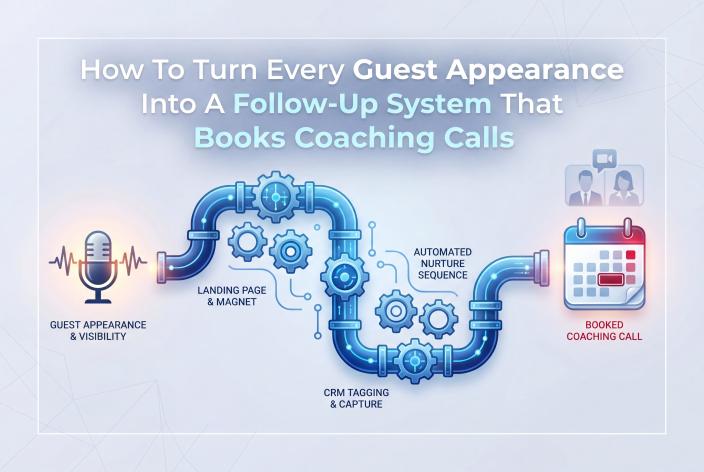
In this article, I’ll walk you through a practical follow-up system you can build around every guest appearance, so your visibility turns into captured leads, nurtured trust, and more qualified coaching conversations.
Why Visibility Without Follow-Up Rarely Becomes Consistent Client Flow
Guest appearances are powerful because they let you borrow trust.
When someone hears you on a podcast, watches you in a summit, attends a partner workshop, or sees you on a panel, you’re not walking in cold. The host or partner has already created a bridge.
But that bridge needs somewhere to lead.
A guest appearance usually creates a short window of attention. During that window, the listener is thinking things like:
- “That was useful.”
- “I like how they explain things.”
- “I wonder if this applies to me.”
- “I should look them up later.”
That moment is fragile.
If the next step is vague, they’ll probably drift. If the next step is too big, they may hesitate. If the next step sends them to your generic homepage, they have to figure out what to do by themselves.
Most won’t.
The better approach is simple: every appearance gets its own path.
That path should help the right person move from attention to trust to conversation without requiring you to manually chase every listener.
This is where follow-up becomes more than an email sequence. It becomes the system that protects the relationship.
What Every Guest Appearance Needs Before It Goes Live
Before your next interview, summit session, or partner event goes live, you want the back end ready.
Not perfect. Ready.
Here’s the simple checklist.
A Relevant Lead Magnet
Your lead magnet should connect directly to what you talked about.
If you were interviewed about stress recovery for executives, don’t send people to a general “healthy habits” checklist. Give them the next practical step related to the conversation.
A few examples:
- A short assessment
- A planning worksheet
- A private training
- A checklist
- A case study breakdown, if you have one you can share accurately
- A short email course
- A quiz
- A resource guide
The goal is not to impress them with volume.
The goal is to answer this question: “What would help this person take one useful step after hearing me speak?”
That’s how your lead magnet feels like service instead of bait.
A Dedicated Landing Page
Please don’t send people from a specific appearance to your homepage.
Your homepage has too many jobs. It talks to too many people. It usually asks the visitor to do too much thinking.
A dedicated landing page keeps the path clean.
It should include:
- A headline that matches the topic of the appearance
- A short explanation of who the resource is for
- A simple opt-in form
- A reminder of what they’ll receive
- A short line that connects back to the podcast, summit, panel, or partner workshop
For example:
“Thanks for listening to my conversation on building calm leadership habits. Download the 10-minute reflection guide we talked about here.”
That feels natural. It also reassures the visitor they’re in the right place.
A CRM Tag For The Appearance
Every guest appearance should have its own CRM tag.
This is where many coaches get sloppy.
They may collect names and emails, but they don’t record where those people came from. Later, everyone looks the same inside the email list.
That makes follow-up generic.
A simple tag might look like:
- Podcast: Leadership Habits Interview
- Summit: Burnout Recovery Session
- Partner: Finance Workshop With Sarah
- Panel: Wellness For Founders
This matters because source context tells you what the person already knows.
If someone came from a summit session about burnout, they should not receive the same first follow-up as someone who came from a referral partner’s private workshop about scaling a business.
A CRM helps you remember the relationship context. Even a basic tracking sheet can work at first, but the important thing is to record the source and plan the follow-up before the momentum fades.
A Calendar Path For Ready Prospects
Some people need nurturing.
Some people are ready now.
Give both groups a path.
If you sell higher-touch coaching, consulting, or advisory work, there should be a clear way for qualified prospects to raise their hand for a conversation. A practical application or planning call path can help filter people, so your calendar doesn’t fill with poor-fit calls.
That path might include:
- A soft invitation on the thank-you page
- A short application or qualification form
- A calendar link for the right-fit person
- A confirmation sequence that prepares them for the call
- Reminders that reduce no-shows and keep the conversation warm
This doesn’t need to feel pushy.
It can be as simple as:
“If this topic connects to something you’re actively trying to solve, you can also book a planning conversation here.”
That sentence gives ready prospects permission to move.
How To Match Follow-Up To The Type Of Appearance
A podcast listener, summit attendee, and partner referral may all join your list after hearing you speak.
But they arrive with different levels of trust and context.
So your follow-up should reflect that.
Podcast Listener Follow-Up
Podcast listeners often feel like they discovered you privately.
They may be walking, driving, cooking, or listening between meetings. They heard your voice and started forming an impression.
Your follow-up should feel conversational.
A good podcast follow-up sequence might look like this:
- Deliver the resource and mention the podcast conversation.
- Share one useful takeaway that goes deeper than the interview.
- Tell a short story about why this issue matters.
- Invite them to reply with a simple question.
- Offer a planning call path if they’re actively working on the problem.
Keep the first email human.
Something like:
“Glad you found your way here from the interview. If the conversation hit home, this guide will help you see where your current pattern is costing you the most energy.”
That’s warmer than a canned “welcome to my newsletter” message.
Summit Attendee Follow-Up
Summit attendees are usually comparing ideas across multiple speakers.
That can be good for authority. It can also mean they’re consuming a lot of information quickly.
Your job is to help them remember why your perspective mattered.
A good summit follow-up sequence might include:
- The replay or promised resource
- A recap of your main teaching point
- A story, example, or diagnostic question connected to your session
- A simple invitation to identify where they are stuck
- A path to a planning or sales conversation for qualified prospects
Summit follow-up should be planned before the event. One summit conversation from the Virtual Summit Strategies podcast made this point clearly: when follow-up is not planned, it usually doesn’t happen, and the relationship is built after the initial interaction.
That applies to attendees and speakers.
You don’t want to finish the event exhausted and then start wondering what to send.
Write the follow-up while the message is still fresh.
Partner Referral Follow-Up
Partner referrals often arrive with more borrowed trust.
Someone they already know introduced them to you, hosted you, or recommended your work.
That means your follow-up should honor the partner relationship.
A strong partner referral sequence might include:
- A warm welcome that mentions the partner or workshop
- A reminder of the shared topic or problem
- A useful resource that continues the conversation
- A values-based note about who your work is best for
- A clear invitation to book a call if they want help applying it
You can also create a partner-specific landing page.
For example:
“Resources For Sarah’s Leadership Community”
That small detail tells the visitor, “This was made for people like me.”
And that feeling matters.
How To Keep Follow-Up Warm Without Manually Chasing Everyone
Good automation should not make people feel like they’re being handled by a machine.
It should help you follow up the way you would if you had perfect memory, unlimited time, and no delivery calendar.
That means your automation should do 4 things well.
It Should Remember The Context
The first job of your CRM is to remember where the person came from.
Podcast. Summit. Workshop. Panel. Referral partner. Paid event. Webinar.
That context shapes the message.
When you tag contacts properly, you can send follow-up that matches the conversation they already heard.
This is the difference between:
“Hey, here’s my newsletter.”
And:
“Thanks for joining my session on rebuilding trust after burnout. Here’s the worksheet I mentioned.”
One feels like a list. The other feels like continuity.
It Should Send The First Message Fast
The first email should arrive while the appearance is still fresh.
If someone opts in for a resource, they should receive it quickly. That sounds obvious, but many coaches still rely on manual follow-up, delayed replies, or scattered tools.
Speed matters because attention fades.
A fast first message says, “You’re in the right place, and I’m going to take care of you.”
It Should Invite Small Engagement
You don’t need to push everyone to book a call immediately.
Sometimes the best early step is a simple reply.
Try questions like:
- “Which part of the conversation felt most relevant to you?”
- “Where are you noticing this problem most right now?”
- “Are you trying to solve this personally, with a team, or for clients?”
These replies can teach you a lot.
They also turn a subscriber into a conversation.
It Should Route Ready People To The Right Next Step
Your follow-up should help people self-identify.
Some are curious. Some are researching. Some are ready to talk. Some are not a fit.
Give each person a clean path.
For ready prospects, that might be a planning call or application. For people who need more trust, it might be a relevant training or nurture sequence. For poor-fit contacts, it may simply be useful content and no sales pressure.
That’s how automation becomes respectful.
It doesn’t force everyone into the same box.
How EventRaptor And GHL/CRMRaptor Fit Into The System
This is much easier when the event activity, CRM records, tags, calendars, workflows, and follow-up are connected.
EventRaptor handles the virtual event management side. That can include event pages, registration, speaker and session organization, attendee data, reminders, promoter tracking, and event-related communication.
GHL/CRMRaptor supports the CRM and follow-up side. That can include contact records, tags, custom fields, calendars, funnels, workflows, automation, and follow-up.
Together, they help turn visibility into a managed path.
Here’s what that can look like in practice:
| Guest Appearance Asset | What It Does | Why It Matters |
|---|---|---|
| Dedicated Landing Page | Captures the right lead from the right appearance | Keeps the message specific and relevant |
| CRM Tag | Records the source of the lead | Makes follow-up more personal |
| Follow-Up Workflow | Sends timely emails and reminders | Prevents warm leads from going cold |
| Calendar Path | Lets ready prospects book or apply | Gives serious people a clear next step |
| Event Data | Connects registrations and attendance to follow-up | Helps you continue the conversation after the event |
You don’t want your summit registrations in one place, your email list in another, your speaker contacts in a spreadsheet, your call bookings in a calendar tool, and your notes floating around in your head.
That’s where things get missed.
A connected system gives every appearance a job. It captures attention, records context, follows up, and routes the right people forward.
The Simple Guest Appearance Follow-Up Blueprint
Here’s a practical version you can use before your next appearance.
Step 1: Define The One Next Step
Ask yourself:
“What should a right-fit listener do after hearing this?”
Choose one primary next step.
That could be downloading a guide, taking an assessment, registering for a workshop, or booking a planning call.
Keep it simple.
Step 2: Build The Landing Page
Create a page that speaks directly to that audience and appearance.
Include:
- The name or context of the appearance
- The promised resource
- A short benefit statement
- A clean opt-in form
- A soft invitation for people who want deeper help
Step 3: Tag The Contact
Create a CRM tag before the appearance goes live.
Use naming that will still make sense later.
For example:
Source - Podcast - Leadership Habits
Or:
Source - Summit - Burnout Recovery 2025
The exact format matters less than consistency.
Step 4: Write The First 5 Follow-Up Messages
You don’t need a massive campaign to start.
Write 5 useful emails:
- Deliver the resource.
- Expand on the topic from the appearance.
- Share a diagnostic question or useful framework.
- Address a common hesitation or misunderstanding.
- Invite the right person to book a planning conversation.
Make these sound like you.
If you would never say “unlock your limitless potential” to a real human, don’t put it in the email.
Step 5: Add A Calendar Or Application Path
For higher-touch coaching, a filtered path can save a lot of time.
You might ask a few simple questions before someone books:
- What are you trying to solve?
- Why now?
- What have you already tried?
- What kind of support are you looking for?
- Are you looking for coaching, consulting, implementation, or something else?
This helps you protect your calendar and prepare for better conversations.
Step 6: Review The Results After The Appearance
After the appearance, look at the path.
Ask:
- How many people visited the page?
- How many opted in?
- Which emails got replies?
- Did anyone book a call?
- Were the calls qualified?
- Where did people stop moving?
You’re not looking for perfection.
You’re looking for leaks.
Once you see the leak, you can improve the system.
Common Follow-Up Leaks To Fix First
If your guest appearances are not turning into calls, check these areas.
The Call To Action Was Too Vague
“Visit my website” is usually too broad.
Give people one useful next step.
The Resource Did Not Match The Conversation
If the listener came for one topic and the resource shifts to another, trust drops.
Keep the path connected.
The Follow-Up Was Too Generic
A person who heard you on a specific topic should feel that continuity in the emails.
Use the CRM tag to personalize the first few messages by source.
The Calendar Path Was Hidden
Some people are ready sooner than you think.
Give them a respectful way to raise their hand.
The System Was Built After The Opportunity Passed
Trying to build follow-up after the interview airs or the summit ends is stressful.
Prepare it before the appearance goes live.
That one habit alone can change how much value you get from every stage you step onto.
Your Follow-Up System Is Part Of Your Authority
Authority is not only what happens while you’re speaking.
It’s also what happens after someone says, “I want to learn more.”
Do they land on a page that speaks to their situation?
Do they receive the resource quickly?
Do the emails feel relevant?
Can they find the next step if they’re ready?
Do you remember where they came from?
That experience tells a prospect a lot about how you run your business.
And for a coach, that matters.
A clean follow-up system makes your expertise easier to trust. It helps people feel guided before they ever get on a call. It also gives you a calmer way to turn visibility into real conversations without depending on memory, mood, or manual chasing.
That’s the point.
Not more random visibility.
A path behind the visibility.
The Next Step
If you’re already appearing on podcasts, summits, panels, partner workshops, or webinars, you may be closer than you think.
You may not need to start from scratch. You may need to connect the attention you’re already earning to a better capture, nurture, CRM, and calendar path.
If you want help finding where your current follow-up system is leaking conversations, Book your Client Attraction Planning Call.
On the call, we’ll look at where your client flow is getting stuck, what kind of follow-up system makes sense for your coaching business, and whether a summit, funnel, CRM, automation, or done-for-you implementation path is the right next move.