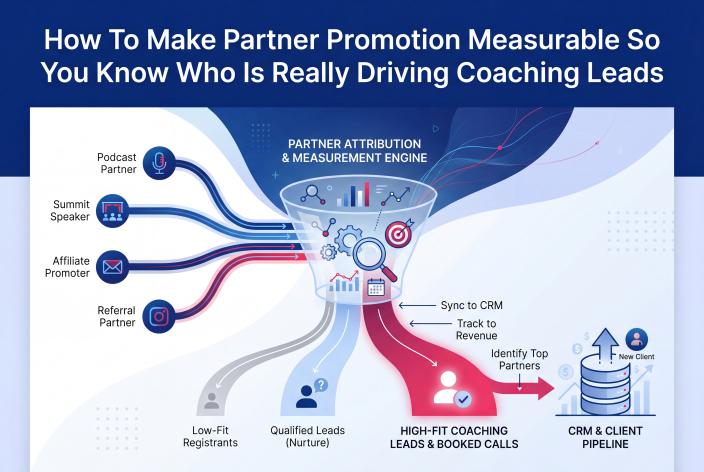
If you grow through partners, speakers, podcasts, giveaways, workshops, or summits, there’s a point where your gut feeling stops being enough.
You know someone promoted you.
You know a few people registered.
You think one speaker brought in a good crowd.
But when it’s time to decide who to thank, who to collaborate with again, who sent qualified prospects, and where your next client conversations really came from, things get fuzzy fast.
That fuzziness costs you.
Because partner promotion can be one of the best ways for a coach to build authority and reach warmer prospects. But only when you can see what’s actually happening.
Otherwise, you’re left with inbox memories, spreadsheet fragments, half-tracked links, and a vague sense that “the event went pretty well.”
That’s not enough if you’re trying to build a predictable client attraction system.
Why Partner Growth Gets Messy So Quickly
Partner promotion sounds simple at first.
You invite a few speakers. You give them a registration link. They share it with their audience. People register. You follow up.
Nice and clean, right?
Then the real campaign starts.
One speaker asks for a different link. Another promotes from LinkedIn and email. A podcast guest mentions the event without using the right URL. A giveaway contributor sends traffic on the final day. A referral partner sends 3 people directly to your calendar. Someone forwards an email. Someone else shares a replay page.
Now you’re trying to answer basic questions like:
- Who actually drove registrations?
- Which partners sent people who attended?
- Which registrants were strong potential clients?
- Which source produced VIP buyers or call bookings?
- Which partners should be invited into a deeper collaboration?
If every link, registrant, and opt-in source is tracked manually, the whole thing becomes fragile.
And when the tracking is fragile, your decisions become emotional.
You remember the partner who was loudest. You notice the person who posted the most. You assume the speaker with the biggest audience created the most momentum.
But the quieter partner with a highly aligned niche may have sent fewer people and better leads.
That’s the kind of thing you need to know.
What Partner Attribution Really Means
Partner attribution means you can connect a lead, registration, purchase, booked call, or later opportunity back to the person or channel that helped create it.
In plain English, it helps you see who raised their hand because of whom.
For coaches, this matters because relationships are part of your growth engine. Speakers, podcast hosts, affiliate partners, referral partners, workshop guests, community owners, and giveaway contributors can all help you get in front of the right people faster.
But partnership only becomes a repeatable strategy when you can track the movement.
A good attribution process helps you see:
- Which partners generate attention
- Which partners generate qualified leads
- Which partners generate buyers
- Which partners generate booked calls
- Which partners create long-term referral value
Notice the progression.
Registrations are useful. But they’re only the beginning of the story.
The coach who wants better client flow needs to measure the path from visibility to trust to conversation.
The Core Numbers To Track In A Partner Campaign
You don’t need to turn your coaching business into a data lab.
But you do need enough visibility to make better decisions.
Here are the numbers I’d want a coach to track in any partner-powered campaign.
| What To Measure | Why It Matters | What It Helps You Decide |
|---|---|---|
| Registrations By Partner | Shows who created initial interest | Who can move an audience to act |
| Attendance Or Engagement | Shows whether the registrants stayed involved | Whose audience is genuinely interested |
| Qualified Leads | Shows whether registrants match your ideal client profile | Which partners reach the right people |
| VIP Buyers Or Offer Buyers | Shows who sent people willing to invest | Which audiences have buying intent |
| Calls Booked | Shows who helped create sales conversations | Where future collaboration may be worth deepening |
| Long-Term Referrals | Shows value beyond the first campaign | Who belongs in your relationship strategy |
Here’s a tip.
Don’t treat every registration as equal.
A partner who sends 50 loosely matched registrants may look great on a leaderboard. Another partner may send 12 people, with 4 who fit your coaching offer beautifully.
If your offer is high-touch coaching, the second partner may matter more.
So measure volume, yes. But also measure fit, intent, and movement toward a real next step.
Why Unique Promoter Links Matter
Unique promoter links are one of the simplest ways to make partner promotion measurable.
Each partner gets their own link. When someone registers through that link, the system can attribute that registration to the correct partner.
That one change removes a lot of guesswork.
You no longer have to ask, “Where did these people come from?” after the campaign. You can see which partners, speakers, or affiliates helped create registrations.
EventRaptor supports unique promoter links, promoter attribution, performance reporting, leaderboards, CSV exports, and cross-event attribution. It also supports registrant lists, search and filtering, VIP indicators, registration timestamps, data exports, growth graphs, direct email actions, and CRM sync.
That means the campaign can be managed as a real event growth process, rather than a pile of links and spreadsheets.
And that matters when you’re running more than one event, working with more than one partner, or trying to improve each campaign instead of rebuilding from memory.
How To Track Quality Beyond The First Opt-In
A lot of coaches stop tracking too early.
They know who registered. Then the rest of the journey gets blurry.
The real value shows up when partner attribution follows the lead into your CRM and follow-up process.
For example, imagine a leadership coach running a virtual summit for managers moving into executive roles.
The coach has 12 speakers. Each speaker gets a unique promoter link. Registrants are tagged by source. The registration form includes a few useful questions about role, challenge, and interest level.
Now the coach can see more than raw registrations.
They can identify:
- Which speaker’s audience included the most right-fit prospects
- Which registrants requested more information
- Which people clicked through to the next-step invitation
- Which leads booked a call
- Which leads need longer nurture
- Which partners may be ideal for a future workshop or referral relationship
That’s where CRM follow-up becomes important.
Event attention is warm for a short window. If the registrant data sits in a spreadsheet for 2 weeks, the relationship cools. If the contacts are synced, tagged, and moved into a relevant follow-up path, the conversation can keep going while the event is still fresh.
Good automation doesn’t replace the relationship.
It protects the relationship by making sure the next useful message goes out on time.
How Leaderboards Can Encourage Promotion Without Creating Weird Competition
Leaderboards can help partners stay engaged.
They show momentum. They make promotion visible. They give speakers and contributors a reason to check in and keep sharing.
But you need to use them with some care.
If the leaderboard is framed poorly, it can make partners feel like they’re being judged only by list size. That’s not the tone you want, especially if your business is built on trust and collaboration.
The better frame is simple.
The leaderboard is a momentum tool.
It helps everyone see that the campaign is moving. It celebrates people who are helping. It creates light, friendly energy around promotion.
You can keep it healthy by doing a few things:
- Thank partners publicly for participation, not only rank.
- Celebrate aligned promotion, helpful introductions, and thoughtful shares.
- Use private data to evaluate lead quality, not public pressure.
- Avoid language that makes smaller partners feel irrelevant.
- Follow up personally with partners who sent high-fit leads, even if their registration count was lower.
This is important.
The best collaboration partners are not always the ones with the largest audience.
They’re often the ones with the most aligned audience, the strongest trust, and the willingness to keep building the relationship after the campaign.
How Partner Attribution Helps You Make Better Collaboration Decisions
Once you can see partner performance clearly, your post-event decisions get much easier.
You can stop guessing who “seemed active” and start asking better questions.
Questions like:
- Who drove registrations from a right-fit audience?
- Who promoted on time and communicated clearly?
- Who sent people who engaged, bought, booked, or replied?
- Who would be a good fit for a future summit, workshop, podcast swap, or referral relationship?
- Who needs better promotional assets next time?
- Which channels created attention but not qualified movement?
This is where measurement becomes relational, not cold.
You’re not reducing people to numbers. You’re using the numbers to treat the relationship more intelligently.
A partner who drove strong interest deserves a better thank-you, a clearer follow-up, and maybe a deeper collaboration.
A partner who didn’t get much traction may still be valuable. Maybe the topic wasn’t right for their audience. Maybe the timing was off. Maybe they need better swipe copy or a shorter promotional path.
Data gives you a better conversation.
And better conversations create better partnerships.
How To Connect Partner Attribution To CRM Follow-Up
The cleanest system connects the event platform to the CRM.
Here’s the simple version of what you want:
- A partner shares their unique promoter link.
- A prospect registers through that link.
- The registrant is captured with source attribution.
- The contact is synced or exported into your CRM.
- The contact is tagged by partner, campaign, interest, and relevant next step.
- Follow-up continues based on what the person did or requested.
- Booked calls, purchases, and later referrals can be reviewed against the original source.
That’s how you move from “I think this partner helped” to “I can see where this opportunity came from.”
EventRaptor handles the virtual event side, including registration, event pages, speaker and promoter tracking, attendee data, email communication, exports, and reporting. GHL/CRMRaptor can support the CRM, funnel, calendar, workflow, automation, and follow-up side.
Together, those pieces make the client attraction path easier to manage because the event activity and follow-up system are connected.
A Simple Partner Tracking Checklist For Coaches
Before your next summit, giveaway, webinar series, podcast collaboration, or speaker-led campaign, walk through this checklist.
Before The Campaign
- Give each partner a unique tracking link.
- Decide which outcomes matter beyond registrations.
- Create partner tags or source fields in your CRM.
- Prepare swipe copy that matches the event promise.
- Decide how VIP buyers, booked calls, and qualified leads will be tracked.
- Make sure your thank-you page and next-step path are clear.
During The Campaign
- Watch registrations by partner.
- Track which partners are actively promoting.
- Share friendly momentum updates.
- Use leaderboards to encourage energy, not pressure.
- Monitor whether traffic is converting into the right kind of leads.
- Keep partners informed without flooding them with messages.
After The Campaign
- Review registrations, attendance, buyers, booked calls, and lead quality.
- Thank partners based on contribution and relationship value.
- Move registrants into the right follow-up paths.
- Identify partners for future collaborations.
- Notice where the promotional assets or topic may need improvement.
- Keep nurturing leads who are interested but not ready yet.
This is the kind of process that turns collaboration into a growth asset.
Not a one-time burst of activity.
A trackable source of authority, audience growth, and warmer conversations.
The Real Win Is Knowing What To Do Next
Partner promotion is powerful because trust transfers.
When someone you respect introduces you, interviews you, features you, or shares your event, their audience doesn’t meet you as a random stranger. They meet you with a little borrowed trust.
Your job is to capture that attention, understand where it came from, follow up while it’s still warm, and learn which relationships deserve more investment.
That’s what measurable partner promotion gives you.
You get clearer data. Better follow-up. Smarter collaboration decisions. And a calmer way to build authority without depending only on daily content or random referrals.
If you want help applying this to your coaching business, Book your Client Attraction Planning Call. On the call, we’ll look at where your current client flow is getting stuck, how partners and events could fit into your growth strategy, and what kind of funnel, CRM, follow-up, or virtual event system could make sense next.