Why Sales Calls Feel Harder When Context Is Missing
You can be great on sales calls and still feel like every conversation starts cold.
The prospect books. You see a name on your calendar. Maybe you remember they registered for your webinar. Maybe they clicked an email. Maybe they came through a partner, a summit, a referral, or a VIP offer.
But when the call starts, you're piecing it together in real time.
That's exhausting.
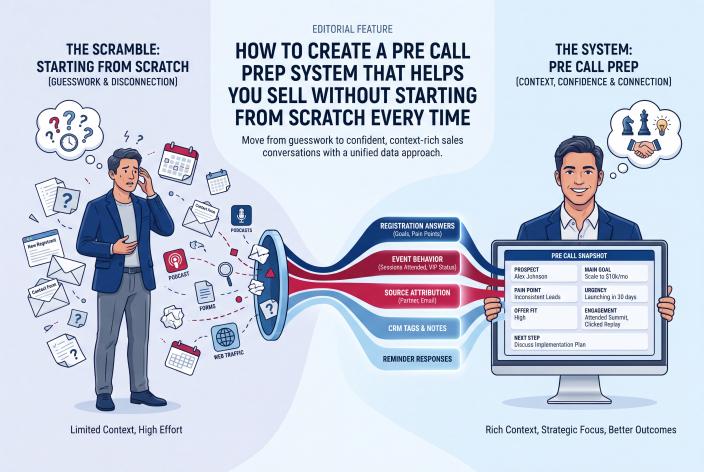
A good pre call prep system fixes that. It gives you a simple way to understand who this person is, what they want, what they've already engaged with, and what kind of conversation you should be ready to have.
And here's the practical truth. You don't need a giant sales operations department to do this well. You need the right questions before the calendar, the right data flowing into your CRM, and a simple review process before each call.
That way, you show up prepared instead of performing detective work while the prospect is talking.
What A Pre Call Prep System Should Collect Before The Calendar
Before someone lands on your calendar, your system should collect enough context to help you understand fit and intent.
You don't need a 30-question application that feels like homework. You need the few answers that help you prepare.
Start with these basics:
- What problem are they trying to solve?
- What goal are they trying to reach?
- Why are they looking for help now?
- What have they already tried?
- What kind of support are they looking for?
- How did they find you?
- Which offer, event, workshop, summit, or resource brought them into your world?
For a coach, this is gold.
If someone says, "I've been relying on referrals and I need a steadier way to get clients," that tells you a lot before the call starts.
If someone says, "I watched your summit session on follow-up and realized I'm losing people after they register," that tells you where to begin.
Your prep system should help you avoid the awkward opening where you ask questions they already answered somewhere else.
Instead, you can say:
"I saw in your notes that referrals have been your main source of clients, but the flow has been unpredictable lately. Let's start there."
That feels different.
It tells the prospect, "You listened before we even got on the call."
How To Read Intent From The Clues They Already Give You
Most prospects leave a trail before they ever book.
The problem is that many coaches never see the trail in one place.
They have registration answers in one tool, email clicks somewhere else, calendar notes in another system, and maybe a spreadsheet from a past event. So the call feels disconnected from the actual relationship.
Your pre call prep system should pull the useful clues together.
Registration Questions
If someone registered for your summit, webinar, workshop, or meeting, their registration answers can tell you what they care about right now.
Useful registration questions might include:
- "What's your biggest challenge with attracting right-fit clients?"
- "What would make this event worth your time?"
- "Are you currently selling a coaching offer?"
- "What are you hoping to improve in the next few months?"
EventRaptor can support custom registration questions and attendee data, which makes registration more useful than a name and email form. It helps you collect information you can use later for follow-up, segmentation, and sales conversations.
Form Answers
A booking form should not repeat every registration question.
It should update the context.
For example:
- "What prompted you to book this call now?"
- "What would you like help mapping out?"
- "Do you already have an offer, audience, and sales process in place?"
- "Where do you feel stuck in your current client attraction system?"
These answers help you understand urgency.
Someone who says, "I'm launching a group program soon and need the funnel and follow-up cleaned up," is in a different place than someone who says, "I'm still deciding what I want to sell."
Both deserve respect. But they need different conversations.
VIP Status And Event Behavior
If someone bought a VIP pass, claimed a replay, attended multiple sessions, or engaged with a specific topic, that behavior matters.
It may show deeper interest.
It may show the problem they're researching.
It may show which part of your message created trust.
EventRaptor supports VIP status, attendee dashboards, event pages, follow-up emails, CRM tagging, and structured event journeys. That matters because the event should not disappear when the session ends. The relationship should keep moving while interest is warm.
Source Attribution
Where did this person come from?
A partner link? A speaker referral? A giveaway? A podcast appearance? A direct email? A workshop registration page?
Source attribution helps you understand the context of trust.
If they came through a speaker or partner, they may already trust you by association. If they came through a cold registration page, they may need more grounding. If they came through a follow-up sequence after attending your event, they may already understand your framework.
EventRaptor supports promoter links, partner attribution, promoter performance reporting, and exports. That helps you see who promoted, who registered, and which partners created momentum.
Email Clicks And Follow-Up Signals
Email behavior is another clue.
Did they click the call booking link after a case-study style email? Did they click a replay? Did they click a message about CRM cleanup, event strategy, or follow-up?
You don't need to overread every click. You simply want to notice patterns that help the conversation feel relevant.
For example:
"I noticed you came through the follow-up sequence after the workshop. Was there a specific part that made you decide to book?"
That's a natural question. It opens the door without sounding creepy.
A Simple CRM View To Review Before Every Call
Your CRM should give you a quick pre call snapshot.
This is where GHL/CRMRaptor comes in as the CRM and workflow layer. It can support contact records, tags, custom fields or values, calendars, funnels, workflows, automation, and follow-up, so the context from your visibility and events can stay organized.
The goal is simple. Before a call, you should be able to open one contact record and see the story.
Here's a practical layout:
| CRM Field | What It Tells You |
|---|---|
| Main Pain Point | What problem they believe they need solved |
| Desired Goal | What outcome they want |
| Urgency Trigger | Why now matters |
| Offer Fit | Whether your service seems relevant |
| Source | Where they came from |
| Event Or Campaign | Which summit, webinar, workshop, or resource they engaged with |
| VIP Or Attendee Status | How deeply they engaged |
| Important Clicks | Which topics or offers got attention |
| Notes Before Call | What you want to remember when opening the conversation |
| Next Step | What should happen after the call |
Keep it clean.
If your CRM view becomes a dumping ground, you'll stop using it. You want the handful of fields that help you prepare in 2 or 3 minutes.
Here's a tip.
Create a "Pre Call Review" section inside the contact record. Put the key fields at the top. Then train yourself, or your assistant, to review that section before every call.
No hunting. No tab overload. No searching your inbox 4 minutes before the call starts.
Reminder Messages That Make The Call Feel More Personal
Reminder messages are often treated like calendar babysitting.
"Your call is tomorrow. Here's the Zoom link."
Useful? Sure.
But a better reminder can also reinforce trust and help the prospect arrive prepared.
Here are a few examples you can adapt.
The Simple Confirmation Message
"Hi {{first_name}}, I'm looking forward to our call on {{appointment_date}}. Before we meet, take a minute to think about where client flow feels most inconsistent right now. That will help us use the time well. Here's your call link: {{meeting_link}}."
The Context Aware Reminder
"Hi {{first_name}}, I saw that you're interested in building a more consistent client attraction system. On our call, we'll look at where things may be getting stuck, such as visibility, offer clarity, follow-up, CRM, or conversion. Here's your call link: {{meeting_link}}."
The Event Follow-Up Reminder
"Hi {{first_name}}, thanks again for joining the event. Since you booked a planning call, we'll use the conversation to connect what you learned with what might make sense for your business next. Here's your call link: {{meeting_link}}."
The Reassuring Reminder
"Hi {{first_name}}, no need to prepare a perfect presentation for our call. Just come ready to talk through what you're trying to sell, how people currently find you, and where the follow-up or conversion path feels unclear. Here's your call link: {{meeting_link}}."
These messages do more than improve attendance.
They make the call feel guided before it begins.
And when GHL/CRMRaptor is handling the CRM, calendar, workflow, and reminder layer, those messages can be triggered consistently instead of depending on your memory.
Good automation protects the relationship. It helps you follow up on time, with context, while the person is still interested.
How This Fits With Events, Funnels, And Follow-Up
A pre call prep system works best when it's connected to the rest of your client attraction system.
Think about the journey:
- A right-fit prospect sees you through an event, partner, email, workshop, or summit.
- They register and answer a few useful questions.
- Their contact record is created or updated.
- Their engagement adds context through tags, source data, VIP status, or clicks.
- They receive relevant follow-up while interest is warm.
- They book a call.
- You review the CRM snapshot before the conversation.
- The call starts with context, not guesswork.
That's the difference between scattered visibility and a real conversion path.
EventRaptor handles the virtual event side, including registration, speaker and attendee management, event pages, promoter tracking, reminders, attendee data, and follow-up paths.
GHL/CRMRaptor supports the CRM, funnel, calendar, workflow, automation, and follow-up side.
Together, they help you move from attention to trust to conversation without duct-taping the whole process together across disconnected tools.
What To Build First
If your current process feels messy, don't try to rebuild everything this week.
Start with the pre call essentials.
Build this first:
- A short booking form with pain, goal, urgency, and fit questions.
- A CRM contact view that shows source, tags, event history, and key answers.
- A pre call review habit before every sales conversation.
- Reminder messages that help the prospect feel prepared.
- A follow-up workflow for people who book, reschedule, no-show, or need more nurturing.
Once that is working, you can get more advanced.
You can add event behavior, partner attribution, VIP status, email clicks, replay engagement, and more detailed segmentation.
But the first win is simple.
Stop starting from scratch every time someone books a call.
The Bottom Line
Your sales calls should feel like the next step in a relationship, not the beginning of a brand-new conversation.
When your registration questions, booking forms, event data, CRM tags, reminders, and follow-up are connected, you walk into the call with a clearer picture. The prospect feels seen. You ask better questions. And you spend less time rebuilding context that your system could have carried forward for you.
If you want help applying this to your coaching business, Book your Client Attraction Planning Call. We'll look at where your current client flow is getting stuck and what kind of pre call prep, CRM, funnel, follow-up, or event strategy could make sense next.