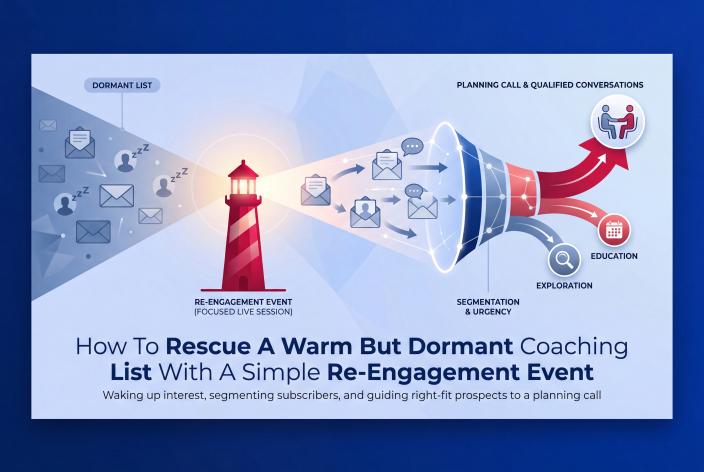
If you have a list that used to feel warm but now sits there quietly, you're not alone.
You send an email. A few people open. Maybe one person replies. Then the list goes back to sleep.
That can feel discouraging, especially when those people didn't come from nowhere. They opted in. They registered for something. They heard you speak. They downloaded a resource. At some point, there was interest.
So what happened?
Usually, the relationship went quiet because there wasn't a timely reason to reconnect. No fresh conversation. No clear next step. No system keeping the relationship moving while interest was still warm.
A simple re-engagement event can change that.
I'm not talking about a massive summit with 40 speakers and months of planning. I'm talking about a focused live workshop, panel, roundtable, or training built around a painful current problem your audience already cares about.
Done well, it helps you wake up the list, learn who is still interested, segment by urgency, and guide right-fit people toward a useful next conversation.
Let's walk through how to do it.
Why A Dormant List Still Has Value
A dormant list can feel like a room full of people with their backs turned.
But that isn't always what's happening.
Some of those people are still interested. Some still need help. Some may be more ready now than they were when they first joined your world.
The problem is that you don't know who is who.
That's why re-engagement should do more than ask, "Are you still there?"
A better goal is to create a meaningful signal.
You want to learn:
- Who still cares about the problem you solve
- Who is dealing with it right now
- Who wants education only
- Who may be ready for a deeper conversation
- Who should be moved into a different nurture path
- Who can be cleaned from the list over time
A small event gives people a reason to raise their hand again.
And because the event is tied to a specific problem, their response tells you something useful.
Choose A Topic Based On A Painful Current Problem
The topic does most of the heavy lifting.
If your dormant list has been quiet, a broad topic usually won't wake it up. "How to improve your life" is too soft. "How to grow your business" is too general. "Mindset for success" may be true, but it doesn't create urgency by itself.
You want a topic that lands in the reader's real week.
Ask yourself these questions:
- What problem is my ideal client tired of thinking about?
- What mistake are they probably making because they don't see the full system yet?
- What has changed in their life, health, business, leadership, money, relationships, or confidence that makes the issue feel current?
- What conversation would they quietly admit they need right now?
For example, a business coach might choose:
- "Why Referrals Have Slowed Down And How To Rebuild A Steadier Client Pipeline"
- "How To Turn A Quiet Email List Into Qualified Sales Conversations Again"
- "The Follow-Up Gaps That Keep Warm Prospects From Booking Calls"
A health coach might choose:
- "How To Get Back On Track When Stress Has Taken Over Your Routine"
- "Why Your Energy Keeps Dropping Even When You're Doing The Right Things"
- "A Simple Reset Plan For People Who Know What To Do But Can't Stay Consistent"
A leadership coach might choose:
- "How To Stop Carrying Every Decision For Your Team"
- "The Quiet Burnout Pattern High Performers Miss Until It Costs Them"
- "How To Rebuild Trust And Accountability Without Micromanaging"
Notice the pattern.
The topic is specific. It names a real problem. It creates a reason to attend now.
Here's a tip.
If your event title could apply to almost anyone, sharpen it. Your dormant list needs a clear signal that says, "This is for the situation you're in right now."
Pick The Smallest Event Format That Creates A Real Conversation
A re-engagement event should be easy to say yes to.
That means the format should feel useful, focused, and manageable.
You could use:
- A 45-minute live workshop
- A 60-minute Q&A session
- A small expert panel
- A practical training with a short worksheet
- A live audit or hot seat session
- A roundtable for a specific type of client
The format matters less than the strategy behind it.
Your event should accomplish 4 things:
- Name the problem clearly
- Teach something useful
- Help attendees diagnose where they are stuck
- Offer a simple next step for people who want help applying it
That last part matters.
A re-engagement event is not only a content session. It is a trust pathway.
People should leave with more clarity than they had before. The right people should also see why a planning conversation would be useful.
Invite Dormant Subscribers Without Sounding Desperate
This is where many coaches get awkward.
They either over-apologize for disappearing, or they try to sound overly exciting to make up for the silence.
You don't need either one.
You can be plain, warm, and relevant.
The best re-engagement invitations usually feel like this:
- "I've been hearing this problem come up more often."
- "If this is on your mind right now, I'm hosting a simple session."
- "This may be useful if you're trying to solve this without adding more complexity."
- "If you're in a different season now, no problem. I wanted to make sure you saw it."
That's human.
It doesn't beg for attention. It doesn't pretend you're best friends. It gives them a useful reason to decide.
A Simple Invitation Structure
Use this 5-part structure for your email:
- Acknowledge the current problem
- Explain why you're hosting the event
- Say who it's for
- Tell them what they'll walk away with
- Invite them to register
Here's a simple example:
Subject: If Your Client Pipeline Has Gone Quiet
Hi [First Name],
If your client flow has felt quieter than usual lately, this may help.
I'm hosting a short live workshop on how to rebuild momentum when referrals, content, and occasional outreach aren't creating enough qualified conversations.
We'll look at where client flow usually gets stuck, how to spot weak follow-up, and how to create a clearer path from visibility to booked calls.
If this is something you're working on right now, you can register here.
Simple. Direct. Respectful.
By the way, you can send more than one invitation. Just make each email useful.
One email can focus on the pain. Another can explain the takeaways. Another can answer, "Is this for me?"
Use Registration Questions To Segment Interest And Urgency
Registration is where your list starts talking again.
This is why you don't want a basic name and email form only.
Ask a few simple questions that help you understand where people are now.
Good registration questions might include:
- What best describes your current situation?
- What is the biggest issue you're trying to solve right now?
- How soon do you want to make progress on this?
- What have you already tried?
- Would you like help mapping out your next step?
Keep it short.
You are looking for useful signals, not a full intake form.
For a coach, those signals can show:
- Topic interest
- Stage of readiness
- Problem intensity
- Offer fit
- Follow-up priority
- Possible sales conversation readiness
This is where your CRM and follow-up system matter.
When registration answers can connect to tags, custom fields, and follow-up paths, you don't have to rely on memory or messy spreadsheets. EventRaptor supports custom registration questions, attendee data, CRM tagging, follow-up emails, attendee dashboards, and structured event journeys. GHL/CRMRaptor can support the CRM, calendar, workflow, automation, and follow-up side around that event.
The practical benefit is simple.
You can treat different people differently based on what they told you.
Someone who says, "I need help now" should not receive the same follow-up as someone who says, "I'm just exploring."
Build The Event Around Diagnosis Before Invitation
Your event should teach. Absolutely.
But the strongest re-engagement events also help people diagnose themselves.
Why?
Because dormant subscribers often don't need another pile of tips. They need a clearer understanding of what is actually blocking progress.
For a coach trying to wake up a list, a simple teaching flow could look like this:
- Name the current problem
- Explain why the usual fixes don't create steady progress
- Show the missing system or sequence
- Give a simple self-assessment
- Teach one practical shift they can use now
- Invite the right people into the next step
For example, if you're teaching coaches how to rebuild client flow, you might explain that the issue often appears in one of these places:
| Breakdown Point | What It Looks Like |
|---|---|
| Positioning | People don't quickly understand why your work matters |
| Authority | You're credible, but not known for a clear problem yet |
| Capture | People see you but don't enter your world |
| Nurture | Leads hear from you too rarely or too randomly |
| Follow-Up | Warm interest fades before the next conversation |
| Conversion | Calls happen, but too many people are not ready or aligned |
That kind of framework is useful.
It also helps right-fit prospects see why they may need help building the system, not just collecting more information.
Create A Short Post-Event Follow-Up Sequence
The event is not finished when the live session ends.
This is where the real re-engagement happens.
People attended. They answered questions. They showed interest. Some may have opened the door to a deeper conversation.
Follow up while the topic is still fresh.
A simple post-event sequence can do the job.
Email 1 Should Deliver The Replay And Reinforce The Diagnosis
Send this soon after the event.
Include:
- Replay link if you offer one
- A short recap of the main idea
- The diagnostic framework
- One question that helps them reflect
- A soft invitation to the planning call
Example question:
Which part of your client attraction system feels weakest right now: authority, capture, nurture, follow-up, or conversion?
That question helps them think. It also helps them reply.
Email 2 Should Segment Based On Their Problem
This email can help people find themselves.
You might say:
If your list is quiet, your next step may be different depending on why people went quiet.
Then outline a few paths:
- If people open but don't click, the topic or offer may not feel urgent enough
- If people click but don't register, the event promise may need sharper positioning
- If people register but don't attend, reminders and pre-event nurture may need attention
- If people attend but don't book, the next step may not be clear enough
This email teaches and segments at the same time.
People often recognize themselves in one of the patterns.
Email 3 Should Invite Right-Fit People To Talk Through Their Next Step
This is your direct invitation.
Keep it calm.
You can say:
If this session helped you see that your list, events, funnel, CRM, or follow-up need to work together more clearly, the next step is to map out what that could look like for your business.
Then use the CTA:
Book your Client Attraction Planning Call
On that call, you can look at where their client flow is getting stuck, whether the gap is positioning, authority, offer clarity, funnel, CRM, follow-up, or event strategy, and what kind of client attraction system could make sense next.
No pressure. Just a clear next step for the people who are ready for help.
Make The Follow-Up Feel Human With Automation
Some coaches hesitate here.
They hear "automation" and picture cold, robotic messages.
Good automation does the opposite. It helps you follow up at the right time, with the right message, based on what the person did or told you.
That is more respectful than forgetting, delaying, or sending the same generic note to everyone.
For a re-engagement event, automation can help you:
- Send confirmation emails after registration
- Remind people before the event
- Tag people based on registration answers
- Send different follow-up messages based on attendance or interest
- Invite high-fit prospects to book a planning call
- Keep nurturing people who are interested but not ready yet
This is much easier when your registration, event pages, reminders, attendee data, CRM tags, and follow-up are connected.
EventRaptor can manage the virtual event side, including registrations, event pages, attendee dashboards, speaker or session details when needed, reminders, and follow-up communications. GHL/CRMRaptor can support the CRM, calendar, funnel, workflow, and follow-up layer.
Together, they help the event become part of the client attraction system instead of another isolated campaign.
Keep The Re-Engagement Event Small Enough To Finish
The goal is momentum.
Don't turn a list rescue into a giant production unless the strategy calls for it.
Start with the smallest version that can create useful signals and meaningful conversations.
A practical re-engagement event plan could be:
- Choose one painful current problem
- Write a clear event promise
- Send a warm invitation to dormant subscribers
- Ask 3 to 5 registration questions
- Deliver a useful live session
- Follow up with replay, diagnosis, and invitation
- Move right-fit people toward a planning call
- Continue nurturing everyone else based on what they showed you
That is enough.
You can always expand later into a larger workshop, webinar series, summit, or partner event.
But first, prove that the topic creates a response.
What To Watch After The Event
After your re-engagement event, don't judge success only by immediate sales.
Look for signals.
Useful signals include:
- Which subject lines got attention
- Which subscribers clicked
- Which people registered
- How they answered the questions
- Who attended live
- Who watched the replay
- Who replied to follow-up
- Who booked a call
- Which topic created the most energy
This information helps you make better decisions.
Maybe your topic needs sharpening. Maybe your list is more interested in one problem than another. Maybe your follow-up is too vague. Maybe your planning call invitation needs to connect more clearly to the pain they already named.
Now you have data from behavior, not just guesses.
The Real Win Is Restarting The Relationship
A dormant list doesn't have to stay dormant.
But it needs a better reason to re-engage than another generic newsletter.
Give people a useful event around a problem they feel now. Ask smart registration questions. Teach in a way that helps them diagnose what is stuck. Follow up while interest is warm. Then invite the right people into a planning conversation.
That's how a quiet list becomes a source of qualified conversations again.
And if you want help applying this to your coaching business, start with a planning call.
Book your Client Attraction Planning Call
We'll look at where your client flow is getting stuck and what kind of authority, event, funnel, CRM, and follow-up system could make sense next.