If you’ve ever stared at a list of leads and thought, “I know I should follow up, but what do I even say?” you’re in good company.
Most coaches don’t lose warm leads because they don’t care.
They lose them because every person on the list starts to look the same.
A summit registrant. A podcast listener. A workshop attendee. A referral. A person who clicked the VIP offer. Someone who booked a call 4 months ago and disappeared.
They all get dumped into one list. Then the coach either sends a generic newsletter or avoids following up because it feels awkward.
Here’s the better path.
Segment your warm leads by context, so your follow-up can speak to what they already showed you.
That’s what makes a message feel personal.
Not fancy wording. Not fake intimacy. Context.
Why Warm Leads Go Cold When Context Gets Lost
A warm lead usually raised their hand in some way.
They registered for an event. Joined a workshop. Asked for a resource. Listened to you on a podcast. Came through a referral. Clicked something. Replied to something. Attended something.
That action tells you something.
But if your system only stores their name and email, you lose the very detail that would make your follow-up useful.
So you end up writing messages like:
“Just checking in.”
“Wanted to see if you had any questions.”
“Thought I’d follow up.”
Those messages are polite. But they don’t help the person remember why they cared.
A stronger follow-up reminds them of the moment they entered your world, connects that moment to the problem they want solved, and gives them a clear next step.
For a coaching business, segmentation is how you preserve that memory without holding every detail in your head.
The Minimum Useful Segments For A Coaching Business
You don’t need 47 complicated segments to follow up well.
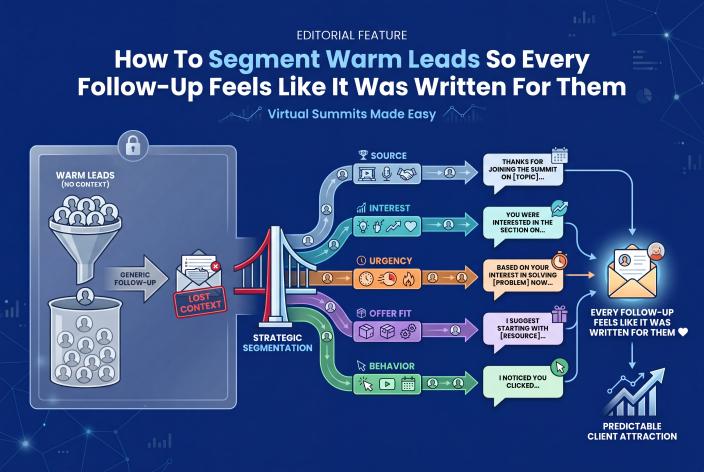
You need enough structure to answer 5 practical questions:
- Where did this person come from?
- What did they show interest in?
- How urgent does their problem seem?
- Which offer might fit them?
- What have they done recently?
That’s the minimum useful segmentation model.
Let’s make it practical.
| Segment Type | What It Tells You | Example |
|---|---|---|
| Source | How they entered your world | Summit, podcast, referral, workshop, webinar |
| Interest | What topic caught their attention | Weight loss, leadership, retirement planning, relationship repair |
| Urgency | How soon they may need help | Exploring, actively looking, ready for a call |
| Offer Fit | Which path may serve them best | Private coaching, group program, VIP day, diagnostic session |
| Behavior | What they actually did | Registered, attended, clicked, replied, booked, no-showed |
Simple, right?
But this is where everything changes.
Because now your follow-up can sound like this:
“You joined the workshop on rebuilding confidence after burnout, and I noticed you were especially interested in the section on decision fatigue. If that’s still active for you, here’s the next step I’d suggest.”
That feels different because it is different.
It’s based on real context.
Segment By Source So The Opening Feels Natural
The first segment to capture is source.
Why?
Because the way someone found you shapes the relationship.
A referral lead already has borrowed trust. A summit registrant may know the event theme but not your offer. A podcast listener may feel like they know your voice. A workshop attendee has already spent focused time with you.
Those people should not receive the exact same first follow-up.
Summit Registrants Need Event Context
Summit registrants often arrive because the topic, speakers, or event promise caught their attention.
Your follow-up should connect to the event experience.
You might reference:
- The summit theme
- Sessions they registered for or attended
- The problem the event was built around
- Their VIP status, if relevant
- The next step after the event
A useful prompt could be:
“Thanks for joining the summit on [topic]. A lot of people come to this conversation because they’re trying to solve [specific problem] without piecing everything together alone. If that’s where you are right now, I’d suggest starting with [resource or next step].”
This is where EventRaptor becomes helpful operationally. It supports registration management, VIP status, registration details, custom registration questions, attendee dashboards, reminders, follow-up emails, and CRM sync. That means the event does not have to end as a messy spreadsheet of names.
You can carry the event context into the follow-up path.
Podcast Listeners Need Recognition And Continuity
Podcast listeners are usually entering through trust and resonance.
They heard your voice. They connected with a story, idea, or framework. They may not be ready to buy yet, but they have already spent time with you.
Your follow-up should continue the conversation.
A simple prompt:
“You mentioned you found me through the podcast episode on [topic]. If that episode resonated, my guess is you’re thinking about [specific issue]. Here’s one thing I’d look at next.”
Notice the tone.
It does not pounce.
It respects the way they entered.
Workshop Attendees Need Action-Based Follow-Up
Workshop attendees gave you something valuable.
Focused attention.
That means your follow-up can be more direct, especially if the workshop taught a problem they want solved soon.
You might segment them by:
- Registered but did not attend
- Attended live
- Stayed until the offer
- Clicked the booking link
- Asked a question
- Requested the replay
Each behavior deserves a different message.
For someone who attended live:
“You joined the workshop on [topic], and the next useful step is to look at where this is showing up in your business right now. If you want to apply the framework to your situation, here’s the best place to start.”
For someone who registered but missed it:
“You registered for the workshop on [topic], but it looks like life got busy. Here’s the replay, and if you only have 10 minutes, start with the section on [specific part].”
That second message feels human because it meets reality.
People miss things. A good system still follows up.
Referral Leads Need Trust And Specificity
Referral leads are different.
They often come with a name attached.
That context matters.
A referral follow-up should acknowledge the relationship without sounding entitled to the sale.
Try this:
“[Referrer Name] suggested we connect because you’re looking at [problem or goal]. I’d be happy to help you think through what’s happening and whether my work is a fit. Either way, I can point you toward a useful next step.”
That’s warm, grounded, and respectful.
You’re not treating them like a cold opt-in.
Segment By Interest So The Message Feels Relevant
Source tells you where the person came from.
Interest tells you what they care about.
For a coach, this can be incredibly simple.
If you’re a health coach, interests might include:
- Energy
- Weight loss
- Hormones
- Gut health
- Stress
If you’re a business coach, interests might include:
- Lead generation
- Sales calls
- Offers
- Hiring
- Productivity
If you’re a relationship coach, interests might include:
- Communication
- Trust repair
- Dating
- Conflict
- Emotional safety
The point is not to trap people in rigid buckets.
The point is to stop sending everyone the same message when they have clearly shown different needs.
A person who registered for a summit session on sales confidence should not only receive general “grow your business” emails.
A person who clicked a workshop link about burnout recovery should not get the same follow-up as someone exploring executive performance.
When you segment by interest, your nurture emails can say, “This is for the thing you actually care about.”
That’s where trust grows.
Segment By Urgency So You Don’t Overwhelm Or Under-Serve
Urgency matters.
Some leads are curious.
Some are comparing options.
Some are actively trying to solve a painful problem now.
If you treat all 3 the same, you’ll either push too hard or follow up too lightly.
Here’s a simple urgency model:
| Urgency Level | What It Means | Best Follow-Up Style |
|---|---|---|
| Exploring | They’re learning and not ready to act yet | Educational nurture, stories, useful frameworks |
| Problem-Aware | They know something needs to change | Diagnostic content, examples, invitations to assess their situation |
| Ready To Act | They clicked, replied, booked, or asked about help | Direct call invitation, offer-specific follow-up, personal check-in |
You can capture urgency through custom registration questions, quiz answers, call applications, reply behavior, or link clicks.
For example, a summit registration form might ask:
“What best describes where you are right now?”
- I’m learning what’s possible
- I know I need to fix this soon
- I’m actively looking for help
That one answer can change the follow-up.
The “learning” person gets education.
The “actively looking” person gets a clearer invitation.
Good follow-up feels timely because it matches the person’s stage.
Segment By Offer Fit So You Invite People To The Right Next Step
Not every warm lead belongs on a sales call for your highest-touch offer.
Some need a resource.
Some need a workshop.
Some need a diagnostic.
Some are ready for private coaching.
Some may be better for a group program.
Offer-fit segmentation helps you protect your calendar and your energy.
You might tag leads by:
- Main problem
- Business or life stage
- Budget range, if appropriate
- Desired outcome
- Type of support they want
- Best next offer
This does not need to feel cold or mechanical.
It can be service-oriented.
The goal is to guide people into the next step that actually fits.
A follow-up prompt might be:
“Based on what you shared, I’d suggest starting with [offer or resource] rather than jumping straight into [other option]. It will help you clarify [specific issue] before you make a bigger decision.”
That kind of message builds trust because it shows judgment.
You’re not just trying to move everyone into the same box.
Segment By Behavior So Your Timing Gets Smarter
Behavior is where your system starts to feel alive.
What did the lead do?
Did they register? Attend? Watch a replay? Click a booking link? Reply to an email? Visit the sales page? Miss the call?
Each action is a clue.
A few useful behavior segments include:
- Registered but did not attend
- Attended but did not click
- Clicked but did not book
- Booked but did not show
- Replied with interest
- Bought a low-ticket offer
- Asked about pricing
- Went quiet after a sales conversation
These behaviors should trigger different workflows.
A person who clicked your booking link twice probably deserves a different message than someone who opened 1 newsletter 6 weeks ago.
This is where tags, custom fields, and workflows protect relationships.
Tags can mark what happened.
Custom fields can store details, such as source, topic, urgency, or preferred next step.
Workflows can send the right reminder, notify you when a personal touch is needed, or move someone into the right nurture path.
And when EventRaptor is connected with GHL/CRMRaptor, event activity can flow into the CRM and follow-up system. EventRaptor manages the event side, including registrations, speaker or attendee activity, reminders, and event follow-up. GHL/CRMRaptor supports the CRM, calendar, funnel, workflow, and automation layer.
That connection matters because your follow-up should not depend on memory, mood, or a sticky note on your desk.
Warm Follow-Up Prompts You Can Adapt
Here are a few human prompts you can use as starting points.
Please do not copy them like a robot.
Use your voice. Add the real context. Make them sound like something you would actually say.
For A Summit Registrant
“Thanks for registering for [event name]. Since you were interested in [topic], I wanted to send one practical next step. Most people looking at this are trying to [specific goal or challenge]. If that’s true for you, start with [resource, replay, or invitation].”
For A VIP Summit Attendee
“I saw you upgraded to VIP for [event name], so I’m guessing this topic matters enough that you want to revisit it. If you’d like help applying the ideas to your own situation, the next useful step is [call, assessment, workshop, or resource].”
For A Podcast Listener
“Glad the episode on [topic] brought you here. If that conversation hit home, you may be looking at [specific issue]. I put together [resource or next step] to help you think through it more clearly.”
For A Workshop Attendee
“Thanks for joining the workshop on [topic]. The part that usually creates the biggest shift is [specific idea]. If you want to use that in your own business, here’s the next step I’d suggest.”
For Someone Who Clicked But Did Not Book
“I noticed you looked at the option to talk through [topic]. No pressure at all. If you’re still considering it, the call is useful when you want to figure out [specific decision or problem]. If now isn’t the right time, I can also send you something simpler to start with.”
For A Referral Lead
“[Name] suggested we connect because you’re working through [problem or goal]. I’d be happy to learn a bit more and see whether I can help. If I’m not the right fit, I’ll do my best to point you in a useful direction.”
See the pattern?
Each message starts from context.
That’s why it feels written for them.
A Simple Segmentation Setup You Can Build This Week
If your current follow-up is scattered, don’t try to rebuild everything at once.
Start with the smallest system that creates better conversations.
Here’s a practical setup:
-
Create Source Tags
- Summit
- Podcast
- Workshop
- Referral
- Webinar
- Partner
-
Create Interest Tags
- Use your main content or offer themes
- Keep the list short enough to manage
-
Create Urgency Fields
- Exploring
- Problem-aware
- Ready to act
-
Create Offer-Fit Fields
- Private coaching
- Group program
- Diagnostic
- Resource nurture
- Not a fit right now
-
Create Behavior Tags
- Registered
- Attended
- Missed
- Clicked booking link
- Replied
- Booked
- No-showed
-
Create 3 Core Workflows
- New warm lead nurture
- Event or workshop follow-up
- Sales call or booking follow-up
That’s enough to make your follow-up noticeably smarter.
You can refine later.
How Event-Based Leads Become Easier To Follow Up With
Virtual events create rich segmentation opportunities because people reveal what they care about through registration, attendance, session interest, VIP behavior, partner source, and engagement.
EventRaptor supports that process with registrant management, search and filtering, VIP indicators, promoter attribution, registration timestamps, attendee data, scheduled emails, reminders, follow-up communication, and CRM sync.
That means a summit or workshop can become more than a list-building moment.
It can become a structured trust journey.
Someone registers.
They receive useful reminders.
They attend or watch later.
Their interest and behavior are captured.
They receive follow-up that matches what they did.
The right people are invited into a next step.
And the rest continue to be nurtured without disappearing.
That is how automation supports relationships.
It keeps the right context in motion.
Your Follow-Up Should Feel Remembered
Warm leads don’t need you to sound clever.
They need you to remember why they showed up.
That is the real promise of segmentation.
You can follow up with more confidence because you’re not guessing from a blank screen. You’re responding to a real moment, a real interest, and a real signal.
And when your summit, workshop, podcast, referral, CRM, tags, fields, workflows, and follow-up are connected, your business starts to feel calmer.
Less “Who was that again?”
More “Here’s the next helpful step for this person.”
That’s the kind of follow-up that creates trust before the sales conversation.
If you want help mapping this out for your coaching business, Book your Client Attraction Planning Call. On the call, we’ll look at where your current follow-up is getting stuck and what kind of segmentation, CRM, event, funnel, or automation strategy could make sense next.