If you've ever run a workshop, summit, webinar, giveaway, podcast campaign, or speaker series, you already know the problem.
The idea feels exciting.
Then the moving parts start multiplying.
Pages. Emails. Speaker details. Calendar links. Zoom access. Registration forms. Reminder sequences. CRM tags. Follow-up. Reporting. Partner links. Attendee questions.
And somewhere in the middle of all that, you're still supposed to sound like the trusted expert your audience came to learn from.
That's where many proven coaches get stuck. They don't need to do less important work. They need to stop personally carrying every operational detail that surrounds the work.
So how do you decide what your team should own?
You start by separating the decisions only you can make from the execution other people or systems can handle.
Start With The Campaign Outcome Before Assigning Tasks
Before you delegate anything, answer this question:
What is this campaign supposed to create?
Not just registrations. Not just attendance. Not just a nice looking event page.
What should happen after someone enters the campaign?
For most coaches, the real goal is some version of this:
- Build authority in a specific niche
- Grow an owned audience
- Create trust before the sales call
- Start better conversations with right-fit prospects
- Move warm leads into the right follow-up path
- Learn what message, topic, or offer is getting traction
That outcome should shape the whole campaign.
A summit designed to build authority through guest experts needs different roles than a small private workshop designed to book strategy calls. A giveaway designed for list growth needs different follow-up than a webinar aimed at a high-touch coaching offer.
Here's a tip.
Do not assign tasks until you've named the job of the campaign.
Your team can build pages, write drafts, schedule emails, collect speaker assets, configure registration, and pull reports. But they need to know what the campaign is trying to accomplish first.
Otherwise, everyone gets busy and nobody knows whether the campaign is moving prospects closer to trust.
Separate Strategy Decisions From Execution Tasks
This is the simplest way to protect your voice while still getting help.
Some decisions should stay close to you because they affect positioning, trust, and the client experience.
Other tasks should move away from you because they are repeatable, technical, administrative, or process-driven.
Use this as your first filter.
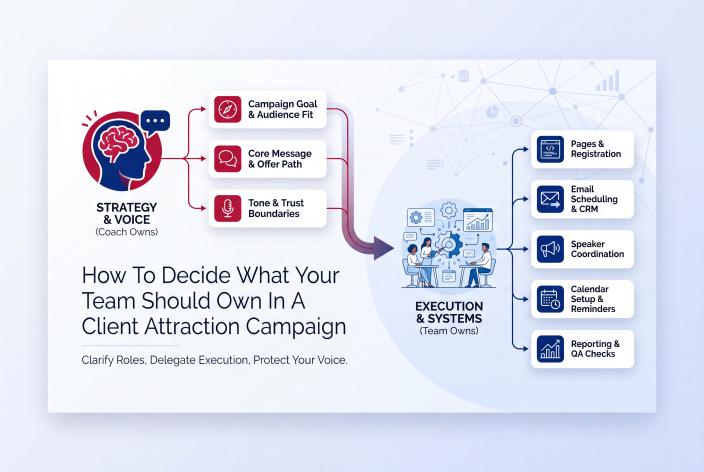
Strategy Decisions The Coach Should Own
You should stay involved in the decisions that define the promise, audience, and experience.
That usually includes:
-
Campaign Goal What do you want the campaign to lead to? A booked call, a waitlist, a workshop invite, a VIP offer, a consultation, or long-term nurture?
-
Audience Fit Who is this for, and who is it not for? Your team can help sharpen this, but you need to recognize the right people when you see them.
-
Core Message What should the right prospect understand by the end of the campaign?
-
Offer Path What is the natural next step after the event, webinar, or series?
-
Tone And Trust Boundaries What language feels aligned? What feels too pushy, too vague, or too hype-driven?
-
Sales Readiness Criteria What makes someone a good fit for a call now versus someone who needs more nurturing?
These are leadership decisions.
Your team can support them. They can ask good questions, draft options, and organize the thinking. But you should not disappear from this layer.
Why?
Because your authority is built through the clarity of your message, not just the polish of your assets.
Execution Tasks Your Team Can Own
Once the strategic direction is clear, your team can carry a lot more than you may realize.
Execution tasks often include:
- Building registration pages and thank-you pages
- Creating attendee dashboard pages or event access pages
- Setting up calendar details and reminder timing
- Organizing speaker applications, bios, headshots, and session descriptions
- Sending speaker invitations and collecting missing materials
- Creating email drafts from your approved messaging
- Scheduling welcome emails, reminders, nurture emails, and follow-up emails
- Configuring CRM tags, custom fields, lists, and workflows
- Connecting forms, calendars, and booking paths
- Exporting registrant data and reviewing campaign reports
- Checking for broken links, missing event details, and outdated copy
These tasks matter. A lot.
But they do not all require your hands.
They require your direction, your standards, and a clear process.
Identify What Requires Your Voice
A growing coaching business has a particular challenge.
Your marketing needs to sound like you, but it can't depend on you typing every sentence, checking every link, and answering every operational question.
So separate voice from labor.
Your voice is needed when the message carries trust.
For example:
- The invitation into the campaign
- The opening story or teaching angle
- The way you name the audience's problem
- The way you describe the transformation
- The bridge into your offer
- The pre-call education that helps prospects arrive warmer
- Sensitive follow-up messages after someone shows interest
Your team can absolutely draft these pieces. In fact, a good team should.
But you should review them for accuracy, tone, and fit.
Ask yourself:
- Does this sound like something I would actually say?
- Does it respect the reader's intelligence?
- Does it make the next step feel useful rather than forced?
- Is the promise clear without being exaggerated?
- Would I feel comfortable if a great-fit prospect saw this before speaking with me?
That's the voice filter.
Once a piece passes that filter, your team can repurpose it into emails, page sections, reminder copy, social posts, speaker swipe copy, and follow-up messages.
You stay in the meaning. They handle the multiplication.
Create Role Clarity For The Campaign Machine
Client attraction campaigns get messy when everyone assumes someone else owns the details.
So write down ownership before the campaign gets moving.
A simple ownership map can save hours of confusion.
| Campaign Area | Coach Owns | Team Owns |
|---|---|---|
| Strategy | Goal, audience, offer path, trust boundaries | Notes, planning docs, campaign map, task list |
| Pages | Core promise, offer positioning, final approval | Registration page, thank-you page, event access page, updates |
| Emails | Voice, key teaching points, sensitive follow-up tone | Drafting, scheduling, testing, segmentation, send checks |
| Speakers | Ideal speaker criteria, relationship priorities | Applications, invitations, bios, headshots, reminders, session details |
| CRM | Sales process, qualification criteria, pipeline meaning | Tags, workflows, forms, lists, calendar links, follow-up routing |
| Calendar | Availability rules, call types, boundaries | Booking setup, confirmations, reminders, reschedule paths |
| Reporting | Business interpretation and next decisions | Registrant exports, promoter reports, email data, attendance summaries |
This table is not about bureaucracy.
It's about relief.
When the right person owns the right part, you stop waking up wondering whether the reminder went out, whether the speaker uploaded their materials, or whether the hottest leads were tagged correctly.
Use Systems To Reduce Manual Coordination
You can run a campaign manually once.
But when campaigns become part of your growth strategy, manual coordination starts costing more than it appears.
The hidden cost is not only time. It's attention.
Every time you copy a Zoom link, update a page, check a spreadsheet, send a reminder, or wonder who promoted, your brain leaves the leadership work and drops back into admin mode.
That's why the system matters.
For virtual summits, workshops, giveaways, webinars, and speaker-led campaigns, EventRaptor helps bring event pieces into one organized system. That can include event pages, registration, speaker workflows, schedules, reminders, promoter tracking, attendee data, follow-up, exports, and CRM-connected workflows.
Then the CRM layer, such as GHL/CRMRaptor, can support the funnel, contact records, tags, calendars, workflows, automation, and follow-up around the campaign.
The point is practical.
Your event activity and your follow-up system should be connected.
When someone registers, attends, clicks, books, no-shows, or needs more nurturing, that information should help guide what happens next.
Good automation does not make the relationship colder. It helps you follow up while interest is still warm.
Decide What To Delegate With This 5-Part Filter
When you're unsure whether to own or delegate a task, run it through this filter.
1. Does This Task Require My Judgment?
If the task affects positioning, offer promise, audience fit, or a delicate client experience, stay involved.
You may still ask your team to prepare options. But your judgment matters.
2. Does This Task Require My Voice?
If the message needs your personal perspective, review it.
If it's a reminder, confirmation, calendar note, or operational update based on approved language, your team can usually handle it.
3. Is This Task Repeatable?
Repeatable work should become a checklist, template, or workflow.
Registration setup, reminder timing, speaker follow-up, thank-you pages, CRM tagging, and reporting should not be reinvented each time.
4. Is This Task Technical Or Administrative?
Technical and administrative work is usually a strong candidate for delegation.
That includes page publishing, calendar setup, CRM configuration, Zoom links, email scheduling, exports, and QA checks.
5. Would Owning This Task Pull Me Away From Revenue Or Relationships?
This one is big.
If the task keeps you from coaching, selling, leading the campaign, building partner relationships, or creating useful teaching content, it may belong with your team.
Your highest value is not being the human glue between tools.
Your highest value is creating trust and guiding right-fit prospects toward a good decision.
Use Done-For-You Support Without Losing Control
Many coaches worry that handing off implementation means losing control.
That's a reasonable concern.
Your reputation is personal. Your audience is sensitive to tone. Your offer depends on trust.
So done-for-you support should not mean disappearing from the process. It should mean having a team that can translate your strategy, voice, and offer into working campaign assets.
A healthy done-for-you relationship usually includes:
- A clear planning conversation before buildout begins
- Agreement on the campaign goal and offer path
- Voice samples or approved messaging direction
- Review points for key pages and emails
- A defined owner for CRM, calendar, and follow-up setup
- A simple reporting rhythm after launch
- Room to improve based on what the campaign reveals
You keep control of the decisions that shape trust.
Your team owns the build, setup, tracking, and follow-through.
That is how you grow without becoming the bottleneck.
Build A Campaign Debrief Into The Process
A campaign is not finished when the live date passes.
The follow-up and debrief are where the system gets smarter.
After the campaign, look at questions like:
- Which topic or message attracted the right people?
- Which partners or speakers helped create qualified attention?
- Which emails got replies or clicks?
- Which registrants booked calls?
- Which leads need more nurture?
- Where did people drop off?
- What should be repeated, revised, or removed next time?
Your team can gather the data.
You should help interpret the business meaning.
That combination creates better campaigns over time.
You stop guessing from memory and start making decisions from the path people actually took.
The Simple Ownership Rule
If you remember one thing, make it this:
Own the decisions that shape trust. Delegate the tasks that support delivery.
You should own the promise, audience, offer path, voice, and client experience.
Your team can own the pages, reminders, speaker coordination, CRM setup, calendar flow, automations, testing, exports, and reporting.
And when those pieces are connected, your campaign becomes calmer.
People register, get reminded, attend, receive the right follow-up, and move into the next step with less manual chasing from you.
That is what a real client attraction campaign should do.
It should help the right people know, trust, and remember you, then give them a clear path to continue the conversation.
Get Help Deciding What To Build Or Delegate Next
If you're looking at your next workshop, summit, webinar, podcast campaign, giveaway, or speaker series and wondering what your team should own, don't leave that decision to guesswork.
The right answer depends on your offer, audience, current systems, sales process, and where client flow is getting stuck.
If you want help applying this to your business, Book your Client Attraction Planning Call.
On the call, we'll look at what you're trying to sell, how prospects currently find you, where the campaign work is getting heavy, and what kind of authority, funnel, CRM, follow-up, or done-for-you support could make sense next.