You probably don't need another random marketing idea.
You need to know what is actually stuck.
That's a very different decision.
A summit, workshop, podcast, funnel, nurture sequence, or CRM cleanup can all be useful. But only when the asset matches the bottleneck in your coaching business.
If you're already good at helping clients, the issue usually isn't that you lack value. It's that the path from visibility to trust to conversation is unclear, inconsistent, or too dependent on your manual effort.
So before you choose the next thing to build, slow down and diagnose the real constraint.
Start With The Bottleneck Before You Pick The Asset
Most coaches choose client attraction assets based on what feels urgent.
Leads are quiet, so they think they need a funnel.
Their audience feels small, so they think they need a summit.
Follow-up feels messy, so they think they need a CRM.
Any of those might be true.
But the better question is this:
Where is trust breaking down before the sales conversation?
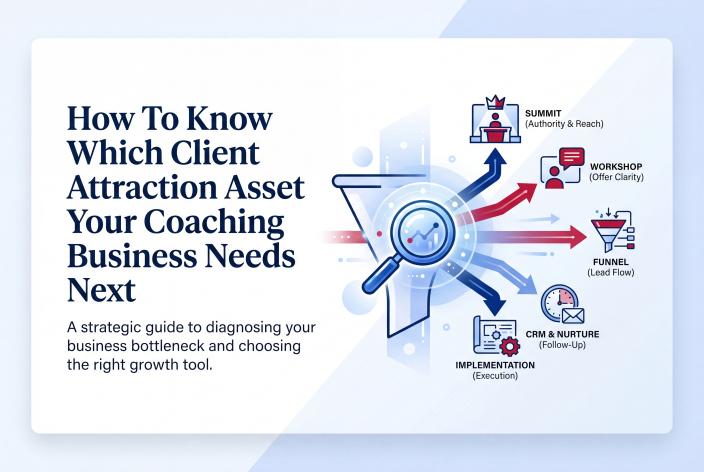
Look at these 5 common bottlenecks.
The Visibility Bottleneck
You have a real offer, but too few right-fit people know you exist.
This often shows up as:
- You can sell when you get the right person on a call
- Your referrals are decent, but unpredictable
- Your content gets some engagement, but not enough conversations
- You feel known by a small circle, but invisible in the broader niche
When visibility is the issue, you need an asset that puts you in front of more aligned people through borrowed trust, partnerships, interviews, workshops, or events.
Good next assets may include:
- A virtual summit
- A partner workshop
- A podcast guesting campaign
- A collaborative giveaway
- A speaker-led campaign
The goal is focused exposure with a clear path for people to raise their hand.
The Offer Clarity Bottleneck
People hear what you do, but they don't quickly understand why it matters now.
This is painful because you may have deep expertise. You may even be excellent in conversation. But your public message feels too broad, too abstract, or too hard to act on.
Signs include:
- Prospects say, "That sounds interesting," but don't move forward
- Your content educates, but doesn't create demand
- Your sales calls require too much explanation
- You attract people who are curious, but not serious
When this is the bottleneck, building a big campaign too soon can amplify confusion.
A smaller workshop, webinar, or offer diagnostic campaign may be better. You need fast market feedback before you scale visibility.
Jennie Wright, who has helped build summit strategies, described the importance of understanding the host's story, goals, ideal client, message, niche, offer, and overall alignment before building the summit around that person and their business. That point matters here. The asset has to fit the offer, not just the calendar.
The Authority Bottleneck
You are visible enough for some people to notice you, but you're not yet seen as the obvious guide for a specific problem.
This can happen when your content is helpful but scattered. Or when your credentials are strong, but prospects don't yet connect them to the transformation they want.
Signs include:
- People like you, but still compare you to cheaper alternatives
- You get calls with people who need a lot of convincing
- You don't have enough public authority signals around your niche
- Your market doesn't associate you with one clear problem or outcome
When authority is the issue, you need an asset that lets you lead the conversation.
That could be a summit, a hosted expert panel, a signature workshop, a focused podcast series, or a curated interview campaign.
The point is to become known for a conversation your best prospects already care about.
The Follow-Up Bottleneck
You are getting attention, but it leaks away.
This is one of the most common issues for coaches who are more skilled than their backend systems.
People register. They attend. They reply. They download. They say they're interested.
Then life gets busy.
And because follow-up is manual, scattered, or emotionally awkward, the relationship goes cold.
Signs include:
- You have old leads sitting in spreadsheets, inboxes, or notes
- You don't know who should be followed up with next
- You send emails only when you remember
- You have no clear nurture path after events or workshops
- Warm prospects disappear after showing interest
When follow-up is the issue, a new visibility asset may simply create more leakage.
You may need a nurture sequence, CRM cleanup, calendar flow, tagging system, post-event follow-up path, or reactivation campaign.
Good automation doesn't replace relationship. It protects the relationship by helping you respond while interest is still warm.
The Implementation Bottleneck
You know what should exist, but it never gets built cleanly enough to work.
This is where many proven coaches get stuck.
They have strategy notes, half-built funnels, a CRM they don't fully trust, a workshop idea, a list of potential partners, and maybe a summit outline.
But no complete path.
Signs include:
- You keep starting campaigns and rebuilding from scratch
- Your tools don't talk to each other cleanly
- You rely on memory, spreadsheets, and last-minute effort
- You spend too much time managing freelancers or tech tasks
- You postpone visibility because the backend feels messy
When implementation is the issue, the best next asset may be a simpler build that creates momentum.
That could be one clean registration page, one workshop funnel, one follow-up sequence, one CRM cleanup, or one repeatable event workflow.
The win is not complexity. The win is completion.
Match The Asset To Your Current Stage
Once you understand the bottleneck, choose the asset that fits your stage.
Here's a simple way to think about it.
| Your Current Stage | Likely Bottleneck | Better Next Asset |
|---|---|---|
| You have a strong offer but not enough people know you | Visibility | Partner workshop, podcast guesting, summit, collaborative campaign |
| People listen but don't act | Offer Clarity | Smaller workshop, webinar, message test, sales page refinement |
| You are visible but not positioned as the authority | Authority | Hosted summit, expert panel, interview series, signature event |
| You get leads but they go cold | Follow-Up | Nurture sequence, CRM cleanup, calendar flow, reactivation campaign |
| You have ideas but nothing works together | Implementation | Done-for-you funnel, event workflow, CRM setup, integrated campaign build |
Notice the pattern.
The asset is not the strategy by itself. The asset is the delivery vehicle for the strategy.
A summit can build authority. A workshop can test messaging. A podcast can create trust. A funnel can guide action. A CRM can make follow-up consistent.
But each one needs the right job.
When A Summit Makes Sense
A virtual summit can be a powerful authority-building asset when you are ready to lead a specific conversation in your niche.
It makes sense when:
- You have a clear audience
- You know the problem your event should address
- You have a meaningful offer or next step behind the event
- You can bring together speakers, partners, or contributors with shared audience alignment
- You are prepared to follow up after the event
A summit is especially useful when your business needs more than traffic. It can help you borrow authority through speakers, grow your audience through partner promotion, and create a trust-building journey before inviting people into the next step.
But here's the part many coaches miss.
The summit should not end when the sessions end.
If there is no follow-up path, no segmentation, no nurture, no offer bridge, and no sales conversation strategy, the event becomes a lot of work for a short burst of attention.
When A Smaller Workshop Or Partner Campaign Makes More Sense
A smaller asset may be the smarter next move when you need clarity or momentum before a larger campaign.
Choose a workshop, webinar, or partner campaign when:
- Your offer message still needs testing
- Your audience is small, but focused
- You have limited support for managing a larger event
- You want to validate a topic before inviting speakers
- You need a faster path to conversations
A partner workshop can work beautifully when one trusted person already has access to the audience you serve.
A webinar can help you test the promise, flow, objections, and call to action.
A short interview campaign can help you build relationships and learn the language your market actually uses.
These smaller assets are not lesser moves. They are often the responsible move when your business needs sharper feedback before a bigger build.
How Offer Price, Audience Size, And Support Change The Decision
Your asset should fit the business behind it.
If Your Offer Is Higher Touch Or Higher Priced
You usually need more trust before the call.
That means your asset should educate, qualify, and create a stronger relationship before someone books.
Good fits include:
- A summit with a clear authority theme
- A high-value workshop
- A multi-email nurture sequence
- A podcast or interview series that deepens trust
- A funnel that pre-frames the sales conversation
The higher the commitment, the more your prospects need to feel understood before they speak with you.
If Your Audience Is Small
You don't need to pretend you have a huge platform.
You need leverage.
That often means partnerships, speakers, collaborators, referral partners, and focused events where trust transfers from people your prospects already know.
A small list with strong alignment can be more useful than a large audience that doesn't care about your offer.
So if your audience is small, think partnership first.
If Your Support Is Limited
Be honest about your operational capacity.
A multi-speaker summit has many moving parts: speakers, pages, registration, reminders, schedules, access links, attendee questions, follow-up, and partner promotion.
If you are doing everything yourself, a smaller workshop or simpler partner campaign may help you build confidence without drowning in coordination.
And if events are becoming a serious part of your growth strategy, that's when infrastructure starts to matter more.
Where EventRaptor Fits Into A Repeatable Growth System
EventRaptor is useful when events become part of a real client attraction system, not a one-off project.
A coach can run a simple event manually once. But as events become more strategic, the moving parts multiply.
You need to manage registration pages, attendee data, speaker workflows, reminders, event schedules, promoter links, CRM updates, follow-up, and reporting.
EventRaptor helps coaches and experts organize those pieces in one event growth system. It supports things like event setup, registration management, speaker and session management, event pages, promoter tracking, email reminders, attendee dashboards, CRM sync, and reporting.
That matters because your event is not just a date on the calendar.
It is part of the journey from visibility to trust to conversation.
And when GHL/CRMRaptor is connected around the CRM, calendar, funnel, workflow, and follow-up side, the event activity has a better chance of becoming an organized pipeline instead of a pile of names you meant to follow up with later.
The goal is calmer execution and better follow-through.
A Simple Decision Filter For Your Next Asset
Before you build the next thing, ask yourself these questions:
-
Do enough right-fit people know I exist?
If not, focus on visibility through partnerships, speaking, summits, or collaborative campaigns. -
Do prospects quickly understand why my offer matters?
If not, test and refine the message with a smaller workshop, webinar, or sales conversation path. -
Am I seen as the trusted authority for a specific problem?
If not, create an authority-building asset that lets you lead the conversation. -
Do interested people get followed up with consistently?
If not, fix your nurture, CRM, tags, reminders, and post-event path. -
Can I actually implement the asset well?
If not, simplify the asset or get help building it properly.
Here's a tip.
If you're unsure which answer matters most, don't start with the biggest asset. Start with the bottleneck that is costing you the most trust right now.
That is where the next build should begin.
Build The Asset Your Business Is Ready To Use
The right client attraction asset should make your business clearer, not heavier.
It should help the right people notice you, trust you, understand your offer, stay connected, and take the next step when the timing is right.
Sometimes that asset is a summit.
Sometimes it's a workshop.
Sometimes it's a funnel, a nurture sequence, a podcast campaign, or a CRM cleanup that finally makes follow-up feel sane.
The smart move is to match the asset to your current stage, your offer, your audience, and your ability to execute.
If you want help applying this to your own coaching business, Book your Client Attraction Planning Call.
On the call, we'll look at where your client flow is getting stuck and what kind of authority, event, funnel, CRM, follow-up, or implementation strategy could make sense next.