You spent weeks lining up speakers. You wrote the emails. You promoted on LinkedIn, in Facebook groups, on Instagram. You ran the event, and the energy in the room was electric.
Then you made your offer. And... crickets.
Here's the truth most coaches don't want to hear. The summit wasn't the problem. The webinar wasn't the problem. Your offer was the problem.
A virtual summit can put warm, interested prospects right in front of you. But all of that attention means very little if the offer you present at the end doesn't make the right people think, "I need this."
So before you book a single speaker or design a single landing page, you need to build an offer your audience genuinely cannot turn down.
Let's walk through exactly how to do that.
Why a Weak Offer Kills Your Summit Results
Most coaches blame low conversions on the wrong things. They think they need more registrants, better speakers, fancier slides, or a longer event.
But when we troubleshoot underperforming summits, the issue almost always traces back to the offer itself. The audience showed up. They were engaged. They were interested. And then the offer landed flat because it didn't connect with what they actually wanted, or it didn't remove the reasons they hesitate to buy.
Your summit is the vehicle. Your offer is the destination. If the destination isn't compelling, nobody's getting in the car.
The good news? Building an irresistible offer is a learnable skill. And once you have it dialed in, everything else in your business gets easier. Your summit converts. Your webinars convert. Even your one-on-one sales conversations become smoother because you've done the hard thinking upfront.
The Eight Components of an Offer That Removes Buying Resistance
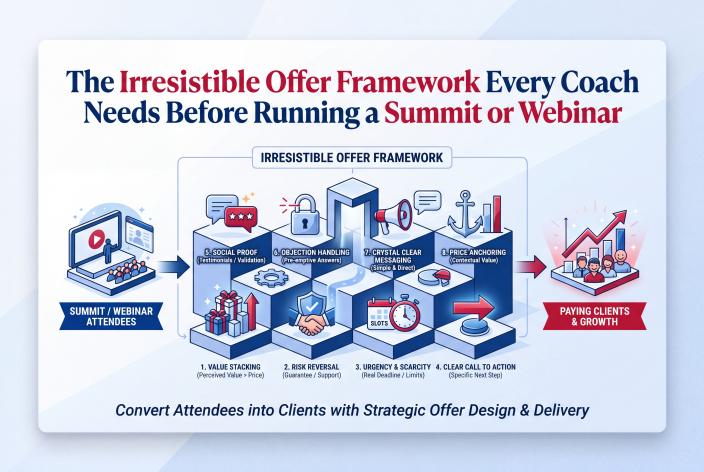
An irresistible offer has eight moving parts. Miss one, and you make the decision harder for your audience. Build them clearly, and the right next step becomes easier to understand.
Here's what goes into it:
- Value stacking that makes the price feel like a fraction of what they're getting
- Risk reversal that puts the weight on your shoulders, not theirs
- Urgency and scarcity that are genuine and move people to act now
- A clear call to action that tells them exactly what to do next
- Social proof that validates the decision they're about to make
- Objection handling baked directly into the offer structure
- Crystal clear messaging so an eighth grader could understand what you're selling
- Price anchoring that makes your real price feel like an obvious win
Let's dig into the ones that make the biggest difference.
How to Build a Value Stack That Makes the Price Feel Like a Steal
Value stacking is about adding more perceived value to your offer without significantly increasing your cost to deliver it.
Think about what you could include that costs you very little but solves a real problem for your buyer. Templates, worksheets, bonus training modules, access to a private community, a recorded masterclass. All of these can carry high perceived value while costing you almost nothing to deliver.
Here's the key most people miss. Your value stack should be strategic, not random.
Every bonus should do one of two things. It should either overcome a specific objection your prospect has, or it should help them get results faster once they buy.
For example, if someone is thinking, "I'd love to join this coaching program, but I don't even have my offer figured out yet," and you include a bonus called "The 60-Minute Offer Builder Workshop," you just eliminated their reason to wait.
If they're worried about the tech side of building funnels, and you include done-for-you templates or a tech setup walkthrough, that objection dissolves too.
The same logic applies whether you are selling a low-ticket workshop, a diagnostic, or a higher-touch coaching program. The stack should make the buyer feel clearer, more confident, and more supported.
| Value Stack Element | Purpose | Perceived Value |
|---|---|---|
| Core program or service | Delivers the main transformation | High |
| Bonus that removes the #1 objection | Eliminates "I'm not ready yet" | Medium to High |
| Quick-start guide or templates | Reduces overwhelm and speeds results | Medium |
| Community or group access | Provides accountability and belonging | Medium |
| Recorded training or masterclass | Adds expertise without your live time | Medium to High |
The total perceived value should be meaningfully higher than the price. When people can see that difference clearly, the decision becomes easier.
Risk Reversal Strategies That Actually Build Trust
Here's where most coaches default to "30-day money-back guarantee" and call it done. That can work for low-ticket digital products. For coaching programs, it can work against you.
Why? Because a money-back guarantee on a coaching program creates the wrong incentive. Someone can go through your entire program, consume all your intellectual property, decide they didn't feel like implementing, and ask for a refund. You've invested hours of your time and energy, and you're left with nothing.
One useful approach is support-based risk reversal.
Instead of promising an outcome you cannot fully control, define what kind of support, review, or fit protection you provide if the buyer gets stuck.
This shows confidence without pretending you can remove the buyer's responsibility. It also keeps the focus on fit, implementation, and honest support.
Price Anchoring That Makes Your Real Price an Obvious Decision
Price anchoring is a psychological principle where you present a higher reference point before revealing the actual price. It works because our brains evaluate numbers relative to other numbers, not in isolation.
There's a well-known study from a billiard table retailer. When salespeople showed the most expensive table first and worked down, total revenue increased dramatically compared to starting with the cheapest option and working up.
The same principle applies to your offer. When you present your value stack before you reveal the investment, people have a reference point for what they are actually receiving. The price is no longer floating in isolation.
You can also anchor against the cost of alternatives. What would it cost to hire a full marketing team? What would they spend on ads to generate the same number of leads a summit produces? What's the price of staying stuck for another six months?
When the alternative costs more in time, money, and frustration, your offer starts to look like the bargain it actually is.
Aligning Your Summit So It Pre-Sells the Offer Organically
This is where most summit hosts go wrong, and it's the part that ties everything together.
Your summit theme, your topics, and your speakers should all be chosen through one lens: preparing your audience to say yes to your offer.
That means your summit should address the problems that stop people from buying, not solve the problem your offer solves. Read that again. Your summit removes the blocks. Your offer delivers the transformation.
If you're selling a coaching program on building sales funnels, your summit topics might cover LinkedIn strategies, networking tactics, crafting your message, creating content, and overcoming imposter syndrome. Each session helps attendees realize they need systems in place. Each session makes them more ready and more eager to invest in the full solution.
By the time you present your offer, the audience has already experienced the value you bring. They've seen you facilitate incredible speakers. They've learned actionable strategies. And the natural next step, the obvious next step, is to work with you directly.
That alignment between summit content and offer is what separates summits that create real buying context from summits that only collect registrations.
Urgency and Scarcity That Are Genuine
Urgency and scarcity work. They're among the most powerful psychological triggers for getting people to act. But they must be real.
Fake countdown timers that reset when you refresh the page? People notice. And it destroys trust instantly.
Here are approaches that are both genuine and effective:
- Cohort-based deadlines. "The next group starts May 15th. Registration closes May 12th." Real date, real deadline.
- Early-bird pricing. "The first 10 clients get charter pricing. After that, the investment increases." And you actually increase it.
- Summit-exclusive bonuses. "If you're here live and you book a call today, you get this bonus that won't be available after the event." Then remove it.
- Capacity limits. "We only take 10 clients per quarter for our done-for-you program." When you hit 10, you close enrollment.
One practical use is pre-selling VIP tickets before the summit starts with a real price increase at a real deadline. That is different from a fake timer that resets when someone refreshes the page.
Putting It All Together
Before you plan your next summit or webinar, sit down and build your offer first. Start with the end in mind.
Ask yourself these questions:
- What transformation does my audience want?
- What stops them from committing to that transformation right now?
- How does my offer deliver the outcome they desire while busting through those blocks?
- What can I stack into the offer that removes every reason to say "not yet"?
- How am I reversing the risk so they feel safe investing?
- What genuine urgency can I create?
When you answer those questions honestly and build your offer around the answers, your summit becomes a conversion engine. Your webinar becomes a client-generating machine. And your sales conversations become a natural extension of the value you've already delivered.
Your Next Step
Building an irresistible offer takes thought, strategy, and an understanding of what your specific audience needs to hear before they'll invest. It's one of the most valuable things you can do for your coaching business, and it's also one of the hardest to do alone.
That's exactly the kind of thing we help coaches build every day. From crafting the offer to designing the summit that pre-sells it to setting up the entire funnel that nurtures and converts, we handle the execution so you can focus on what you do best: coaching.
If you want help mapping how your offer, summit, and follow-up system should work together, Book your Client Attraction Planning Call. We'll walk through your goals, look at where you are now, and identify what may need to change next.