You can run a beautiful summit.
You can invite great speakers, get people registered, send reminders, and deliver strong sessions.
But if your offer is unclear, weak, or disconnected from what your audience actually wants next, the whole thing feels frustrating.
It’s like throwing a dinner party with no food.
People may enjoy the conversation. They may even tell you it was valuable. But they won’t know what to do next.
And that’s where a lot of coaches lose the momentum they worked so hard to create.
The real opportunity is not just getting people to attend your summit or webinar. The opportunity is guiding the right people from interest, to trust, to a clear next step.
That takes an irresistible offer.
Not hype. Not pressure. Not a random discount.
A well-built offer that makes your best prospects think, “This is exactly what I need next.”
Let me walk you through how to build one.
Why qualified leads still do not convert
Here’s the uncomfortable truth.
A qualified lead can still say no if your offer does not feel obvious, valuable, timely, and safe.
That does not mean your coaching is bad.
It usually means the path from attention to decision is not clear enough yet.
Most coaching offers struggle for 5 common reasons:
- The promise is too broad.
- The next step feels too big.
- The value is hidden inside coaching language.
- The prospect does not understand why now matters.
- There is no trust-building bridge between free content and paid work.
This is especially important with summits and webinars.
A summit is powerful because it builds relationships, authority, and attention. But the summit itself should not carry the entire revenue burden.
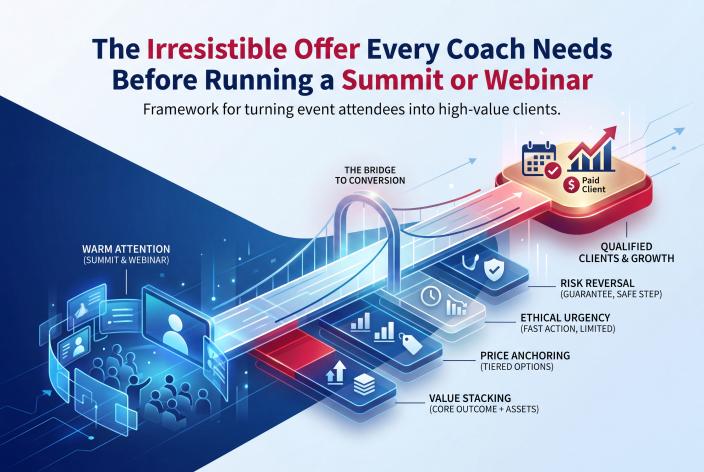
The stronger way to think about it is this: the summit creates warm attention, and the offer plus post-summit strategy turns that attention into action.
That is a huge distinction.
Your summit or webinar creates warm attention. Your offer turns that attention into action.
What makes a coaching offer irresistible
An irresistible offer is not just a lower price.
It is a clear, valuable, believable next step that matches the audience’s current level of trust and urgency.
For coaches, that usually means the offer does 4 things well:
- Names the specific problem your audience wants solved.
- Gives them a meaningful first win.
- Shows a clear path to a bigger transformation.
- Reduces the perceived risk of taking the next step.
Notice what is missing from that list?
Complicated funnels. Fancy branding. A giant audience.
Those things can help. But they do not rescue a vague offer.
If your audience is coming from a summit or webinar, they need a bridge. They have learned from you. They have heard your voice. They may trust you more than they did 45 minutes ago or 3 days ago.
But they still need to know what happens next.
That next step could be:
- A paid diagnostic session
- A private coaching intensive
- A short implementation sprint
- A group coaching program
- A workshop or masterclass
- A planning call for qualified prospects
- A lower-priced course that leads into deeper work
The exact format matters less than the clarity of the offer.
So let’s build it properly.
The value stacking framework for coaches
Value stacking means increasing the perceived value of the offer without simply adding more delivery burden to your calendar.
This matters because many coaches try to make an offer better by adding more calls.
More calls. More Voxer. More worksheets. More access. More time.
And suddenly, the offer becomes heavy to deliver.
A smarter value stack gives the client more confidence, clarity, speed, support, and usefulness, without forcing you to personally carry every piece.
Start with the core outcome
Before you add bonuses, define the main transformation.
Ask yourself:
- What problem is this offer designed to solve?
- What result should the client be closer to after completing it?
- What kind of person is ready for this offer now?
- What does this prepare them to do next?
For example, a business coach running a summit for consultants might offer a “Client Attraction Blueprint Session” that helps attendees diagnose their positioning, offer, lead flow, and follow-up gaps.
That is specific.
It does not promise to fix the entire business in one call. It promises a useful, relevant next step.
Add assets that create speed and confidence
Here’s a simple value stack you can adapt.
| Offer element | What it does | Coach example |
|---|---|---|
| Core session or program | Delivers the main transformation | 90-minute strategy session or 6-week coaching sprint |
| Quick win resource | Helps them make progress fast | “7-Day Message Clarity Checklist” |
| Implementation template | Reduces friction | Outreach script, weekly planning board, meal plan, money tracking sheet |
| Assessment or audit | Creates diagnosis | Funnel review, health habit scorecard, leadership style assessment |
| Bonus training | Adds depth without adding live time | Recorded masterclass or mini-course |
| Follow-up touchpoint | Increases completion and trust | 14-day check-in, email review, or implementation review |
| Next-step map | Shows the longer journey | Personalized roadmap or client attraction plan |
The key is alignment.
Every item should help your audience move toward the result they already want.
If you are running a summit, this is similar to how strong summit offers are built. A common all-access pass structure includes on-demand session access, a quick-win solution, speaker bonuses, audio files, and sometimes a specialty item that makes the top tier more appealing.
That is not random stuffing.
It is a stack of useful assets around one audience problem.
Use price anchoring without being weird about it
Price anchoring helps your audience understand value.
When someone sees only one price, they evaluate it in isolation. When they see multiple options, they compare.
That comparison can help them choose the offer that fits them best.
In summit offers, one tested strategy is using tiers. For example:
- A lower-priced tier
- A higher-value tier
- A third “decoy” tier that makes the better option easier to choose
A decoy tier does not necessarily increase the number of buyers, but it can help serious buyers recognize the higher-value option.
Another tested approach is an anchor tier.
For example, a summit offer might include a starter replay tier, a workshop tier, and a premium diagnostic tier. The highest tier will usually attract fewer buyers, but it gives serious buyers a more appropriate next step.
That is the power of giving serious buyers a serious option.
For a coach, this could look like:
| Tier | Example | Best for |
|---|---|---|
| Starter | $47 to $97 resource or replay bundle | People who want to learn more |
| Core | $197 to $497 workshop, diagnostic, or implementation kit | Warm prospects who want guided progress |
| Premium | $700+ intensive, VIP day, private session bundle, or application-based coaching path | Serious buyers who want direct help |
You do not need to copy those numbers exactly.
Your pricing should match your audience, promise, niche, and delivery model.
But you do want to give the right people a way to raise their hand.
Because some people are ready for more.
And if you only offer a small thing, they may assume that is all you can help them with.
Build urgency that respects the relationship
Urgency works when it is real.
It damages trust when it feels manufactured.
That is especially true for coaches, because your reputation is personal. People are buying your judgment, your guidance, and your care.
So your urgency needs to be grounded in something honest.
Here are ethical urgency options that work well around summits and webinars:
- Fast-action bonus: Available to the first 10 buyers or to those who act by the end of the day.
- Diminishing bonuses: 3 bonuses are available at first, then 1 disappears each day.
- Early-bird pricing: A lower price before the summit or webinar begins.
- Live-event pricing: A special price available during the event window.
- Offer close: The offer ends on a specific date because delivery, onboarding, or access begins.
- Limited implementation spots: Used when your capacity is genuinely limited.
A simple warning here.
Do not stack so much scarcity on people that they feel pushed around.
If you hit your summit audience with too much urgency and scarcity during the summit, you can drive some of them away.
That is not what you want.
The goal is not to squeeze people. The goal is to help ready people act while the value is fresh and the timing makes sense.
Risk reversal that builds trust
Risk reversal answers the quiet question in your prospect’s mind.
“What if this is not right for me?”
Good risk reversal does not mean you remove all responsibility from the buyer. It means you reduce unnecessary fear.
There are several ways coaches can do this:
- A clear satisfaction guarantee
- A first-session guarantee
- A “complete the work and get support” promise
- A conditional refund policy
- A diagnostic before full enrollment
- An application process to protect fit
- A low-cost paid consultation before a high-ticket offer
One real example from the summit training world is a “First Day Money Back Guarantee” used for a workshop. If attendees did not get the value of the workshop on the first day, they could request a refund before the end of the workshop and still finish the rest of the workshop.
That kind of guarantee works because it is specific.
It tells the buyer when to evaluate. It tells them how to act. And it shows confidence in the experience.
For coaches, risk reversal could sound like:
- “If after our first session you do not feel this is the right fit, tell me before we schedule session 2 and I’ll refund your payment.”
- “If you complete the pre-work and do not leave the intensive with a clear action plan, I’ll add a follow-up implementation review at no extra cost.”
- “If your application shows this is not the right next step, I’ll tell you directly and point you toward a better path.”
That last one is underrated.
Sometimes the strongest trust builder is honest qualification.
You do not want tire-kickers. But you also do not want good prospects hesitating because the next step feels risky or vague.
A good guarantee says, “You are safe to take the next step if this is truly a fit.”
The post-summit offer is where many coaches leave money behind
Many coaches think the offer has to happen only during the event.
But your best conversions often come after the trust has had a little time to settle.
One useful summit strategy is to invite the new audience into a webinar or masterclass shortly after the summit ends. The timing often works well when attendees have finished the event but the engagement has not gone cold.
From there, the path can be simple:
- Deliver a valuable masterclass.
- Invite the right people into a consultation, diagnostic, or strategy session.
- Use that conversation to understand fit.
- Offer the deeper coaching program when it is appropriate.
- Give a smaller next step for people who are interested but not ready for the main offer.
In some summit models, the consultation is paid at $97 or $197 to filter out tire-kickers before offering a higher-ticket program.
For your business, the call might be free, paid, or application-based.
The principle is the same.
Do not leave warm attendees wandering around after the event wondering what to do next.
Give them a clear bridge.
3 real offer structures you can model
Here are 3 practical structures adapted for coaches.
1. The quick-win summit offer
This is your starter offer during the summit or webinar.
It might include:
- Replay access
- A quick-win training
- Speaker or expert bonuses
- Templates or worksheets
- Audio versions
- A special bonus for the top tier
This works well because attendees are already consuming content and want continued access.
A strong all-access pass can help offset event costs and identify the attendees who are most engaged, depending on the audience, traffic, pricing, and offer quality.
2. The anchored premium tier
This gives serious buyers a bigger option.
Example for a coach:
- $47 replay and resource bundle
- $197 implementation workshop
- $700 VIP diagnostic and workshop bundle
The premium tier should be genuinely valuable. A high anchor tier needs to feel meaningfully stronger than the lower options, or it will look like decoration.
This can also help frame your post-summit coaching offer, because buyers begin to see the value of deeper support.
3. The post-event consultation path
This is where many coaches should pay close attention.
Your summit or webinar warms the audience. Your masterclass deepens trust. Your consultation or planning call creates the bridge into your main coaching offer.
For example:
- Summit topic: “How Women Executives Can Stop Burning Out Without Stepping Back From Leadership”
- Post-summit masterclass: “The 5-Part Sustainable Leadership Reset”
- Call invitation: “Apply for a Leadership Reset Strategy Session”
- Main offer: 12-week executive coaching program
- Downsell: 2-hour leadership planning intensive
See how each step makes sense?
That is what you want.
No random offers. No awkward pitch. Just a natural path.
Your irresistible offer checklist
Before you run your next summit or webinar, review your offer against this checklist.
Your offer should answer:
- Who is this specifically for?
- What problem does it help them solve?
- What result or first win can they expect?
- Why is this the right next step after the event?
- What is included in the value stack?
- What makes the value feel greater than the price?
- What risk reversal helps them feel safe?
- What urgency is honest and appropriate?
- What happens if they are interested but not ready for the main offer?
- What follow-up sequence continues the relationship after the event?
That last question matters.
Because the money is rarely only in the registration.
It is in the follow-up, the trust, the timing, and the path you build after someone raises their hand.
The offer is only one part of the system
An irresistible offer is powerful.
But it works best inside a complete client attraction system.
That means your summit or webinar needs:
- A strong authority-building topic
- The right audience and partners
- Registration and reminder sequences
- Clear event communication
- A compelling offer
- CRM tracking
- Email and SMS follow-up
- Calendar and application flow
- Post-event nurture
- A sales conversation that matches the promise
This is where a lot of coaches get stuck.
They understand the idea. They can see the strategy. But building the whole path while also serving clients is a lot to carry.
That is exactly why we help coaches build these systems with done-for-you implementation.
At VirtualSummits.com, EventRaptor, and CRMRaptor, we look at the whole journey: authority, visibility, offer, funnel, CRM, follow-up, and booked conversations.
Because a summit without a conversion path creates attention.
A summit with the right offer and follow-up can become a real pipeline asset.
Ready to map your offer into a client attraction system?
If your coaching works but your client flow is still inconsistent, your next step may not be more content or another disconnected tool.
It may be a clearer offer and a better path from visibility to trust to qualified conversations.
That is what we can help you map out when you Book your Client Attraction Planning Call.
On the call, we’ll look at where you are now, what you are trying to sell, how your audience currently finds you, and what kind of summit, webinar, funnel, CRM, and follow-up system could make sense for your business.
No hype. No pressure.
Just a practical conversation about what your client attraction system should look like next.