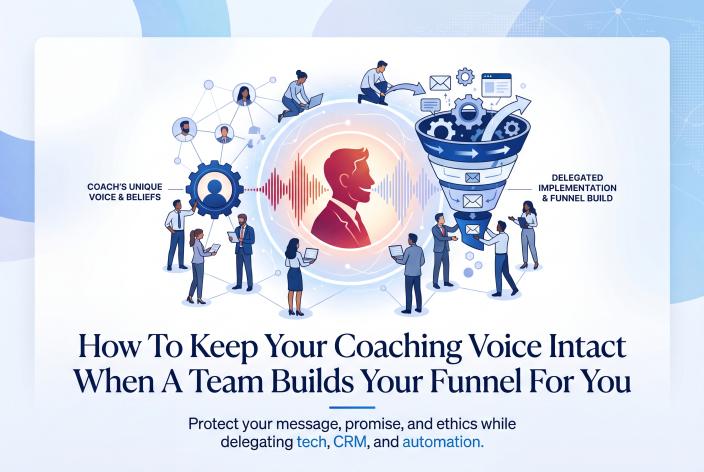
You want help building the funnel.
You want the pages, emails, reminders, CRM, booking flow, event setup, and follow-up to finally work together.
But there’s a quiet fear underneath it all.
What if the team builds something that doesn’t sound like you?
What if your brand starts to feel generic? What if the copy gets too aggressive? What if the automation makes people feel handled instead of helped?
That fear is reasonable.
For a coach, your voice is not decoration. It’s part of the client experience. It carries your beliefs, your standards, your way of seeing the problem, and the way prospects decide whether they trust you.
So the goal is not to hand your voice over to a team and hope they “get it.”
The goal is to keep the right things in your control while delegating the parts that should not be living in your head every week.
Let me explain.
Your Voice Is More Than Your Writing Style
When coaches talk about “voice,” they often mean tone.
Warm. Direct. Gentle. Bold. Spiritual. Clinical. Strategic. Playful.
That matters, of course.
But your real coaching voice goes deeper than word choice. It includes:
- What you believe about your clients
- How you frame the problem they’re facing
- What you will and won’t promise
- How you want prospects to feel before a sales call
- What kind of urgency feels ethical to you
- How you explain transformation without overhyping it
- How you handle hesitation, timing, and objections
That’s why done-for-you support can feel risky.
A team can build a page. They can write emails. They can connect a CRM. They can set up reminders, tags, forms, calendars, event pages, and follow-up workflows.
But if they build all of that without understanding your beliefs, the whole thing can feel like someone else wearing your clothes.
And your prospects can sense that.
What Should Stay In Your Control
You do not need to approve every button color or tinker with every automation trigger.
But there are several pieces you should never fully outsource without direction.
These are the voice-and-values decisions that shape the whole funnel.
Your Core Message
Your message is the plain-language reason your work matters to your audience.
It answers questions like:
- Who do you help?
- What are they struggling with?
- What do they want instead?
- Why does your approach make sense for them?
- What do they need to understand before they are ready to work with you?
A team can help sharpen this.
They can help make it clearer, more specific, and easier for prospects to respond to.
But the raw truth should come from you. You know the conversations. You know the client language. You know the moments when someone finally says, “That’s exactly what I’ve been trying to say.”
Protect that.
Your Beliefs About The Problem
Good funnel copy is not just a list of benefits.
It carries a point of view.
For example, if you’re a health coach, do you believe your clients need more discipline, or do they need a better relationship with their body? If you’re a leadership coach, do you believe executives need more productivity tricks, or do they need cleaner decision-making under pressure?
Those beliefs change everything.
They change the headline. They change the emails. They change the sales page. They change the pre-call education.
Your team needs access to those beliefs before they build the funnel.
Your Client Promise
Your promise should be clear, grounded, and true.
This is where many coaches get nervous, and for good reason. You do not want copy that makes income claims, health claims, relationship claims, or life-change claims that go beyond what you can responsibly stand behind.
So define your promise before implementation begins.
A useful version sounds like this:
- “I help this specific person move toward this specific outcome through this specific kind of work.”
Then define the boundaries.
What can you confidently say? What needs softer language? What should never be implied?
A good implementation team should welcome that clarity. It makes the funnel stronger.
Your Sales Ethics
Every coach has a line.
Some are comfortable with limited-time bonuses. Some are not. Some use application forms. Some prefer simple booking flows. Some use direct invitation emails. Some want a slower nurture path.
There is no single ethical style that fits every coaching business.
But there should be a clear standard.
Before your team writes follow-up emails or builds sales workflows, tell them:
- What urgency is acceptable
- What pressure tactics are off-limits
- How you want to talk about price
- How you want to handle “not ready yet” prospects
- What kind of sales call experience you want people to have
This is how your funnel becomes an extension of your coaching, not a separate personality bolted onto your business.
What You Can Safely Delegate
Now let’s talk about the other side.
Because if you keep everything in your control, you don’t have a team. You have a group of people waiting for you to make every small decision.
That’s exhausting.
And it defeats the purpose of hiring help.
Here are the pieces a skilled implementation team can usually own once the strategy and voice are clear.
| Area | What You Guide | What The Team Can Build |
|---|---|---|
| Messaging | Audience, beliefs, promise, boundaries | Page structure, copy drafts, email drafts, call-to-action flow |
| Funnel | Offer path and sales process | Landing pages, thank-you pages, booking paths, tracking, testing |
| CRM | How prospects should be categorized | Tags, contact records, custom fields, workflows, calendar connections |
| Follow-Up | Tone, timing preferences, sales ethics | Email and SMS sequences, reminders, nurture campaigns, reactivation paths |
| Events | Topic, audience, speaker fit, purpose | Registration pages, speaker coordination, schedules, reminders, attendee data |
EventRaptor is built around this kind of practical delegation for virtual events. It can support registration pages, attendee dashboards, speaker profiles, event schedules, reminder emails, promoter tracking, registrant management, CRM sync, and follow-up workflows. That means the event does not have to live across spreadsheets, inboxes, page builders, and memory.
GHL/CRMRaptor can support the CRM, funnel, calendar, workflow, automation, and follow-up side around that event or campaign.
Together, the idea is simple.
Your voice guides the experience. The system carries it consistently.
Why Automation Does Not Have To Feel Cold
Many coaches hear “automation” and picture robotic emails, fake personalization, and pushy reminders.
That can happen.
But good automation is really about timely care.
Someone registers for your workshop and gets the right confirmation.
Someone books a call and receives helpful preparation.
Someone attends your summit and gets a thoughtful next step while the conversation is still fresh.
Someone isn’t ready now, so they continue receiving useful education instead of being forgotten.
That is not cold. That is respectful.
The problem starts when automation is written without empathy, strategy, or voice. The fix is to build it from your actual client journey.
Ask:
- What does this person need to know right now?
- What might they be worried about?
- What would I say if I were following up personally?
- What is the cleanest next step if they are ready?
- What is the most respectful next step if they are not?
Those answers give your team the raw material they need.
A Simple Brand Voice Handoff Process
You do not need a 40-page brand bible to protect your voice.
You need a practical handoff your team can actually use.
Here is a simple process.
Step 1 Capture Your Natural Language
Start by collecting real examples.
Pull from:
- Sales call notes
- Client emails
- Podcast interviews
- Webinar transcripts
- Social posts that sounded like you
- Voice memos about your offer
- Client questions you answer often
You’re looking for the phrases you use naturally.
The messy ones are often the best ones.
Step 2 Define Your Voice Boundaries
Make 2 lists.
First, list what should be true about your tone:
- Calm and grounded
- Direct but not harsh
- Warm but not fluffy
- Practical and specific
- Encouraging without overpromising
Then list what should never show up:
- Fake scarcity
- Shame-based selling
- Big income promises
- Overly spiritual language
- Corporate jargon
- Aggressive objection handling
This gives your team guardrails.
And guardrails make creative work faster.
Step 3 Explain Your Core Beliefs
Write 5 to 10 belief statements your funnel should carry.
For example:
- “People do better when they feel understood before they feel challenged.”
- “The right client does not need to be pressured into a clear next step.”
- “Follow-up should feel like service, not chasing.”
- “A sales call should help both sides decide whether there is fit.”
These beliefs become filters for every page, email, reminder, and call invitation.
Step 4 Map The Client Journey In Plain English
Before your team builds the funnel, map the journey.
Keep it simple:
- How does someone first become aware of you?
- What do they opt in for?
- What do they learn before they are invited to a call?
- What qualifies them as a better-fit prospect?
- What happens if they book?
- What happens if they do not book?
- What happens after the event, workshop, summit, or webinar ends?
This matters because a funnel is the whole journey from attention to trust to conversation.
The page is only one piece.
Step 5 Review For Voice Before You Review For Perfection
When your team sends copy or funnel assets, do not start by wordsmithing every sentence.
First ask:
- Does this sound like our point of view?
- Would my best clients recognize me in this?
- Is the promise accurate?
- Does the follow-up feel respectful?
- Is the next step clear?
Once those are right, then polish.
If you start with tiny edits, you may miss the bigger issue.
The Best Team Does Not Remove You From The Process
Done-for-you should not mean “disappear and hope.”
A strong team still needs your insight.
They need your stories, beliefs, client language, offer details, and decisions. They need to know what feels right and what feels off. They need your feedback when the first version is close but not quite there.
But they should not need you to become the project manager, copywriter, funnel builder, CRM technician, event coordinator, and automation specialist all at once.
That is the line.
You stay in control of the soul of the business.
The team helps build the structure that carries it.
How This Applies To Summits, Webinars, And Funnels
If you run a virtual summit, workshop, webinar, or speaker-led campaign, voice protection matters even more.
There are more touchpoints:
- Speaker invitations
- Registration pages
- Confirmation emails
- Reminder emails
- Attendee dashboards
- Session descriptions
- VIP messages
- Follow-up emails
- Sales call invitations
- Partner swipe copy
Each touchpoint teaches people how to experience your brand.
EventRaptor can help organize many of the event pieces, including speaker workflows, session details, registration, pages, schedules, attendee data, email communication, promoter tracking, and reporting. GHL/CRMRaptor can support the CRM and follow-up path that helps keep the relationship moving after the campaign.
But the system still needs your voice at the center.
That is what keeps the event from feeling like a random list-building activity.
It becomes an authority-building experience that helps the right people know, trust, and remember you.
A Quick Voice Protection Checklist
Before a team builds your funnel, answer these questions:
- Who exactly are we trying to attract?
- What do they need to believe before they book a call?
- What promise can I stand behind?
- What claims should we avoid?
- What tone should the funnel carry?
- What sales tactics are off-limits?
- What should happen when someone is interested but not ready?
- What parts of the journey can the team build without waiting on me?
- Where do I need review rights before anything goes live?
If you can answer those clearly, you can delegate with much more confidence.
You do not have to choose between keeping your voice and getting help.
You need the right handoff, the right guardrails, and the right implementation path.
The Calm Next Step
If your coaching works but your client flow still depends too much on referrals, manual follow-up, social posting, or occasional launches, this may be the stage where real infrastructure makes sense.
And if you’re worried that getting help will make your marketing feel less like you, that is exactly the kind of thing to talk through before anything gets built.
If you want help applying this to your coaching business, Book your Client Attraction Planning Call.
On the call, we can look at where your current client attraction system is getting stuck, what needs to stay in your control, and what kind of funnel, CRM, event, follow-up, or done-for-you implementation support could make sense next.