Most coaches finish a summit exhausted. They send one replay email, take a few days off and move on. A month later the recordings are sitting in a folder and the new subscribers have gone cold.
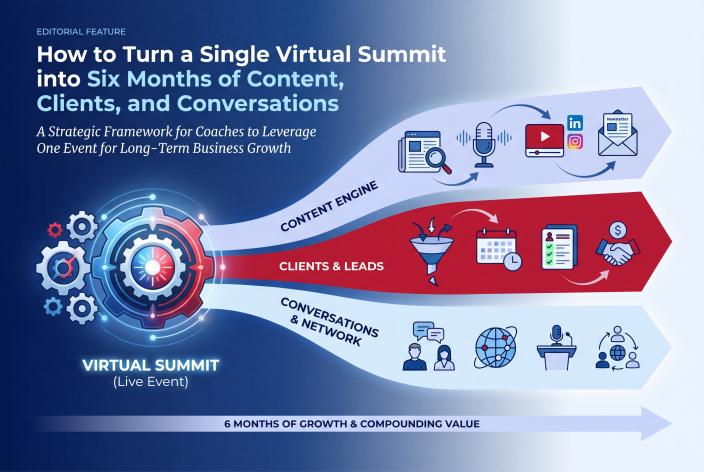
You can turn one virtual summit into six months of content, clients and conversations by deciding how you'll reuse it before anyone records. After the event, you work a simple schedule. Follow up with registrants in the first two weeks, offer every speaker a call in the first month, then release the recordings as podcast episodes, clips, articles and a lead magnet over the months that follow.
This is for coaches, therapists and healing practitioners, and anyone running an expert-led service business who has run a summit or is planning one. You're good at your work. What you don't want is a big event that gives you two busy weeks and then goes quiet.
Key Takeaways
- Put reuse rights in your speaker agreement before anyone records, so you can turn sessions into podcast episodes, clips and articles without awkward emails later.
- Within two weeks of the summit, send registrants a thank-you, the replays and a clear invitation to your offer, while they still remember you.
- Email every speaker after the event and offer a short call about working together, because those relationships often outlast the list.
- Release the recordings on a six-month schedule, one or two pieces a week, and point each one at a lead magnet or a booked call.
- Tag registrants in your CRM by what they did (attended, bought VIP, came in through a promoter) so your follow-up fits where each person is.
Why a Summit Keeps Paying After the Last Session
The first two weeks after a summit get all the attention. Over time, though, most of the money shows up later.
When Jennie and I ran Own Your Stage in February 2022, the first summit we ran on EventRaptor, it added 466 new people to our list. It brought in more than $24,000 in sales within two weeks of the event. By February 2024, that one summit had passed $50,000 in sales, because new registrants kept buying.
I've had the opposite experience too. At one summit I was too worn out to put a proper offer together. It added 476 new people to our list and made only about $1,800 during the event. Those people will keep buying from us for years, though, so I still count it as a success. Across all our summits, people who joined through a summit have gone on to buy more than $250,000 from us. These are our own results, and they don't predict what your summit will do.
So think of your summit as two things that keep working after the event. You get a library of expert teaching you own, and you get a group of peers who now know and like you. If you treat it only as a list-building exercise, you'll use about a tenth of what you built.
Set Up the Reuse Before You Record
The six months start before the summit, with three small decisions.
- Get permission in writing. Your speaker agreement should say how you can use the recordings after the event: replays, a paid archive, audio episodes, short clips, written articles. Speakers sign agreements inside EventRaptor, and you can see who has signed and who hasn't, so you don't end up chasing PDFs by email.
- Record intros that stand on their own. Chandler Bolt did this well. He never opened an interview with "Welcome to day one." He just introduced himself and his guest. That meant he could add a short bumper later and release every summit interview as an episode of the Self-Publishing School podcast.
- Ask one good registration question. A single question about what people are struggling with gives you a way to sort your follow-up later, and it tells you which sessions to repurpose first.
If you want the full list of formats, here's a closer look at what to do with your summit recordings after the live event.
The First Two Weeks Belong to Your Registrants
Interest fades fast. Ivy Slater put it bluntly on the podcast: most people fall off on follow-up. They write the email sequence, send it, and two months later nothing else has gone out.
Here's a plain sequence for the first 14 days, with a day-by-day follow-up plan by attendee segment if you want more detail:
- Day 1. Thank everyone and send the replay links, with a note about when the free replays come down.
- Days 2 to 5. Send one email that picks out the most useful idea from each day of the summit, written in your own voice.
- Days 5 to 10. Invite people to your next step. That could be a workshop, a group program or a call. It works best when you decided on your main offer and the bridge to it before the summit started.
- Days 10 to 14. Send one last reminder about the offer, then move everyone onto a regular weekly email.
In my experience, a good follow-up process might turn 10 to 15% of registrants into clients. That's my experience, not a promise. Without one, plenty of hosts add hundreds of people to their list and sign almost nobody.
Turn Your Speakers Into a Referral Network
Your speakers are the part of the summit people forget to follow up with. That's a shame, because a speaker who enjoyed your event already trusts you.
Natalie Luneva described what she does after her events. She emails each speaker to say thank you, sends their recording so they can share it, and asks if they'd like to talk about working together since they serve the same audience. She said almost every one, about 9 out of 10, agreed to a call.
Ivy Slater adds something simple: send a personal thank-you note. It's good manners, and people remember it.
On those calls, keep it practical. You could:
- swap guest spots on each other's podcasts or email lists
- run a joint workshop for both audiences
- agree to refer clients who'd be a better fit for the other person
- invite them back to speak at your next event
Your promoter report tells you who to call first. It shows which speakers brought in registrants, and those people already proved they'll show up for you.
Months Two to Six, Release the Recordings on a Schedule
Navid Moazzez has said that a typical summit with 20 to 30 sessions can give you enough content for a year or two. You don't need that much. Six months of steady releases is plenty, and it fits around client work.
| Month | Main focus | What goes out |
|---|---|---|
| 1 | Registrants and speakers | Replay emails, offer invitation, speaker thank-yous and calls |
| 2 | Audio and articles | One session a week as a podcast episode, one article written from a transcript |
| 3 | Short clips | Two or three clips a week from your strongest sessions, each linking to an opt-in |
| 4 | Lead magnet | A "best of" replay bundle of three or four sessions behind an opt-in page |
| 5 | A smaller live event | A workshop or one-day summit with a few favorite speakers |
| 6 | Review | Which pieces led to calls, and what the next summit should be |
Every piece should point somewhere. Clips and articles point to the lead magnet. The lead magnet leads into an email sequence. The sequence invites people to a call.
Month five is worth a second look. A smaller event with speakers you already know takes much less work than the first one did, and it puts you back in front of your audience, which is much of why hosting a summit pays off. If you're deciding what size it should be, this comparison of one-day and multi-day summits will help. To fit all of this around a full client load, build it into a campaign calendar that holds up when client work gets busy.
What EventRaptor and Our Team Take Off Your Plate
Most of the six-month plan depends on clean data and a few emails going out on time, and that's work you shouldn't have to do by hand.
On EventRaptor, registrants sync to GHL/CRMRaptor with tags for things like VIP status and which promoter sent them, so your follow-up can start the day the summit ends. Reminder and follow-up emails run on the event's timing. Speaker agreements, applications and session details live in one place, so the permissions you need for repurposing are already on file.
If you'd rather not run any of it yourself, our done-for-you team can produce the whole summit. We write session descriptions and speaker introductions, set up the pages and handle the tech, and your job is to teach, host and make your offer. We've run 13 summits of our own and over 40 summits for clients.
Live sessions run on Zoom. Video hosting is available through CRMRaptor, EventRaptor's GoHighLevel solution, so your session recordings and replays don't need a separate video host. EventRaptor also has video view analytics, so you can see how your session and replay videos are viewed. Use that alongside the calls each piece books to judge your repurposed content.
A Note for Therapists and Healing Practitioners
This plan works for private practice too, with a few adjustments. Label repurposed clips and articles as general education, and never present them as therapy. Don't use stories or testimonials from therapy clients in any of it. Check your licensing board's advertising rules before you publish, especially for clips and lead magnets. You'll probably get the most out of the speaker calls, because other practitioners who spoke at your summit are the people most likely to refer to you.
Frequently Asked Questions
How Long Can I Keep Using My Summit Recordings?
As long as your speaker agreement allows and the content stays accurate. Navid Moazzez has said a summit's content can last a year or two. Sessions on lasting topics hold up longest, and anything tied to a date or a trend wears out sooner.
Do I Need Speaker Permission to Repurpose Their Sessions?
Yes. Write it into the speaker agreement before you record, and list the formats you plan to use, such as podcast episodes, clips, articles or a paid archive. Asking afterwards is awkward, and some speakers may say no.
What Should I Do First When My Summit Ends?
Thank registrants, send the replays and make a clear offer within the first few days. In the same week, email every speaker with their recording and offer a short call. Everything else on the six-month plan can wait until those two things are done.
Can a Small Summit Still Feed Six Months of Content?
Yes. Even a one-day event with a handful of speakers gives you several hours of teaching to cut into episodes, clips and articles. How much you get out of it depends more on the follow-up schedule than on the number of sessions.
Should I Sell Access to the Recordings?
A paid VIP or all-access pass is a common way to do it, and it gives buyers a reason to act during the event. At Own Your Stage, Jennie and I sold 109 VIP tickets at $47. You can sell the archive for a while and later turn a few of the sessions into a free lead magnet.
Your Next Step
Before you plan anything else, open your calendar and block out the six months after your next summit. Write down what goes out in weeks one to four, and name the five speakers you'll call first. Once that's on paper, the rest of the plan has somewhere to go.
If you'd like help mapping that schedule around your offer and the speakers you have in mind, Book your Client Attraction Planning Call. We'll look at how your summit can keep bringing in conversations long after the last session ends.