You have a lead magnet. You have a landing page. You might even have a few emails that go out after someone opts in.
And yet your calendar looks like a ghost town on a Tuesday morning.
So what's going on? You did the things. You followed the advice. You built "a funnel."
Here's the truth. Having a funnel and having a funnel that books qualified calls are two very different things. Most coaching funnels collect email addresses. The good ones turn strangers into people who show up on your calendar ready to talk about working with you.
Let's look at where yours is probably breaking down and what a funnel engineered for coaching client acquisition actually looks like.
A Lead Collector Is Not a Client Acquisition System
Most coaches build what I call a "lead collector." It captures a name and an email. Maybe it delivers a PDF. And then... silence. Or worse, a generic welcome email that reads like it was written by a committee.
A lead collector gives you a number on a spreadsheet. A client acquisition funnel gives you booked calls with people who already understand what you do, believe you can help them, and are genuinely considering investing.
The difference comes down to what happens after someone raises their hand. Every step between "I'm curious" and "I'm ready to talk" is either pulling that person closer or quietly losing them.
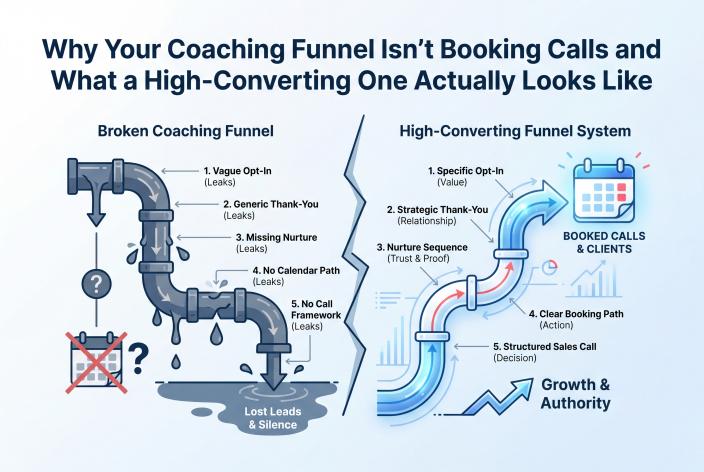
And most coaching funnels have five specific places where that pull turns into a leak.
The Five Places Your Funnel Is Leaking
1. Your Opt-In Page Speaks to Everyone and Resonates with No One
If your opt-in page headline could apply to any coach in any niche, you have a targeting problem. "Unlock Your Full Potential" sounds inspiring. It also says absolutely nothing specific to the person reading it.
Your opt-in page needs to speak directly to one person with one problem. When a health coach writes "The 5-Minute Morning Protocol That Helped ,,Burned-Out Executives Finally Sleep Through the Night," that's a page that stops the scroll. It names the audience. It names the pain. It promises a specific outcome.
Vague headlines attract vague leads. Specific headlines attract people who see themselves in the words and think, "That's exactly what I'm dealing with."
2. Your Thank-You Page Does Almost Nothing
This is one of the biggest missed opportunities in coaching funnels. Someone just opted in. They just took an action. They're engaged, curious, and paying attention right now.
And what do most thank-you pages say? "Thanks! Check your inbox."
That's like someone walking into your office, sitting down, and you saying, "Great, I'll email you sometime."
Your thank-you page is prime real estate. Here's what it should do:
- Confirm and reinforce. Tell them what they're getting and why it matters.
- Introduce you. A short video (even 60 seconds) where you welcome them, share a quick insight, and let them see the real you. This starts the know, like, and trust process immediately.
- Present the next step. Invite them to book a planning call, apply for a qualified conversation, or choose a low-cost VIP resource. They just said yes once. Give them a useful next step while the topic is fresh.
A simple calendar link or application path on the thank-you page can make a real difference because that page usually catches people at their highest moment of interest. Without a next step, that attention leaks away.
3. Your Nurture Sequence Is Missing, Generic, or Way Too Short
Here's where most coaching funnels completely fall apart.
Someone opts in. They get the lead magnet delivery email. Maybe a second email a day later. And then they're dumped into a weekly newsletter that talks about whatever you felt like writing that week.
That's not nurturing. That's hoping.
A real nurture sequence has a job. It moves someone from "I just downloaded a thing" to "I need to talk to this person." And it does that in a deliberate order:
- Deliver value and establish credibility. Your first two emails should make them glad they opted in. Share an insight they can use today. Something that gets a quick result.
- Name their pain with precision. Show them you understand exactly what they're going through. Use the language they use. When they read it and think, "It's like you're reading my mind," you've done your job.
- Share proof and possibility. A client story, a case study, a specific result. Let someone else's transformation do the persuading.
- Address the objections they haven't said out loud. They're thinking, "Can I afford this? Will it work for me? Is now the right time?" Your emails should answer those questions before they ever get on a call with you.
- Invite them to a conversation. By email four, five, or six, you've earned the right to say, "If this resonates, let's talk." And by then, the people who book are pre-sold. They're not tire-kickers. They're ready.
Six to ten emails over two to three weeks. That's the window. If your sequence is three emails and done, you're leaving money and clients on the table.
4. There's No Clear Path to the Calendar
You'd be surprised how many coaching funnels bury the booking link. It's in a footer somewhere. Or it shows up once in one email and never again.
Every touchpoint in your funnel should have a clear, low-friction way to book a call. That calendar link belongs:
- On your thank-you page
- In your email signature
- As a call to action in at least three of your nurture emails
- On your event or content pages
You're not being pushy by making it easy to talk to you. You're being helpful. People need to be reminded that the option exists. Remember, they're busy. They're juggling a dozen tabs and a full inbox. If the link isn't right there when they're feeling motivated, the moment passes.
5. Your Sales Call Has No Framework
This one sits at the very end of the funnel, but it determines whether everything upstream was worth the effort.
If your sales calls feel like awkward conversations where you're not sure when to bring up your offer, you need a framework. A clear structure can guide the conversation naturally from understanding their situation to presenting your solution.
A strong sales call framework does a few things:
- It qualifies early. You confirm they're the right fit within the first few minutes so neither of you wastes time.
- It uncovers the real problem. Not the surface-level answer they give first, but the deeper challenge that's actually keeping them stuck.
- It lets them sell themselves. When you ask the right questions, prospects articulate why they need help. They hear it in their own voice. That's far more powerful than you telling them why they need you.
- It presents the offer as the logical next step. When the conversation flows correctly, your coaching program feels like the obvious answer to everything they just described. There's no pressure. There's just alignment.
The funnel gets them to the call. The framework helps the call become a real decision conversation instead of a rambling consultation.
What Automation Handles So You Don't Have To
Here's the part that changes your quality of life.
Once your funnel is built correctly, automation handles the repetitive work that used to eat your mornings:
- Lead magnet delivery goes out instantly, no matter what time someone opts in.
- Nurture emails fire in sequence, on schedule, personalized with their name and relevant to their situation.
- Calendar booking syncs with your availability and sends confirmation plus reminders automatically.
- No-show follow-up reaches out to people who booked but didn't appear, giving them an easy way to reschedule.
- Post-call sequences continue nurturing leads who weren't ready yet, keeping you top of mind until they are.
You set it up once. It runs 24/7. While you're coaching clients, while you're at dinner, while you're sleeping. The system is doing the work that used to require you refreshing your inbox and manually following up with every single person.
That's the real power of a well-built coaching funnel. It removes you from the parts of the process that don't require your expertise, so you can focus entirely on the parts that do: showing up on calls and serving your clients.
The Funnel Map at a Glance
Here's what the complete flow looks like:
| Stage | What Happens | Goal |
|---|---|---|
| Opt-In Page | Specific headline, clear promise, simple form | Capture the right lead |
| Thank-You Page | Welcome video, reinforce value, calendar link or VIP offer | Start relationship and book first calls |
| Nurture Sequence | 6 to 10 emails over 2 to 3 weeks | Move leads from curious to calendar-ready |
| Booking Page | Calendar with clear expectations for the call | Remove friction and increase show-up rates |
| Discovery Call | Structured framework that qualifies and presents your offer | Convert prospects into clients |
| Post-Call Follow-Up | Automated sequences for both buyers and not-yet-ready leads | Maximize lifetime value of every lead |
Every stage has a specific job. When each one does its job well, the whole system compounds. More of the right people opt in. More of them engage with your emails. More of them book calls. And more of those calls become clients.
Your Funnel Should Work as Hard as You Do
You didn't become a coach to spend your days troubleshooting email sequences and wondering why nobody's booking calls. You became a coach to help people transform their lives.
A high-converting funnel is the infrastructure that makes that possible at scale. It takes the brilliance you bring to every client conversation and builds a bridge between "I've never heard of you" and "When can we start?"
If your current funnel is collecting leads but not booking calls, now you know where to look. Check your opt-in page specificity. Upgrade your thank-you page. Build a real nurture sequence. Make the calendar link impossible to miss. And give your sales calls a framework that supports a clear decision.
If you want help finding the break in your funnel, Book your Client Attraction Planning Call. We’ll look at where your client flow is getting stuck and what kind of funnel, CRM, follow-up, or event strategy could make sense next.
One fix at a time. Each one moves the needle. And when they all work together, you stop chasing clients and start choosing them.