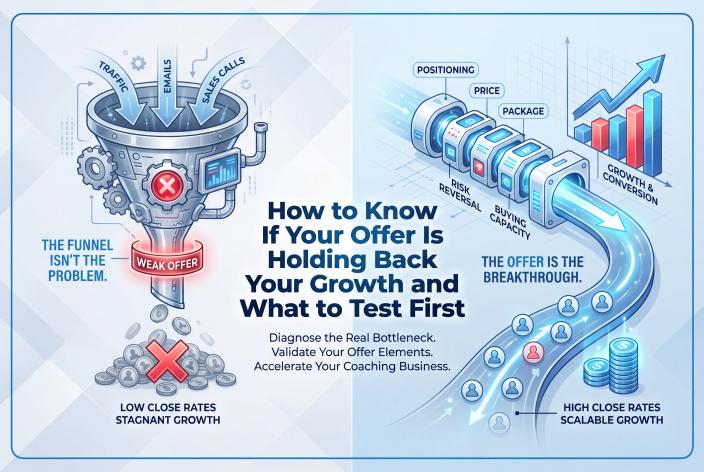
The Funnel Isn't Your Problem
You've got traffic coming in. Your emails are getting opened. People are showing up to your sales calls.
But they're not buying.
So you do what most coaches do. You optimize the funnel. You tweak the landing page. You rewrite the email sequence. You adjust the timing of your follow-ups.
And nothing changes.
Here's the hard truth: a perfect funnel can't sell a weak offer. And most coaches don't realize their offer is the bottleneck until they've already spent months (and money) trying to fix everything else.
The real question isn't whether your funnel is broken. It's whether your offer is.
The Five Offer Elements That Kill Conversions
When I work with coaches who feel stuck, we dig into five specific areas of their offer. One of these is almost always the culprit.
1. Your Positioning Doesn't Match Your Audience's Immediate Problem
You're a relationship coach. Your offer solves "how to build a thriving partnership." But the person on your call is thinking, "I don't even know if I should stay in this relationship."
You're solving a future problem when they need help with a present one.
This is the most common positioning mistake. Your offer is good, but it's aimed at the wrong emotional stage. Your prospect isn't ready for what you're selling because you haven't addressed what's stopping them from being ready.
Test this first. Before you change pricing or packaging, ask yourself: what's the immediate block keeping this person from saying yes? Are they stuck on clarity? Confidence? Permission? Proof?
Reposition your offer to solve that block, not the end result.
2. Your Price Point Signals the Wrong Value
You're charging $3,000 for a three-month program. Your prospect sees that and thinks, "I could get a course for $297."
Or you're charging $297 and your prospect thinks, "This can't be serious coaching."
Price isn't just a number. It's a signal. It tells your prospect what they're actually getting and whether you believe in the transformation you're offering.
The mistake most coaches make is anchoring to what they think is "reasonable" instead of what the market will bear for the specific transformation. A coach helping someone go from $50K to $150K in income can charge differently than a coach helping someone manage anxiety.
Test your price point by looking at three things: your positioning (does the price match the promise?), your proof (do you have case studies backing the result?), and your positioning relative to competitors (are you premium, mid-market, or accessible?).
3. Your Package Is Too Much or Too Little
You're offering a six-month, all-inclusive program when your prospect wants a quick win.
Or you're offering a one-month sprint when they need sustained support to actually implement.
Package structure matters because it removes friction. If your prospect is thinking, "I need help, but six months is a big commitment," that's an offer problem, not a conviction problem.
The fastest test here is to offer two versions: a shorter, lower-ticket option and a longer, premium option. See which one sells. The answer tells you what your market actually wants.
4. Your Risk Reversal Feels Unclear
You're asking someone to pay thousands of dollars and trust that you'll deliver results.
But you're not showing them what happens if they get stuck.
Risk reversal is not about making reckless promises. It is about showing the prospect that you have thought through the moments where fear, doubt, or implementation trouble usually appear.
That might be a clear satisfaction policy, a first-session review, extra support when someone completes the work and still gets stuck, or a diagnostic call before they commit to the bigger program.
The point is not to guarantee an outcome you cannot control. The point is to make the next step feel responsible for the right person.
5. Your Offer Doesn't Match Your Audience's Buying Capacity
You're selling a $10,000 annual package to coaches who are just getting traction and have maybe $2,000 to invest.
You're selling a payment plan when your audience wants to pay in full and move fast.
You're selling a group program when your audience wants one-on-one.
Buying capacity isn't just about money. It's about what your prospect can actually commit to right now, given where they are in their business and life.
Test this by offering multiple entry points. A lower-ticket offer. A payment plan option. A group version alongside one-on-one. See what resonates.
How to Know If It's Your Offer (Not Your Funnel)
Here's the diagnostic question: are you getting calls booked, but low close rates?
If yes, it's your offer.
If you're not getting calls booked at all, it's traffic or follow-up.
But if people are showing up, listening, and saying no, your funnel is working fine. Your offer isn't compelling enough.
The second diagnostic: have you tested the offer itself with real prospects?
Most coaches haven't. They've tested email subject lines and landing page headlines. But they haven't sat down with five prospects and said, "Here's what I'm offering. What would make you say yes?"
That conversation is worth more than a hundred funnel tweaks.
The Fastest Way to Test Without Losing Momentum
You don't need to blow up your whole offer and start over.
Start with one element. Pick the one that feels most off to you. Is it positioning? Price? Package? Risk reversal?
Change that one thing. Keep everything else the same.
Run it for two weeks. Track how many calls you book and how many close.
If the metric improves, you found something. Double down on it.
If it doesn't, change something else.
For example, a health coach might discover that prospects are not rejecting the full transformation. They are stuck on the first step. In that case, the test may be to reposition the offer around getting energy back in the first 30 days rather than trying to sell the whole long-term health journey at once.
Another coach might discover that the group program is not the issue. The issue is that the right prospects want more direct support. That test could be a higher-touch version of the same offer, with clearer qualification before the call.
Sometimes the answer is counterintuitive. But you won't know until you test.
Why Coaches Skip This and Waste Months
Most coaches skip offer validation because it feels like admitting the offer is weak.
It's not. It's the opposite. Testing your offer is how you make it stronger.
The coaches who move fastest are the ones who treat their offer like a hypothesis, not a finished product. They test, they measure, they adjust.
The coaches who move slowest are the ones who keep tweaking the funnel hoping the offer will eventually work.
Don't be that coach.
What to Test First (Ranked by Impact)
- Positioning. Change how you frame the problem and the outcome. This is highest leverage.
- Risk reversal. Clarify what support, review, or fit-check reduces the buyer's sense of risk.
- Price. Test a higher price point with the same offer. You might be leaving money on the table.
- Package. Offer a shorter or longer version and see which sells.
- Proof. Add a case study or testimonial if you don't have one.
Start at the top. Don't move down until you've tested the one above it.
The Real Opportunity
Here's what most coaches miss: a small change to your offer can change the quality of the conversation.
You don't need more leads. You need a better offer.
And you don't need months to figure out if a change works. You need two weeks and honest measurement.
So pick one element. Test it. Measure it. Adjust.
If you want help walking through what a personalized testing plan could look like for your specific offer and audience, Book your Client Attraction Planning Call. We'll help you diagnose which element may be holding you back and what to test first so you can create better conversations without chasing more prospects.
Your funnel is probably fine. Your offer might be the breakthrough waiting to happen.