You can have a funnel that technically “works” and still feel frustrated every time you look at your calendar.
People opt in. They click. They book calls.
Then the sales conversation starts and you realize they’re not your people.
They want a discount. They need six months to think. They don’t understand your offer. They joined for a free tip, not a real transformation. And by the end of the call, you’re tired before you’ve even followed up.
Sound familiar?
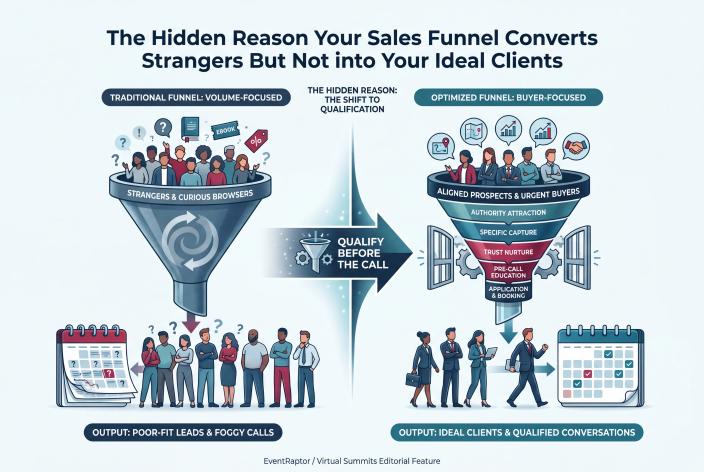
Here’s the truth. A funnel can convert strangers into leads without converting the right strangers into ideal clients.
That’s the hidden reason so many coaches feel like their marketing is busy but their business still feels fragile.
So let’s fix that.
The real job of your funnel
Most coaches think their funnel’s job is to collect leads.
That’s part of it.
But if you sell coaching, especially higher-ticket coaching, your funnel has a bigger job.
It should:
- Attract people with the right problem
- Build trust before the sales call
- Educate prospects on the value of your work
- Filter out poor-fit leads early
- Move qualified prospects toward a conversation
- Give you feedback you can actually use
That’s a very different goal from “get more opt-ins.”
You see, when a funnel is built only for volume, you often get a bigger list and a colder pipeline.
And that creates a nasty little problem.
You start measuring success by numbers that feel good on a dashboard, while your calendar fills with people who were never going to buy.
The better question is simple.
Who is this funnel attracting, and what are they ready to do next?
That one question can change your whole client attraction strategy.
A lead magnet that grows your list is different from one that attracts buyers
Let me explain.
A list-growth lead magnet usually promises quick information.
Things like:
- A free ebook
- A checklist
- A generic guide
- A quick template
- A swipe file
These can work. But they often attract people who want information, not transformation.
In older Virtual Summits training, this was explained very clearly. Ebooks are often seen as low value because there’s so much free information available now. Some people will even use a fake email just to get the download, which means you didn’t really gain a quality subscriber at all.
That’s a painful lesson if you’re paying for traffic.
Now compare that with a buyer-attracting lead magnet.
A buyer-attracting lead magnet does more than deliver information. It helps the prospect see their problem more clearly and understand why solving it matters now.
Here’s the difference.
| List-growth lead magnet | Buyer-attracting lead magnet |
|---|---|
| Gives tips | Diagnoses a real problem |
| Attracts curiosity | Attracts urgency |
| Appeals to everyone | Speaks to a specific audience |
| Creates a download | Creates a next step |
| Measures opt-ins | Measures qualified movement |
So if you’re a health coach, “10 Healthy Morning Habits” might grow your list.
But “The 5 Hidden Reasons High-Achieving Women Stay Exhausted Even When They Eat Well” attracts a very different person.
One person wants ideas.
The other person is starting to recognize the cost of staying stuck.
That’s the shift.
Your lead magnet should help your ideal client say, “This person understands exactly what I’m dealing with.”
Your funnel should qualify before the call
Here’s a tip.
If the first real qualification happens on the sales call, your funnel is doing too little work.
You should know quite a bit before someone lands on your calendar.
You don’t need to make the process feel cold or corporate. You just need to guide people through the right steps.
Use qualification points throughout the funnel
A good coaching funnel can qualify prospects through:
- The language on the landing page
- The promise of the lead magnet
- The questions on the registration form
- The content in the nurture sequence
- The framing before the booking link
- The application questions before the call
- The reminders sent before the appointment
This matters because your sales call should feel like a continuation of trust, not the beginning of clarity.
If someone books a call without understanding who you help, what problem you solve, and what kind of commitment is required, you’re walking into a foggy room.
And foggy rooms create foggy decisions.
Add gentle filters that protect your calendar
You can filter for high-ticket fit without sounding arrogant.
Use language like:
- “This is designed for coaches who have already worked with clients and are ready to build a more predictable client attraction system.”
- “This is a fit if you’re willing to clarify your message, become more visible, and follow up with qualified prospects.”
- “This may be early for you if you’re still deciding what audience you want to serve.”
See how that feels?
Clear. Human. Respectful.
You’re not pushing people away. You’re helping them self-identify.
That’s what a strong funnel does.
Generic landing pages kill conversion because they make prospects work too hard
A generic landing page sounds safe.
It also disappears into the noise.
Your ideal client is busy. They’re already overwhelmed. They’re scanning your page while drinking cold coffee, answering client messages, and wondering why their own marketing still feels messy.
They won’t do the work of translating vague copy into personal relevance.
You have to do that for them.
Weak messaging sounds like this
- “Grow your business with proven strategies”
- “Create more freedom and impact”
- “Learn how to attract more clients”
- “Scale with ease”
There’s nothing wildly wrong with those phrases.
But they don’t create that little snap of recognition.
Your prospect doesn’t think, “Wow, this is for me.”
They think, “I’ve heard this before.”
Strong messaging names the real situation
For coaches, stronger messaging often sounds like:
- “You can sell when the right person gets on a call, but you’re not getting enough of those calls consistently.”
- “Your referrals are appreciated, but they’re too unpredictable to build the next stage of your business on.”
- “Your content gets engagement, but it isn’t reliably turning into qualified conversations.”
- “You’re ready for a client attraction system that sounds like you and works beyond random bursts of visibility.”
That’s the language that moves people.
Why?
Because it names the emotional reality they’re already living in.
And when your landing page does that well, your ideal client feels understood before they ever read the offer details.
The funnel architecture that filters for high-ticket fit
Now let’s get practical.
A high-quality coaching funnel needs more than a landing page and a booking link.
It needs a journey.
Virtual Summits training describes the customer journey as the path that moves someone from a cold prospect to a warm lead, then to a hot customer, and eventually to a raving fan. That’s the piece many entrepreneurs miss.
So what does that journey look like for a coach?
Here’s a simple architecture.
Step 1. Authority-based attraction
Start with something that builds trust, not just clicks.
This could be:
- A virtual summit
- A workshop
- A webinar with real teaching
- A podcast collaboration
- A partner event
- A diagnostic quiz
- A niche-specific guide
The key is to solve a meaningful problem and build relationship.
Virtual summit content has described summits as high value and low risk because attendees can consume helpful information without feeling pressured into a sales pitch. That’s one reason events can increase engagement and improve audience quality.
And that matters for coaches.
Your best prospects need to trust your thinking before they trust your offer.
Step 2. Specific capture
Your opt-in should make the right person feel seen.
Use specificity around:
- Audience
- Problem
- Stage of business or life
- Desired outcome
- Pain they already recognize
- Next step they want
For example, “Client Attraction Audit for Coaches Who Are Getting Referrals But Need a More Predictable Pipeline” is much stronger than “Free Business Growth Guide.”
Specificity lowers the wrong kind of curiosity and raises the right kind of interest.
Step 3. Trust-building nurture
This is where many funnels go quiet or get pushy.
Neither helps.
Your nurture sequence should help prospects understand:
- Why their current approach feels inconsistent
- What the real bottleneck is
- What a better system looks like
- Why timing matters
- What kind of client is a good fit for your work
- How to take the next step
By the way, this is where email and SMS follow-up can be incredibly useful when done well.
Good automation doesn’t make the relationship colder. It makes your follow-up timely, clear, and consistent.
Step 4. Pre-call education
Before someone books, give them context.
This can be a short page, video, or email that explains:
- Who the call is for
- What you’ll discuss
- What they should already have in place
- What kind of transformation your coaching supports
- What happens after the call
This prevents the “So what do you do?” call.
You want prospects arriving with momentum.
Step 5. Application and booking
Your application should help both sides.
Ask questions like:
- What are you trying to accomplish in the next 90 days?
- What have you already tried?
- What is your biggest bottleneck right now?
- What kind of support are you looking for?
- What would make this a clear win for you?
- Are you ready to invest time, attention, and resources into solving this properly?
Notice the tone.
It’s direct, but it’s not harsh.
You’re helping the right people lean in and helping the wrong people pause.
How to optimize for client quality instead of lead volume
Most funnel optimization looks at surface numbers.
Open rates. Click rates. Opt-in rates. Cost per lead.
Those matter.
But if you’re a coach selling a meaningful service, you need another layer.
You need quality metrics.
Virtual Summits training recommends writing down your KPIs, including what you’re okay paying per click, what you’re okay paying per lead, and what your conversion rate is. That kind of tracking gives you a real starting point.
But don’t stop there.
Add these quality questions.
Your client quality diagnostic
Use this after every campaign, workshop, summit, or funnel push.
| Funnel stage | Quality question |
|---|---|
| Lead magnet | Did this attract people with the problem I actually solve? |
| Landing page | Did the right prospects recognize themselves quickly? |
| Nurture | Did leads become more educated and ready for a conversation? |
| Booking page | Did people understand the call before booking? |
| Application | Did the answers show urgency, fit, and readiness? |
| Sales call | Did the prospect already trust my approach? |
| Follow-up | Did the system continue the relationship after the call? |
Now ask the harder question.
Where are the wrong-fit people entering?
Sometimes the problem is the lead magnet.
Sometimes it’s the page.
Sometimes it’s the nurture sequence.
Sometimes your booking link is too easy to access before the prospect understands the offer.
And sometimes your messaging is attracting beginners when your offer is built for committed, ready-to-invest clients.
The point is to test and improve.
Virtual Summits training puts it plainly. Get feedback, do the research, test everything, and be honest about what didn’t perform and why.
That’s how you build a funnel that gets better over time.
5 signs your funnel is attracting curious browsers instead of buyers
Want a quick gut check?
Here are 5 signs your funnel is optimized for activity instead of fit.
-
Your opt-in rate looks good, but few leads book calls
People want the free thing, but they don’t see a reason to continue.
-
Your calls start with too much explanation
If you spend the first 20 minutes creating context, your funnel didn’t build enough trust beforehand.
-
Prospects ask basic questions your funnel should have answered
This usually means your nurture sequence is too thin or too generic.
-
Many leads are interested, but not ready
Your messaging may be attracting people who like the idea of change more than the commitment to change.
-
You feel drained after sales calls
That’s often a sign you’re doing too much convincing and not enough confirming.
Remember, the goal is not more calls with anyone.
The goal is more qualified conversations with people already moving toward trust.
The one shift that changes everything
Here it is.
Build your funnel around the sales conversation you actually want to have.
Start there.
What does your ideal client already understand before they talk to you?
What problem do they recognize?
What have they tried?
What are they ready to change?
What objections need to be softened through education?
What proof, perspective, or positioning would help them trust you sooner?
Once you answer those questions, your funnel becomes much easier to design.
Your lead magnet gets sharper.
Your landing page gets more specific.
Your nurture sequence gets more useful.
Your booking process gets more intentional.
And your sales calls become calmer because the funnel has already done part of the relationship-building work.
That’s when marketing starts to feel less like chasing and more like guiding.
A simple next step
If your funnel is bringing in leads but not enough ideal clients, don’t just add more traffic.
Look at the journey.
Look at the message.
Look at the qualification path.
Look at the follow-up.
And if you’d like help seeing where the real breakdown is, we can walk through it with you.
Book your Client Attraction Planning Call and we’ll talk through what a personalized client attraction system could look like for your coaching business.
We’ll look at your audience, offer, funnel, follow-up, and sales path, then help you see the next practical step.
No hype. No pressure. Just a clear conversation about how to attract more right-fit clients with a system that sounds like you.