A summit registration is more than a name and email.
It is a moment of raised-hand interest.
Someone saw your topic, recognized a problem, trusted the promise enough to register, and gave you permission to continue the conversation. That is a small window of attention. And if you treat it like a dead-end confirmation page, you waste momentum.
This is where many coaches lose good prospects.
They put all their energy into getting registrations. Then they wait until after the summit to think about conversion. By then, interest has cooled, inboxes are crowded, and the registrant has moved on with life.
A stronger summit funnel starts the conversion path the moment someone registers.
Not with pressure.
Not with a pushy pitch.
With a clear, useful journey that helps the right people take the next step when they are ready.
Let's walk through how to build that journey.
The Real Opportunity Starts After Registration
Most summit hosts focus on the registration page.
That makes sense. You need the page to explain the event, show why it matters, and get people signed up.
But once the person registers, the question changes.
Now you need to guide them.
A strong post-registration path helps them:
- Confirm they made a good decision
- Add the event to their calendar
- Understand what to do next
- See your authority more clearly
- Share useful information about their goals or challenges
- Choose a relevant next step if they want help sooner
That last point matters.
Some registrants are only browsing. Some are curious. Some want free education. Some are already looking for help and your summit simply made you visible at the right time.
Your job is to design a path that respects all of them.
The curious person should feel welcomed. The serious prospect should see a clear next step. And the event should still feel like a real value-driven experience, not bait for a sales call.
Map The Journey Before You Build The Pages
Before you write copy or set up tech, map the path.
Keep it simple at first.
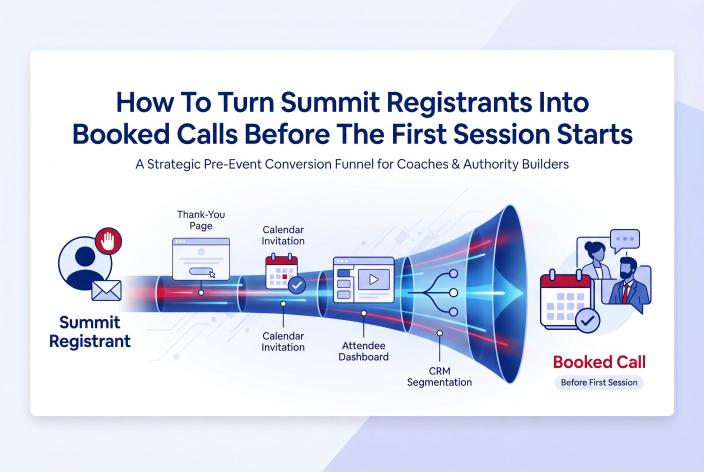
A practical pre-event summit conversion path often looks like this:
- Registration Page
- Thank-You Page
- Calendar Invitation
- Attendee Dashboard
- Pre-Event Email And SMS Reminders
- Qualification And Segmentation
- Planning Call Invitation For The Right People
You do not need to overcomplicate this.
The goal is to make each step useful.
Step 1 Is The Registration Page
The registration page should attract the right people and set expectations.
This is where the registrant decides, "Yes, this is relevant to me."
For a coaching summit, that usually means the page should make the audience and promise clear. Who is this for? What problem will the event help them understand or solve? Why should they care now?
If your registration page is too broad, your follow-up gets harder.
You will have a list of names, but less clarity about who they are, what they want, and whether they are aligned with your offer.
So the conversion path starts with positioning.
A good registration page does more than collect opt-ins. It creates the first filter.
Step 2 Is The Thank-You Page
The thank-you page is prime real estate.
The registrant is paying attention right now. They have just taken action. They are looking for confirmation and the next instruction.
Do not waste this page with only, "Thanks, check your inbox."
Use it to do 4 things:
- Confirm their registration
- Tell them what to expect next
- Encourage them to add the event to their calendar
- Offer an optional next step for people who want help sooner
That optional next step could be a planning call.
For example:
"If you registered because client flow has felt inconsistent and you want help mapping your own attraction system, you can also Book your Client Attraction Planning Call. On the call, we'll look at where your current path is getting stuck and what kind of summit, funnel, CRM, follow-up, or event strategy could make sense next."
Notice the tone.
It is not, "Before you attend, buy from us."
It is, "If this is already a real problem for you, here is a practical way to talk it through."
That makes a big difference.
Step 3 Is The Calendar Invitation
If someone registers and never shows up, the relationship gets weaker.
So the calendar step matters.
After registration, give them a clean way to add the summit, session, workshop, or kickoff to their calendar. Make the date, time, time zone, access path, and next steps easy to understand.
This is especially important for virtual events because attendees are distracted. They register with good intentions, then the day gets busy.
A calendar invitation gives the event a place in their actual life.
And yes, it also creates another chance to reinforce the value of showing up.
A simple calendar description can remind them:
- What the event is about
- Who it is for
- Where to access it
- What to watch for before the event
- How to get help if they want support sooner
Keep it useful. Keep it clean. Keep it aligned with the event promise.
Invite Planning Conversations Without Making The Summit Feel Like A Trap
This is where coaches often get nervous.
They do not want to seem pushy.
Good. That instinct protects the relationship.
The answer is to make the planning call relevant, optional, and clearly connected to the registrant's problem.
A planning call invitation works best when it appears in the right places and says the right thing.
Where To Place The Planning Call Invitation
You can invite registrants to a planning conversation in several places:
- On the thank-you page
- Inside the attendee dashboard
- In a pre-event welcome email
- After someone answers a high-intent registration question
- In reminder emails when the language is relevant and gentle
- On a VIP or bonus page if the summit includes a deeper access path
The thank-you page is usually the cleanest first placement.
Why?
Because it is immediate, visible, and expected. The registrant is already looking for the next step.
The attendee dashboard is another strong place because it can hold more context. You can include event access, speaker details, session information, bonus resources, and a calm invitation for people who want help applying the topic to their business.
How To Say It
The call invitation should not compete with the summit.
It should support the summit promise.
Here is a simple structure:
- Acknowledge why they registered
- Name the problem they may be trying to solve
- Explain what the call helps them think through
- Make the invitation optional
Example:
"If you joined this summit because you are tired of referrals, random content, and inconsistent calls, you may already know you need more than information. You may need a clearer client attraction system. If you want help looking at your business specifically, Book your Client Attraction Planning Call."
That feels human.
It respects the person who wants to attend first. It also opens the door for the person who is ready now.
When To Hold Back
There are times when you should keep the planning call invitation lighter.
For example, if the summit topic is very educational or early-stage, lead with the event experience first. Use the call invitation as a secondary option.
If your summit attracts a mixed audience, use registration answers and CRM tags to decide who receives stronger follow-up.
That way, everyone gets a good attendee experience, and higher-intent prospects get a more relevant path.
Use Registration Questions To Identify Higher-Intent Prospects
Registration questions are one of the most useful parts of the pre-event funnel.
Most hosts ask for name and email only.
That is easy, but it leaves you blind.
Better questions help you understand who registered, what they care about, and whether they may be a fit for a planning conversation.
Ask Questions That Help You Segment
For a summit aimed at coaches, you might ask:
- What kind of coaching or expert business do you run?
- What is your biggest client attraction challenge right now?
- How are most clients currently finding you?
- Do you already have a core offer you sell through conversations?
- What are you hoping to build next?
- Would you like help mapping a client attraction system for your business?
You do not need to ask all of these.
Too many questions can reduce completion. Choose the few that help you guide the next step.
The best registration questions do 2 jobs:
- They help the attendee feel seen
- They help you route follow-up intelligently
Look For Intent Signals
Some answers suggest the person may be more ready for a planning conversation.
For example, a registrant may say:
- They can sell when the right person gets on a call, but they do not get enough calls
- They are relying on referrals and want a more predictable system
- They have tried content, webinars, or funnels without consistent results
- They have a defined offer and want implementation help
- They are planning a summit, workshop, webinar, or group program
- They want CRM, follow-up, or funnel support
Those answers do not mean you should pounce.
They mean you can follow up with more relevance.
The message might say:
"Based on what you shared, it sounds like follow-up and conversion may be part of the gap. If you want to talk through what that could look like in your business, you can Book your Client Attraction Planning Call."
That is respectful because it connects to what they told you.
Build The Thank-You Page As A Conversion Bridge
Your thank-you page should feel like a helpful handoff.
The person registered. Now you are helping them get value from the event and giving the right people a path to go deeper.
Here is a simple layout you can use.
Thank-You Page Structure
| Page Section | Purpose | What To Include |
|---|---|---|
| Confirmation | Reassure them | "You're registered" and the event name |
| Calendar Step | Increase attendance | Add-to-calendar link, date, time, time zone |
| Access Instructions | Reduce confusion | Where to watch, when links arrive, what to expect |
| Quick Question Or Survey | Improve segmentation | One optional question about their biggest challenge |
| Planning Call Invitation | Convert high-intent registrants | A calm CTA for people who want help applying the topic |
| Share Prompt | Encourage partner growth | Invite them to share the event with peers if relevant |
This page should be clean.
Do not cram 12 offers on it. Do not bury the calendar link. Do not make the planning call feel like the real event.
The thank-you page should say, "You're in. Here's how to get the most from this. And if you want help sooner, here is the next step."
That is the feel you want.
Use The Attendee Dashboard To Continue The Journey
The attendee dashboard is where the event becomes more than a registration.
It can help attendees find sessions, access links, speaker information, timing, dashboard messages, VIP messaging, and other event details.
It can also reinforce your authority.
Think about it.
A polished attendee dashboard tells people, "This host has their act together."
That matters for a coach selling a higher-trust service.
When the event experience feels organized, the host feels more credible.
What To Put On The Dashboard
Your dashboard can include:
- Welcome message
- Event schedule
- Session access details
- Speaker profiles
- Calendar reminders
- Bonus or VIP information if relevant
- Instructions for what to do before the first session
- A planning call invitation for people who want help applying the topic
Again, the call invitation should feel like an option, not a demand.
You might say:
"Want help applying these ideas to your own client attraction system? Book your Client Attraction Planning Call and we'll look at where your visibility, funnel, CRM, follow-up, or event strategy may be getting stuck."
Simple. Clear. No pressure.
Connect Event Data To Your CRM And Follow-Up
This is where the system starts to mature.
A summit funnel becomes much more useful when registration data does not sit alone in a spreadsheet.
You want your event activity connected to your CRM, calendar, tags, and follow-up.
EventRaptor supports the virtual event management side, including registration pages, thank-you pages, attendee dashboards, registration details, custom questions, reminders, speaker and session organization, promoter tracking, attendee data, and CRM syncing.
GHL/CRMRaptor supports the CRM layer around the event, including contact records, tags, custom fields or values, calendars, funnels, workflows, automation, and follow-up.
Together, they help you create a cleaner path from event interest to qualified conversation.
Useful Tags To Create
Tags help your follow-up match the person's behavior and intent.
For a summit, you might create tags like:
- Registered For Summit
- Added Calendar
- Attended Live
- Missed First Session
- VIP Interest
- Planning Call Interest
- Booked Planning Call
- Main Challenge Is Referrals
- Main Challenge Is Follow-Up
- Main Challenge Is Funnel
- Main Challenge Is Visibility
Use tags carefully.
You do not need a messy pile of labels that no one understands. You need enough structure to send better follow-up.
Useful CRM Actions To Trigger
Once the data is connected, you can create useful follow-up paths.
For example:
- Send a welcome email after registration
- Send calendar instructions right away
- Send a reminder before the first session
- Send a different message to people who asked for implementation help
- Notify your team when someone requests a planning call
- Move booked calls into the right calendar path
- Send pre-call education before the conversation
- Follow up with attendees after the first session based on their interest
This is where automation becomes more human.
Good automation does not replace relationship. It protects the relationship by making sure people hear from you at the right time, with the right message, while interest is still warm.
Create A Pre-Event Follow-Up Sequence That Warms The Sales Conversation
The pre-event sequence should help the registrant feel confident, prepared, and understood.
It does not need to be long.
A simple version can work well.
Email 1 Is The Confirmation
Send this immediately.
Include:
- Confirmation that they are registered
- The event date and access instructions
- Calendar link
- What to expect next
- A light planning call invitation if appropriate
Email 2 Is The Relevance Email
Send this before the event.
Use it to connect the summit topic to the problem they care about.
For example, if your summit is about authority-building client acquisition, talk about why visibility alone often does not create enough qualified conversations unless there is a follow-up path behind it.
Then invite them to think about their current system.
You can ask:
- Where do leads currently enter your world?
- What happens after someone shows interest?
- How consistently do you follow up?
- Is there a clear path to a sales conversation?
This gets them thinking before the first session starts.
Email 3 Is The Attendance Reminder
Send this close to the event.
Make it practical.
Include:
- Date and time
- Access link or dashboard link
- What to bring or think about
- Why showing up matters
If someone is a high-intent registrant, you can add a short personal-style note:
"If you already know you want help mapping this out for your own coaching business, you can Book your Client Attraction Planning Call before the event begins."
Short. Useful. Calm.
Use VIP Pages Carefully
A VIP page can be useful if your summit includes replays, bonuses, deeper resources, or special access.
But do not let the VIP offer bury the main client attraction path.
If your real business model depends on selling coaching, consulting, implementation, or a higher-ticket service, be clear about the role of the VIP page.
It can:
- Increase attendee commitment
- Offer deeper access
- Segment more engaged registrants
- Create another signal of buying intent
- Give serious attendees more value
It should also support the broader journey.
For example, someone who visits a VIP page, clicks through to learn more, or asks about implementation may deserve different follow-up than someone who only registered and never engaged.
Again, this is where event data plus CRM tags become useful.
Keep The Event Feeling Like A Trust-Building Experience
Here is the line to walk.
You want booked calls.
You also want the summit to feel generous, useful, and aligned with your values.
The way to do both is to make the event valuable on its own and make the call invitation relevant for people who want help applying the ideas.
Do not hide the fact that you help clients.
Do not make every email sound like a pitch either.
A good pre-event conversion path feels like this:
- "Here is the event you asked for."
- "Here is how to get the most from it."
- "Here is a question that helps us understand what you need."
- "Here is a practical next step if you want help with your business."
That is a healthy rhythm.
And it protects trust.
The Simple Pre-Event Conversion Checklist
Use this checklist before your next summit goes live.
Registration And Segmentation
- Is the registration page clear about who the event is for?
- Does the page attract people who could become right-fit clients?
- Are you asking 1 to 3 useful registration questions?
- Do those answers map to CRM tags or follow-up paths?
Thank-You Page
- Does the page confirm the registration clearly?
- Is the calendar step obvious?
- Are event access instructions easy to understand?
- Is there a calm invitation to book a planning call?
- Does the page still feel like part of the event, not a sales detour?
Calendar And Dashboard
- Can registrants add the event to their calendar quickly?
- Does the attendee dashboard explain what to do next?
- Are session details, access links, and timing clear?
- Is the planning call invitation present but not overpowering?
CRM And Follow-Up
- Are registrants synced or exported into the right CRM process?
- Are tags used to identify interest, fit, and behavior?
- Are reminder emails scheduled before the event?
- Does high-intent behavior trigger more relevant follow-up?
- Does a booked call move into the right calendar and pre-call sequence?
If these pieces are missing, you may still get registrations.
But the path from attention to trust to conversation will be weaker than it needs to be.
How EventRaptor And GHL/CRMRaptor Fit Together
This is much easier when your event system and CRM system are connected.
EventRaptor helps manage the event side:
- Event pages
- Registration details
- Thank-you pages
- Attendee dashboards
- Custom registration questions
- Reminder and follow-up communications
- Speaker and session management
- Promoter tracking
- Attendee data
- CRM syncing
- Reporting and exports
GHL/CRMRaptor supports the CRM and conversion side:
- Contact records
- Tags
- Custom fields or values
- Calendars
- Funnels
- Workflows
- Automation
- Follow-up
That combination helps you stop treating the summit as a one-time event.
The summit becomes part of a managed client attraction system. People register, get guided, receive reminders, share useful information, get tagged appropriately, and see relevant next steps.
The right registrants can book a planning conversation before the first session starts. Others can attend, learn, and continue to be nurtured.
That is how the event keeps working before, during, and after the live experience.
The Takeaway For Coaches
If you are hosting a summit to build authority and attract right-fit clients, do not wait until the event is over to think about booked calls.
The conversion path starts at registration.
Your thank-you page, calendar invitation, attendee dashboard, registration questions, CRM tags, and pre-event follow-up all shape what happens next.
Done well, this does not make your summit feel pushy. It makes the journey clearer for the people who already want help.
And that is the point.
You are not trying to force every registrant into a call. You are giving the right person a timely, relevant path from interest to conversation.
If you want help applying this to your own coaching business, Book your Client Attraction Planning Call. We'll look at where your client flow is getting stuck and what kind of summit, funnel, CRM, follow-up, or event strategy could make sense next.