If you can sell when the right person gets on the phone, your sales problem may be happening before the call.
That sounds simple. But it's easy to miss.
A prospect doesn't arrive on your calendar as a blank slate. They bring assumptions, doubts, hopes, objections, past disappointments, and half-formed questions.
If your funnel skips the trust-building work, the sales call has to do too much heavy lifting.
You end up explaining your value from scratch. You spend too much time proving you're credible. You answer basic questions they could have understood earlier. And sometimes, you're talking to someone who was never truly ready to book.
So what do you build?
A pre-call trust path.
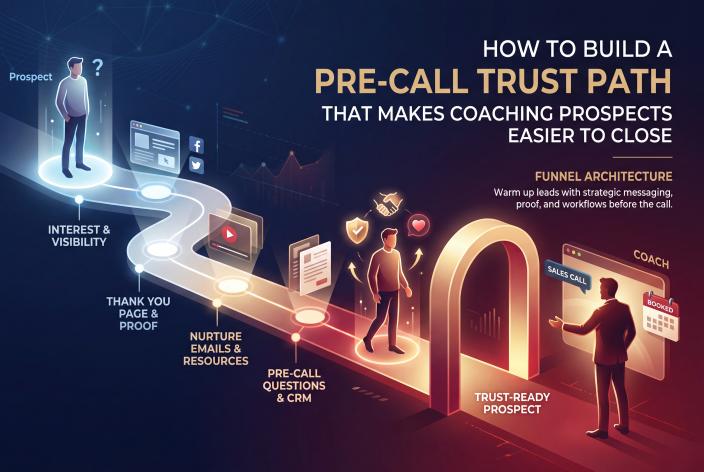
It's the journey that helps a prospect move from mild interest to informed curiosity to a qualified conversation. It includes your landing page, thank-you page, confirmation email, nurture sequence, proof, calendar reminders, and the way your CRM keeps the relationship organized.
When that path works, your sales calls feel different. People show up with more context. They understand why the conversation matters. They have already started to trust your thinking.
And that gives you a much better chance of serving them well.
Why The Sales Call Starts Before The Calendar
Most coaches think the sales process starts when the call begins.
But your prospect started making a decision much earlier.
They made a small decision when they clicked your post, summit session, webinar invite, referral link, podcast mention, or email. They made another decision when they read your landing page. Another when they submitted the form. Another when they saw the thank-you page.
Every step either builds trust or creates quiet friction.
The issue is usually not that your coaching lacks value. For many proven coaches, the real gap is that the path from visibility to trust to conversation is too thin.
EventRaptor's positioning is built around this exact journey. Virtual events, webinars, summits, and speaker campaigns work best when attention gets organized into registration, engagement, follow-up, CRM updates, and the right next step. The event or funnel creates the opening. The follow-up path helps that opening become a qualified conversation.
Here's the practical takeaway.
Your pre-call process should answer the questions your prospect is already asking silently:
- Do I feel understood?
- Is this person credible?
- Is this for someone like me?
- Do they understand my real problem?
- Will this be pushy or useful?
- What happens if I book?
- Is this worth my time right now?
If those questions are ignored, the prospect may still book. But they'll arrive colder, less certain, and more guarded.
Map What Your Prospect Needs To Believe Before Booking
Before you improve pages or automations, map the beliefs first.
This keeps your funnel from becoming a pile of disconnected assets.
A strong pre-call trust path usually helps a prospect believe 5 things.
They Need To Believe You Understand Their Situation
Your landing page should name the tension they already feel.
For a coach's prospect, that might sound like:
- "I've tried to solve this, but I keep slipping back."
- "I know something needs to change, but I don't know what to do next."
- "I don't want another generic program. I want someone who gets the real issue."
For your own coaching business, the words will be different.
But the principle is the same. Your page should make the right person feel recognized before you ask them to act.
They Need To Believe The Problem Is Solvable
People rarely book a serious coaching call because they want information.
They book because they see a possible path.
That doesn't mean you overpromise. It means you show them the shape of the work.
Give them a useful framework. Name the stages. Explain what must be clarified first. Help them see why their current efforts may feel scattered.
You are not trying to coach them fully before the call. You're helping them understand that there is a path worth discussing.
They Need To Believe You Have A Thoughtful Method
A prospect feels safer when they can see how you think.
This is where framework content helps.
You might include:
- A short diagnostic model
- A simple checklist
- A short video explaining your approach
- A few questions to reflect on before booking
- A "what we'll look at together" section
This matters because coaching can feel intangible from the outside.
A clear method makes your work easier to trust.
They Need To Believe The Call Has A Clear Purpose
A vague "book a call" invitation creates hesitation.
A specific planning call or fit conversation feels more grounded.
Tell them what the call is for, what you'll discuss, and what they can expect afterward.
For example:
- You'll look at where they are now.
- You'll clarify what they want to change.
- You'll identify what may be keeping them stuck.
- You'll discuss whether your support is a fit.
That simple clarity lowers pressure.
They Need To Believe Taking The Next Step Fits Their Identity
This one is subtle.
People don't only ask, "Can I afford this?"
They also ask, "Am I the kind of person who does this?"
Your pre-call path should speak to the person they are becoming.
A serious coach, for example, doesn't need to feel ashamed for not having a predictable client attraction system yet. They need to see this as the natural next stage of building a real business.
Your prospects need a similar bridge. Help them see the call as a responsible next step, not a desperate one.
Use The Landing Page To Pre-Frame The Conversation
Your landing page is not just a booking page.
It's the first real sales conversation in written form.
And no, that doesn't mean it needs to be long, dramatic, or stuffed with hype.
It needs to be clear.
A good pre-call landing page should include:
- The specific problem the call helps address
- Who the call is for
- What the prospect should already want or be ready to explore
- What you'll cover on the call
- What happens after they book
- Proof or credibility where you can support it
- A clear calendar invitation
The goal is not to convince everyone.
The goal is to help the right person feel, "Yes, this is the conversation I need."
Here's a simple structure you can adapt:
| Page Section | Job Of The Section |
|---|---|
| Opening Message | Name the problem and desired outcome in plain language |
| Who It's For | Help right-fit prospects recognize themselves |
| What We'll Cover | Make the call feel useful and specific |
| Your Method | Show how you think and create confidence |
| Proof Or Credibility | Support trust without exaggerating |
| Booking Area | Make the next step simple |
| After You Book | Reduce uncertainty and improve show-up quality |
A strong page gives the prospect enough confidence to book without making the call feel like a trap.
Keep Selling On The Thank-You Page
The thank-you page is one of the most underused pieces in a coaching funnel.
Most say something like, "Thanks, you're booked. Check your inbox."
That's a missed opportunity.
The moment after someone books is a high-trust moment. They just raised their hand. They are paying attention. They want reassurance that they made a good decision.
Use the thank-you page to continue the journey.
You can include:
- A short confirmation of what they booked
- A warm note about what to expect
- A short video from you
- A few questions to think about before the call
- A link to a helpful article, podcast, summit session, or framework
- A reminder to add the call to their calendar
- Instructions for completing any pre-call form
Keep it simple.
The thank-you page should reduce uncertainty and build anticipation.
A strong message might sound like this:
"You're booked. Before our call, take 5 minutes to think about where you're getting stuck, what you've already tried, and what a successful next step would look like. That will help us use the conversation well."
Notice what that does.
It makes the call more intentional. It helps the prospect prepare. It positions you as someone who values their time.
Use Confirmation Emails To Build Trust While Interest Is Warm
The confirmation email should do more than deliver the calendar details.
It should make the prospect feel taken care of.
A good confirmation email can include:
- The date and time of the call
- The meeting link
- A short reminder of what the call is about
- One useful reflection question
- Any pre-call form or preparation link
- A simple note about what to do if they need to reschedule
This is where automation can become more human, not less.
When your email arrives quickly, gives clear next steps, and helps the prospect prepare, it feels professional. It also prevents the relationship from going quiet between booking and the call.
EventRaptor supports this kind of organized follow-up on the event side with welcome emails, scheduled reminders, follow-up emails, personalization placeholders, email status tracking, attendee dashboards, and CRM syncing. GHL/CRMRaptor supports the CRM, calendar, workflow, funnel, and follow-up layer around that journey.
Together, those pieces help you avoid the classic problem: someone expresses interest, then the relationship gets lost in memory, spreadsheets, or scattered tools.
Add Proof Without Turning The Page Into A Trophy Wall
Proof matters.
But proof works best when it helps the prospect answer a real buying question.
If you have approved testimonials, use them with context. If you have case studies, keep them specific and honest. If you have credentials, connect them to the problem your prospect cares about.
You don't need to paste every achievement you've ever had onto the page.
A cleaner approach is to match proof to the belief it supports.
| Prospect Question | Useful Proof Type |
|---|---|
| Can this person help someone like me? | Relevant testimonial or client story |
| Do they understand my problem? | Clear diagnostic content |
| Do they have a method? | Framework or process overview |
| Are they credible? | Credentials, experience, speaking, events, or published content |
| Will this feel aligned? | Voice, values, and realistic expectations |
If you don't have strong proof yet, don't fake it.
Use useful thinking.
A clear framework, a thoughtful article, a well-run workshop, or a helpful summit session can build trust because it lets prospects experience how you think before they talk with you.
Send Useful Questions Before The Call
A pre-call form can improve the quality of the conversation.
But only if it feels useful to the prospect too.
Ask questions that help both of you prepare.
For a coaching business, useful questions might include:
- What made you book this call now?
- What have you already tried?
- Where do you feel most stuck?
- What would you like to be different in the next few months?
- What would make this conversation useful for you?
- Is there anything you want me to understand before we speak?
For your own client attraction process, you can use similar questions to qualify fit.
The point is not to interrogate people.
The point is to help the right prospect arrive with more clarity.
And when someone fills out thoughtful answers before a call, your CRM should capture that information in a way you can actually use.
Connect The Funnel To GHL/CRMRaptor Tags And Calendar Workflows
This is where many coaches lose momentum.
They create a page. They connect a calendar. They send a confirmation email. Then everything else lives in separate places.
The result is messy.
You don't know who booked from which event. You don't know who attended a webinar but didn't book. You don't know who clicked a planning call link but stopped short. You don't know which prospects need a reminder, a different nurture path, or a personal follow-up.
A better pre-call trust path uses CRM tags and workflows to keep the journey organized.
For example, you might tag people based on:
- Registered for a summit or webinar
- Attended live
- Watched a replay
- Clicked the planning call page
- Booked a call
- Completed the pre-call form
- No-showed
- Rescheduled
- Qualified but not ready
- Became a client
Inside GHL/CRMRaptor, those tags can support calendar workflows, reminders, follow-up sequences, pipeline stages, and task prompts.
This is not about adding complexity for the sake of it.
It's about making sure interested people don't disappear.
When EventRaptor manages the virtual event side and GHL/CRMRaptor manages the CRM and follow-up side, your visibility has a cleaner path into conversations. Registrations, reminders, attendee data, CRM tags, and follow-up can work together instead of living in different corners of your business.
Build A Simple Pre-Call Trust Path You Can Use This Month
You don't need to rebuild everything at once.
Start with one clean path.
Here's a practical version:
- Create one clear planning call page.
- Name the specific problem the call helps solve.
- Add a short "what we'll cover" section.
- Include one framework or diagnostic explanation.
- Add supported proof if you have it.
- Improve the thank-you page after booking.
- Send a confirmation email that prepares the prospect.
- Add 2 or 3 pre-call questions.
- Tag the lead properly in GHL/CRMRaptor.
- Create a follow-up workflow for booked, no-showed, and not-ready prospects.
That's enough to make a real difference in the sales experience.
Not because it's fancy.
Because it's coherent.
The prospect knows what they booked, why it matters, what to expect, and how to prepare. You know where they came from, what they need, and what should happen next.
That is how trust starts to compound.
The Real Goal Is A Warmer And More Useful Sales Conversation
A pre-call trust path is not there to manipulate people into buying.
It's there to make the conversation better for both sides.
The right prospect arrives more informed. The wrong prospect can self-select out earlier. The sales call can focus on fit, next steps, and real needs instead of basic education.
And you get to sell in a way that feels more like leadership than chasing.
If you're already good at helping clients, this is the kind of infrastructure that lets your business grow with more calm and consistency.
Visibility creates the opening.
Follow-up keeps the relationship alive.
Trust makes the conversation easier.
Get Help Mapping Your Pre-Call Trust Path
If your coaching works but your sales calls still feel too cold, too inconsistent, or too dependent on referrals, your next step may be building a clearer path before the call.
That path might include a stronger planning call page, better event follow-up, a cleaner CRM setup, improved nurture emails, or a virtual summit or webinar strategy that feeds qualified conversations.
If you want help applying this to your own business, Book your Client Attraction Planning Call.
On the call, we'll look at where your client flow is getting stuck and what kind of authority, funnel, CRM, follow-up, or event strategy could make sense next.