If you've ever looked at a fresh list of webinar or summit registrations and thought, "Great, now who are these people?" you're not alone.
A name and email address is useful. But it doesn't tell you much.
It doesn't tell you whether someone is a serious buyer, a curious browser, a peer, a future referral partner, or a person who needs 6 months of nurturing before they're ready to talk.
That's where smart registration questions come in.
For a coach, consultant, or expert-led service provider, registration is one of the first places where your funnel can start doing real qualification work. Done well, it helps you understand who is in front of you, what they care about, where they are stuck, and what next step makes sense.
And here's the best part.
You don't need a 20-question intake form to get useful insight. You need a few well-chosen questions that reveal intent without making people feel like they're applying for a mortgage.
Why List Size Matters Less Than Prospect Clarity
A bigger list can feel exciting.
More registrations. More names. More people in the database. It gives you that little dopamine hit when the numbers go up.
But if you don't know who those people are, your follow-up becomes a guessing game.
You send the same email to everyone. You invite everyone to the same call. You talk to beginners, advanced prospects, tire kickers, and high-fit buyers as if they're all in the same place.
That creates friction.
The better question is simple: who on this list is most aligned with your offer, most aware of the problem, and most likely to benefit from a conversation?
Registration questions help answer that before the sales call.
They can show you:
- What problem the person is trying to solve
- How urgent the problem feels right now
- Whether they're in the right stage for your offer
- What type of support they're already looking for
- Whether they may be a client, partner, speaker, or future referral source
This matters because a virtual summit, webinar, workshop, giveaway, or lead magnet should create a path from attention to trust to conversation. EventRaptor's positioning centers on this exact journey: people register, attend, engage, and move into the right next step through organized follow-up.
So registration is more than a form.
It's the first sorting point in your client attraction system.
The Real Job Of Registration Questions
Your registration questions should not try to close the sale.
They should help you understand context.
Think of them as quiet signals. A prospect's answer can tell you what they want, how they describe the problem, and what kind of invitation will feel relevant later.
A good registration question does 3 things:
- It gives the prospect a reason to reflect.
- It gives you useful segmentation data.
- It helps your follow-up feel more personal and less random.
That's the difference between saying, "Hey, want to book a call?" and saying, "Based on what you shared about inconsistent referrals, this next step may be useful."
One feels generic.
The other feels like you were paying attention.
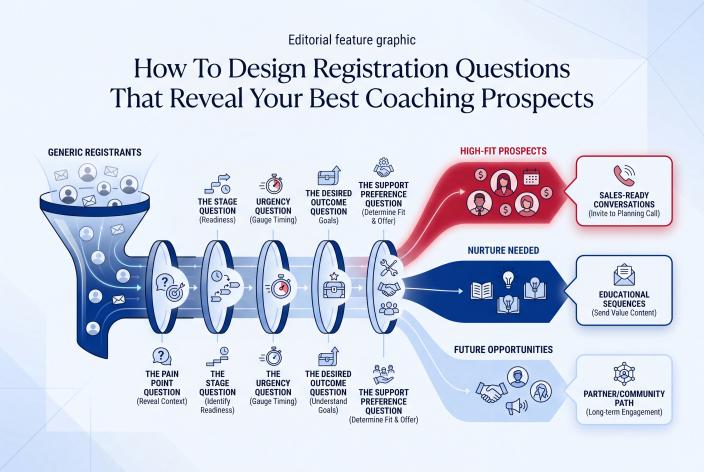
5 Types Of Registration Questions That Reveal Better Prospects
You don't need all 5 in every campaign.
For a simple webinar, 2 or 3 questions may be enough. For a summit, workshop series, or application-driven event, you may ask a little more.
The goal is to learn enough to guide the relationship without creating a registration wall.
1. The Pain Point Question
This tells you what problem brought the person into your world.
Examples:
- "What is the biggest challenge you're facing with client attraction right now?"
- "Where does your coaching business feel most inconsistent today?"
- "What made this topic feel relevant to you?"
This type of question is gold for coaches because prospects often describe their problem in plain language.
They might say:
- "I get referrals, but they come in waves."
- "I can sell when I get calls, but I don't get enough calls."
- "I post content, but I don't know if it's leading anywhere."
Those answers show you the emotional texture of the problem.
They also help you write better emails, better event follow-up, and better sales call invitations because you're using the words your market already uses.
2. The Stage Question
This helps you understand whether the person is in the right season for your offer.
Examples:
- "Which best describes your coaching business right now?"
- "Are you currently signing clients, building your first offer, or trying to make client flow more consistent?"
- "What stage are you in with this problem?"
You can make this multiple choice to keep it easy.
For example:
- I'm still clarifying my offer.
- I've sold before, but client flow is inconsistent.
- I have a working offer and want more qualified conversations.
- I'm preparing to launch or scale a group program, summit, workshop, or webinar.
This matters because each stage needs a different follow-up path.
Someone still clarifying their offer may need education and diagnosis. Someone with a proven offer and inconsistent client flow may be ready for a planning call. Someone launching a summit may need help connecting event strategy, registration, CRM, reminders, and follow-up.
Same list. Different context.
3. The Urgency Question
Urgency helps you understand timing.
This doesn't mean fake pressure. It means you want to know whether the problem is active, important, and relevant now.
Examples:
- "How soon are you looking to improve this?"
- "Is this a current priority, or are you gathering ideas for later?"
- "What happens if this stays the same for the next few months?"
That last question is especially useful for coaches because it reveals consequence.
A person who says, "I'll keep struggling to fill my group program," is in a different place than someone who says, "I'm just curious."
Both can be valuable.
But they should not receive the same follow-up.
4. The Desired Outcome Question
This tells you what the prospect actually wants.
Examples:
- "What would you most like to walk away with from this session?"
- "If this event is useful, what would it help you decide or do next?"
- "What would make the next 90 days feel more stable in your business?"
This question is powerful because prospects often reveal their buying criteria.
Some want more leads. Some want better-fit sales calls. Some want a calmer backend. Some want to stop stitching together tools and finally build a system.
For a coach selling implementation, strategy, or high-touch support, those details matter.
You can use the answer to make your follow-up more relevant. You can also use it to improve your event content because you're seeing what people actually came to solve.
5. The Support Preference Question
This question reveals whether someone is more DIY, done-with-you, or done-for-you in their thinking.
Examples:
- "What kind of support are you most interested in right now?"
- "Are you looking for ideas, a strategy, implementation help, or a team to build with you?"
- "If you decide to improve this area, how would you prefer to move forward?"
Possible answer choices:
- I want to learn and implement myself.
- I want a strategy I can follow.
- I want help building the system.
- I want a team to handle the setup and implementation.
- I'm not sure yet.
This is useful because it helps you avoid treating every registrant like a sales-ready buyer.
Some people need content. Some need a light-touch invitation. Some are actively looking for implementation support and should be invited into a more direct next step.
How To Ask Without Feeling Invasive
The tone of the question matters.
If your registration form feels like an interrogation, people will abandon it. If it feels like you're trying to understand their situation so you can make the event more relevant, they'll usually be more willing to answer.
A few simple guidelines help:
- Keep most questions optional unless the answer is essential.
- Use plain language, not internal marketing jargon.
- Mix multiple choice with 1 short open-ended question.
- Ask only what you will actually use.
- Keep the form short enough that registration still feels easy.
Here's a tip.
If you wouldn't want to answer the question as a first-time registrant, rewrite it.
How Answers Shape Segmentation And Follow-Up
Registration answers become valuable when they guide what happens next.
This is where many coaches drop the ball.
They collect great information, then leave it sitting in a spreadsheet or inside an event platform with no follow-up plan.
A better process connects each answer to a next step.
| Registration Signal | What It May Tell You | Useful Follow-Up |
|---|---|---|
| "I get referrals, but they're inconsistent" | They may need a predictable client attraction system | Send content about authority, capture, nurture, and follow-up |
| "I have a proven offer and need more calls" | They may be closer to sales readiness | Invite them to a planning call or post-event workshop |
| "I'm still clarifying my offer" | They may need diagnosis before implementation | Send educational nurture and positioning content |
| "I want someone to build this with me" | They may value support and implementation | Send a direct but calm invitation to talk through options |
| "I'm just researching" | They may need longer-term nurture | Keep them in a value-based email sequence |
This is where the funnel starts to feel human.
People are not being blasted with the same generic message. They're being guided based on what they told you.
How GHL/CRMRaptor Keeps Prospect Context Organized
Good registration questions create useful data.
But useful data needs somewhere to live.
GHL/CRMRaptor can support the CRM side of this process with contact records, tags, custom fields, calendars, funnels, workflows, automation, and follow-up. EventRaptor can connect event registrations and speaker activity into CRM and marketing systems through integrations, including GoHighLevel contact sync, tag management, and automated tagging.
In practical terms, that means a registrant's answers can help shape what happens next.
For example:
- A stage answer can apply a tag like "Proven Offer" or "Offer Clarity Needed."
- A pain point answer can populate a custom field for follow-up context.
- A support preference can trigger a more relevant nurture path.
- A high-urgency answer can flag someone for a timely call invitation.
- A summit or webinar attendee can be moved into a post-event follow-up sequence.
Now your follow-up is no longer dependent on memory, mood, or digging through notes.
The CRM holds the context so your communication can stay timely and relevant.
And when EventRaptor handles the virtual event side while GHL/CRMRaptor supports the CRM and follow-up side, the campaign becomes much easier to manage. Registration, attendee data, tags, reminders, event pages, and follow-up can work together instead of living in scattered tools.
A Simple Registration Question Framework You Can Use
If you're planning your next webinar, workshop, summit, or lead magnet, start with this structure:
- Ask what problem brought them here.
- Ask what stage they're in.
- Ask how urgent the issue feels.
- Ask what outcome they want.
- Ask what type of support they may want next.
Then map each answer to one of 3 broad follow-up paths:
- Education and nurture
- Invitation to a relevant next event or resource
- Invitation to a sales or planning conversation
Simple? Yes.
Powerful? Also yes.
Because now your registration form is doing more than collecting names. It's helping you recognize who needs what next.
The Takeaway For Coaches
Your best prospects often reveal themselves before they ever book a call.
They tell you through the problem they name, the urgency they feel, the stage they're in, and the kind of help they're looking for.
Your job is to ask in a way that feels natural, then use the answers responsibly.
That is how attention becomes trust.
And trust becomes better conversations.
If you want help improving lead quality, mapping your registration questions, or connecting your event, funnel, CRM, and follow-up strategy, Book your Client Attraction Planning Call.
On the call, we'll look at where your client flow is getting stuck and what kind of client attraction system could make sense for your coaching business.