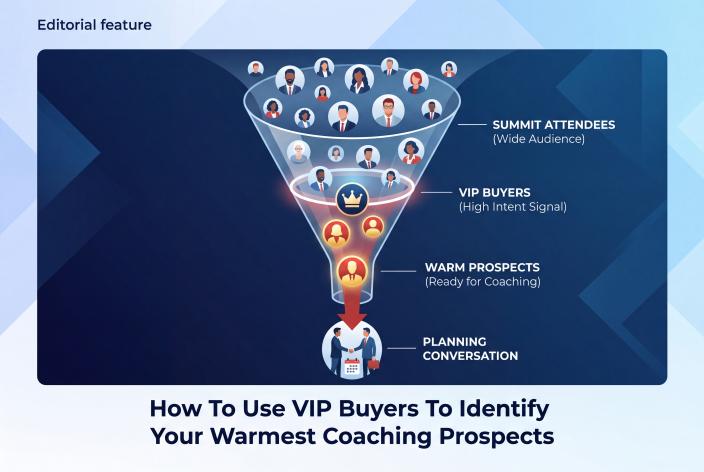
If you host a summit, workshop, webinar, or collaborative event, pay close attention to the people who buy the VIP upgrade.
That small purchase tells you something important.
They did more than register. They raised their hand, trusted you enough to pay, and showed they want more access, more depth, or more support around the topic you brought them into.
For a coach, that matters.
Because your best prospects are often hiding in plain sight. They may not book a call from the first invitation. They may not reply to the first email. But their behavior tells you who is leaning in.
VIP buyers are one of the clearest signals.
Not because every VIP buyer is ready for your highest level offer today. Some are still learning. Some are comparing options. Some simply wanted the replays or bonuses.
But a VIP purchase is a useful intent signal. And when you treat it that way, your summit or event becomes a much smarter client attraction system.
Why A Small Purchase Can Signal Bigger Intent
A free registrant is interested.
A VIP buyer has taken a second step.
That second step matters because it usually points to 3 things:
- Trust
- Urgency
- Higher engagement
They trusted the event enough to enter payment details. They cared enough about the topic to get more than the free version. And they were motivated enough to act while the opportunity was in front of them.
That does not mean they are automatically a perfect coaching client.
It does mean they deserve a more thoughtful follow-up path than a generic post-event newsletter.
Here’s a simple way to think about it:
| Attendee Behavior | What It Can Suggest | Follow-Up Priority |
|---|---|---|
| Registered for free | Topic interest | Nurture and educate |
| Attended sessions | Active engagement | Invite deeper interaction |
| Bought VIP | Trust and higher intent | Prioritize follow-up |
| Clicked offer links | Specific problem awareness | Invite conversation |
| Replied or asked questions | Relationship readiness | Personal outreach |
You see the pattern?
You are not guessing who is warm. You are watching what people do.
And that gives you a calmer, more respectful way to follow up.
Why Coaches Often Miss This Signal
Many coaches focus so much on the event itself that they lose the trail after the purchase.
They celebrate the VIP sale, deliver the replays or bonuses, and then move on to the next campaign.
But the VIP purchase is more than a transaction. It is part of the trust journey.
Someone just told you, through action, “This topic matters enough that I want more.”
So what happens next?
If there is no clear next step, that interest cools. The person goes back to their inbox, their calendar, their problems, and their other priorities.
This is where a good funnel earns its keep.
A funnel is the full path from attention to trust to conversation. The VIP purchase is one milestone in that path. Your job is to guide the right buyers forward without making them feel pushed.
The Best Place To Invite VIP Buyers Into A Planning Conversation
The first invitation should happen right after the purchase.
Why?
Because that is when attention is highest.
The buyer has just taken action. They are thinking about the topic. They are open to the next step. And if your coaching offer connects naturally to the problem the event is solving, a planning conversation can feel helpful.
Your thank-you page can say something simple:
“You’re all set with VIP access. If this topic is connected to a bigger client attraction, business growth, health, leadership, or life transition goal you’re working on, you may also want to book a planning conversation so we can look at what makes sense for your situation.”
For EventRaptor and VirtualSummits.com, the article CTA would look like this:
Book your Client Attraction Planning Call
Notice the tone.
It is not pressure. It is not hype. It is a natural next step for someone who wants help applying the topic to their own business.
For your coaching business, the call name should match your offer and audience. A health coach might call it a Wellness Strategy Call. A leadership coach might call it a Leadership Growth Planning Call. A wealth coach might call it a Financial Clarity Session.
The name matters less than the purpose.
The buyer should understand that the call is a practical conversation, not a trap.
The Post-Purchase Path From Thank-You Page To Calendar
Let me show you the clean version.
A VIP buyer should move through a path that feels personal, helpful, and organized.
Step 1: Confirm The Purchase Clearly
The thank-you page should first reassure them.
Tell them:
- Their VIP access is confirmed
- What they get
- When and how they will receive access
- What to expect next
This reduces confusion and support questions.
It also creates trust. People feel safer when the experience is clear.
Step 2: Offer The Next Conversation As Optional
After confirming the purchase, invite them into the next step.
Use gentle language like:
- “If you want help applying this to your situation...”
- “If this is an area you’re ready to work on more seriously...”
- “If you’d like a more personalized conversation...”
Then link to the calendar.
Keep the invitation short. A thank-you page is not the place for a full sales page.
Step 3: Trigger A VIP Buyer Nurture Sequence
This is where many coaches drop the ball.
The buyer should receive a different follow-up sequence than a free registrant.
Why?
Because their behavior is different.
A VIP nurture sequence can include:
- A warm confirmation email
- A reminder about how to use their VIP access
- A short story or teaching email related to the event topic
- A soft invitation to book a call
- A post-event recap
- A message that helps them decide whether deeper support is a fit
Good automation does not replace the relationship. It protects the relationship by making sure the right message goes out at the right time.
Step 4: Use Behavior To Prioritize Personal Follow-Up
Not every VIP buyer needs a personal email from you immediately.
But some should move to the top of your follow-up list.
Prioritize buyers who:
- Bought VIP early
- Attended live
- Clicked the calendar link
- Watched or accessed deeper content
- Asked questions
- Replied to emails
- Matched your best client profile based on registration answers
This is where CRM tagging becomes useful.
You are no longer relying on memory. You are using behavior and data to decide who deserves more attention now.
How EventRaptor Registration Data Helps You See Who Is Warm
EventRaptor supports the event side of this process by helping you collect and organize attendee and registrant information.
That can include registrant lists, VIP status, promoter attribution, registration growth tracking, custom registration questions, attendee dashboards, follow-up emails, and CRM syncing.
In plain English, that means you can see who raised their hand, how they came in, and what kind of next step may make sense.
For a coach, this is powerful.
Because you do not just want a list of names. You want a clearer picture of where people are in the relationship.
For example, your registration questions might ask:
- “What best describes your current stage?”
- “What is the biggest challenge you want help with?”
- “Are you currently looking for support in this area?”
- “What kind of help are you most interested in?”
When someone buys VIP and their answers match your ideal client profile, you now have a stronger signal.
Not a guarantee.
A signal.
And signals help you follow up more intelligently.
How CRM Tags Help You Prioritize Follow-Up
Your CRM is where the event interest becomes a managed follow-up process.
With EventRaptor connected to GHL/CRMRaptor, event activity can flow into the broader CRM and follow-up system through contact sync, tags, custom values, calendars, funnels, workflows, and automation.
That gives you a simple way to segment people based on action.
A practical tag structure might include:
| Tag | Purpose |
|---|---|
| Event Registered | Identifies everyone who joined the event list |
| VIP Buyer | Separates purchasers from free registrants |
| Attended Live | Shows deeper engagement |
| Clicked Calendar | Marks buying conversation interest |
| Applied For Call | Shows direct next-step action |
| Not A Fit Now | Keeps follow-up respectful |
| Future Nurture | Keeps the relationship alive |
Tags are not magic. They are memory.
They help your business remember what happened so you can respond in a more human way.
Without tags, warm prospects disappear into one big list.
With tags, you can see who should receive a personal note, who should receive a planning call invitation, who needs more education, and who is probably not ready yet.
The Follow-Up Should Match The Buyer’s Energy
Here’s a tip.
Do not treat every VIP buyer like they are one click away from hiring you.
Some are. Many are not.
The follow-up should give them room to move closer.
A simple post-purchase sequence might look like this:
- Immediately After Purchase: Confirm VIP access and invite them to book a planning call if the topic is a priority.
- Before The Event: Send useful preparation content and remind them why the topic matters.
- During The Event: Point them to the most relevant sessions or resources.
- After The Event: Recap the key lessons and invite them to apply the ideas to their own situation.
- Several Days Later: Share a case-relevant teaching point, objection answer, or diagnostic checklist.
- Ongoing Nurture: Keep sending useful content that helps them understand the problem, the cost of waiting, and the value of getting support.
This keeps the relationship warm without making every email a sales pitch.
And when they do book a call, they arrive with more context, more trust, and a clearer understanding of why the conversation matters.
What To Look For Before Inviting A VIP Buyer Personally
Automated invitations are fine.
Personal outreach should be more selective.
Before you send a direct note, look for fit and engagement.
Ask yourself:
- Did they buy VIP?
- Did they attend or access content?
- Did their registration answers match my ideal client profile?
- Did they click the calendar link?
- Did they ask a question or reply?
- Do they seem connected to the problem my coaching solves?
If the answer is yes to several of those, a personal message can be appropriate.
Keep it simple:
“Hi Sarah, I saw you upgraded to VIP for the event and mentioned that your biggest challenge is creating more consistent client conversations. That is exactly what this event is designed to help with. If you want to talk through how this could apply to your business, you’re welcome to book a planning call here.”
That feels different from a mass pitch.
It is specific. It is relevant. It respects the action they already took.
The Bigger Lesson For Your Coaching Funnel
VIP buyers help you see something most coaches need to build into their entire client attraction system.
Your warmest prospects reveal themselves through behavior.
They register. They attend. They buy. They click. They reply. They ask better questions. They come back for more.
When your event, funnel, CRM, and follow-up are connected, you can notice those signals and respond while the interest is still warm.
That is the shift.
You move from chasing everyone to guiding the right people.
And your event becomes more than a few days of content. It becomes an authority-building asset, a relationship-building asset, and a practical way to identify the people most likely to want a deeper conversation.
Your Next Step
If you are planning a summit, workshop, webinar, or speaker-led campaign, do not treat the VIP offer as only a revenue add-on.
Use it as a signal.
Build the path behind it:
- A clear thank-you page
- A helpful planning call invitation
- VIP-specific nurture
- CRM tags that identify buyer behavior
- Follow-up that matches engagement and fit
- A calendar path for the people ready to talk
This is much easier when your event pages, registration data, VIP status, CRM tags, reminders, and follow-up are connected.
EventRaptor helps manage the virtual event side, while GHL/CRMRaptor supports the CRM, funnel, calendar, workflow, and follow-up side.
If you want help applying this to your coaching business, Book your Client Attraction Planning Call. We will look at where your client flow is getting stuck and what kind of authority, funnel, CRM, follow-up, or event strategy could make sense next.