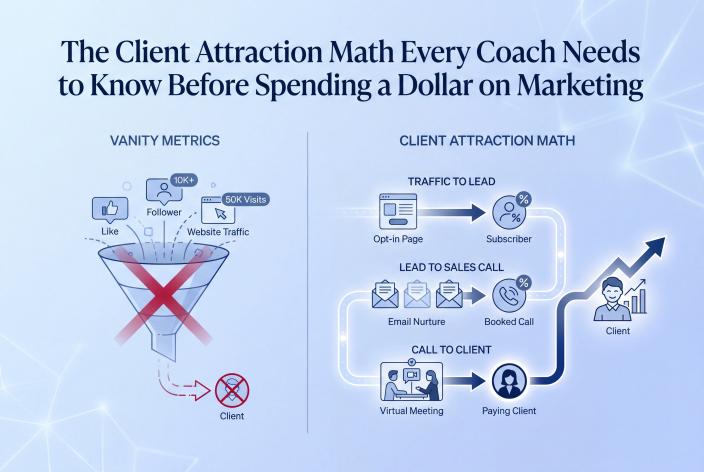
You're Measuring the Wrong Things
Here's the truth nobody wants to hear: your email list size doesn't matter. Your follower count doesn't matter. Your website traffic doesn't matter.
What matters is how many of those people actually become paying clients.
I see coaches obsess over vanity metrics all the time. They'll tell me they grew their list to 5,000 people or hit 10,000 followers, and they're excited. But then I ask the real question: how many clients did that translate into?
Silence.
The answer is usually: not enough to justify the time and money spent. And that's because they're playing a different game than the one that actually makes money.
The Three Ratios That Actually Matter
Let me introduce you to the metrics that will change how you think about marketing forever.
1. Conversion Rate from Traffic to Lead
This is simple. Out of everyone who lands on your opt-in page or registration page, what percentage actually signs up?
The exact target depends on the audience, the traffic source, and the offer. But if people are landing on the page and not opting in, the page is telling you something.
Usually, the headline is too broad, the promise is not specific enough, or the page is not speaking to the problem the visitor already cares about.
2. Conversion Rate from Lead to Sales Call
Now you have them on your list. But what percentage actually book a call with you?
If only a tiny percentage of leads ever schedule a conversation, that does not automatically mean your offer is bad. It may mean your follow-up sequence is weak, your messaging is unclear, or your invitation is buried.
Here's what changes this: a clear, consistent invitation in every email. Not pushy. Just clear. "If you'd like to discuss how this works for your situation, book a call here." And then you make it easy to book.
When you get this right, more of the right people understand why a call is the natural next step.
3. Conversion Rate from Sales Call to Client
This is where the real money lives.
Out of everyone who gets on a call with you, what percentage actually becomes a paying client?
If calls are happening but the wrong people keep showing up, you may have a qualification problem.
If good-fit prospects understand the problem but still do not move forward, you may have an offer, risk reversal, or sales conversation problem.
The Math That Tells You Everything
Let's put this together and see what actually happens.
Say you run a virtual summit. To understand whether it worked, you would track registrations, call invitations, calls booked, qualified calls, show-ups, and clients.
The useful question is not just, "How many people registered?"
It is, "How many right-fit prospects moved from attention to trust to conversation?"
Most coaches do not know because they do not measure the whole path. They run the summit, hope for the best, and then wonder why it did or did not work.
Your Cost Per Client Tells You If You Should Keep Going
This is where you decide if a strategy is worth your time.
Your cost per client tells you whether the strategy is worth repeating.
To calculate it, add up the real cost of the campaign: software, support, ads if you used them, contractor help, and the value of the time involved. Then divide that by the number of clients who came from the campaign.
If the cost per client is healthy compared with the value of the client, you have something to improve and repeat.
If the cost per client is too high, you do not guess. You look for the weak link.
Was it the registration page? The theme? The follow-up? The call invitation? The qualification? The offer? The sales conversation?
The Conversion Signals You Need To Watch
Here are the signals worth watching, depending on your strategy.
For virtual summits: Watch registration page performance, attendance, replay views, email engagement, call invitations, calls booked, and qualified conversations.
For email nurture sequences: Watch opens, clicks, replies, call bookings, and which emails create the most intent.
For paid ads: Watch cost per lead, lead quality, call bookings, and whether paid traffic is bringing people who are actually qualified.
For sales calls: Watch show-up rate, fit, objections, close rate, and whether prospects arrive already understanding your value.
The Real Reason Most Coaches Stay Stuck
They don't measure. They don't know their numbers. So they can't tell if something is working or if they're just throwing darts in the dark.
They'll run a summit, feel excited about the registrations, then feel disappointed when only a small number of clients come from it. But they don't know whether the issue was the summit, the follow-up, the call invitation, the offer, or the sales conversation.
So they abandon summits and try something else. They run ads. Same problem. No measurement. No clarity. Just hope.
Here's what I want you to do. Pick one marketing channel. Could be summits, could be webinars, could be Facebook Lives. Run it. Measure all three conversion rates. Do the math.
If your cost per client is lower than what you'd pay for ads or other channels, keep going and optimize. If it's higher, fix the weak link before you scale.
The Path Forward
You don't need a bigger audience. You need a smarter funnel.
You don't need more followers. You need better conversion rates.
And you don't need to guess anymore. The math is simple. Run it. Know your numbers. Then you'll know exactly which lever to pull to grow.
If you want help building a funnel that turns attention into better conversations, Book your Client Attraction Planning Call. We’ll walk through where your client flow is getting stuck and what kind of authority, funnel, CRM, follow-up, or event strategy could make sense next.
Because once you understand the math, everything changes. You'll know exactly what's working and what's not. You'll spend money with confidence. And you'll build a business that grows by design, not by luck.
The clearer the numbers become, the easier it is to choose the next practical move.