If your client flow feels inconsistent, your first instinct may be to create more content, run another webinar, or push harder for referrals.
That makes sense.
When the calendar gets quiet, visibility feels like the obvious problem.
But here's the uncomfortable part. More attention only helps when the rest of the path can handle it.
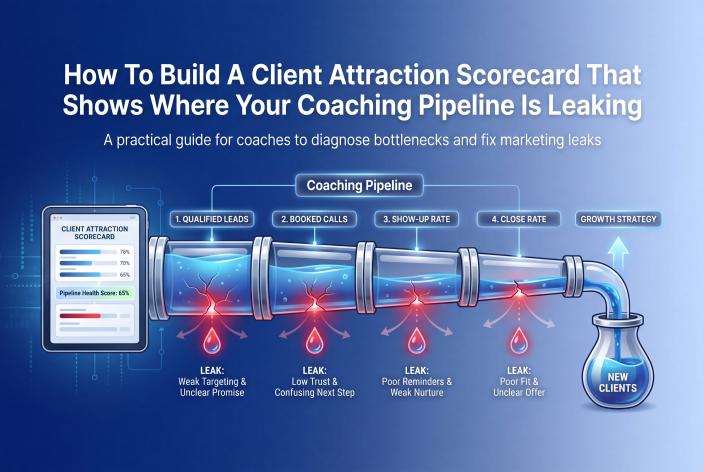
If the right people are seeing you but not opting in, you may have a message problem. If they're opting in but not booking calls, you may have a trust or offer problem. If they're booking but not showing up, you may have a follow-up problem. If they're showing up but not buying, you may have a qualification, sales, or fit problem.
So before you pour more energy into the next tactic, build a simple scorecard.
A client attraction scorecard helps you see where the pipeline is leaking, so you can fix the right part of the system first.
Why Most Coaches Misread Their Pipeline Problem
A lot of good coaches describe their problem like this:
"I need more leads."
Sometimes that's true.
But often, the real issue is that leads are already slipping through gaps you can't see clearly.
A coach might get podcast listeners, workshop attendees, summit registrants, referral introductions, website visitors, or social media interest. But if those people are not captured, tagged, nurtured, followed up with, and guided toward the next useful step, that attention disappears.
And it disappears quietly.
No dramatic failure. No obvious warning light. Just fewer booked calls than expected, too many cold conversations, and that nagging feeling that your marketing should be working better than it is.
That's why your scorecard needs to measure the whole journey:
- Visibility
- Lead capture
- Qualification
- Follow-up
- Call booking
- Show-up
- Sales conversion
- Source quality
The goal is not to obsess over numbers all day.
The goal is to stop guessing.
The Core Client Attraction Scorecard Numbers
You do not need a giant dashboard to start.
You need a few numbers that tell the truth.
Here are the core numbers I would track first.
| Scorecard Number | What It Tells You | Where Leaks Often Show Up |
|---|---|---|
| Qualified Leads | Whether the right people are entering your world | Weak targeting, broad topics, unclear promise |
| Booked Calls | Whether leads are moving toward a real conversation | Weak CTA, low trust, confusing next step |
| Show-Up Rate | Whether booked prospects stay engaged before the call | Poor reminders, weak pre-call nurture, low commitment |
| Close Rate | Whether sales calls are turning into clients | Poor fit, unclear offer, weak sales process |
| Source Quality | Which channels produce the best opportunities | Too much effort spent on low-fit visibility |
| Follow-Up Completion | Whether warm leads are actually being nurtured | Manual follow-up, scattered tools, inconsistent timing |
Let's make each one practical.
Qualified Leads
A qualified lead is someone who fits the audience your offer is designed for and has shown enough interest to be worth follow-up.
For a coach, this might mean they:
- Registered for a workshop on a problem you solve
- Attended a summit session related to your niche
- Downloaded a guide tied to your paid offer
- Applied for a call and answered fit questions well
- Engaged with a partner event or referral introduction
Notice the key word: qualified.
A bigger list filled with people who do not want, need, trust, or value your offer will not make your business calmer.
Your scorecard should separate raw leads from right-fit leads.
Ask yourself:
- How many people entered my pipeline this month?
- How many matched my ideal client profile?
- How many had a problem my offer actually solves?
- How many had enough urgency, capacity, or readiness to continue?
If raw leads are coming in but qualified leads are low, your visibility may be too broad.
Booked Calls
Booked calls show whether your audience is taking a meaningful step toward working with you.
This is where many coaches see the first real leak.
People consume content. They attend events. They say, "This was great." Then they vanish.
Why?
Usually because the next step was not clear, timely, or compelling enough.
Your scorecard should track:
- Total leads captured
- Qualified leads
- Call applications or booking page visits
- Calls booked
- Calls booked by source
That last one matters.
A summit registrant, podcast listener, referral, webinar attendee, and cold social media lead may all behave differently. If you lump them together, you lose the ability to see which channel is producing real opportunity.
Here's a tip.
Track booked calls by source before you decide where to spend more time.
Show-Up Rate
A booked call is not the same as a real sales conversation.
If people book and do not show, your pipeline has friction between booking and attendance.
That friction might come from weak reminders, low urgency, unclear call expectations, or a booking process that lets too many casual prospects onto your calendar.
Your show-up rate is simple:
Completed Calls ÷ Booked Calls = Show-Up Rate
You do not need to compare yourself to anyone else to make this useful.
Just compare your current month to your previous months.
If show-up drops, look at what changed:
- Did the lead source change?
- Did the booking page change?
- Did reminders go out?
- Did prospects receive useful pre-call education?
- Did your application questions qualify commitment?
Good follow-up protects the relationship before the call ever happens.
A timely confirmation, reminder, short pre-call email, or useful piece of education can make the call feel more real and more valuable.
Close Rate
Close rate tells you what happens once a qualified prospect actually speaks with you.
The formula is simple:
New Clients ÷ Completed Sales Calls = Close Rate
But the interpretation takes care.
A low close rate does not automatically mean you're bad at sales.
It may mean:
- The wrong people are booking
- Your offer is not specific enough
- Prospects do not understand the value before the call
- Your pricing and audience are misaligned
- Your sales conversation is doing too much education
- The call is happening too early in the trust journey
This is where many coaches blame themselves when the real problem is upstream.
If prospects arrive confused, skeptical, underqualified, or only mildly curious, the sales call has to carry too much weight.
Your marketing should build trust before the call.
Source Quality
Source quality may be the most underrated number in your scorecard.
Not all leads are equal.
Some sources produce polite interest. Others produce real conversations.
Track each source separately:
- Referrals
- Podcast interviews
- Guest speaking
- Virtual summits
- Webinars
- Workshops
- Organic content
- Email list
- Partner promotions
- Paid traffic, if used
Then score each source on practical quality markers:
| Source | Lead Volume | Fit | Booked Calls | Show-Up | Sales Conversations | Notes |
|---|---|---|---|---|---|---|
| Workshop | Medium | Strong | Track | Track | Track | Good topic fit |
| Podcast Guest Spot | Low | Strong | Track | Track | Track | More nurture needed |
| Broad Social Post | High | Mixed | Track | Track | Track | Needs clearer CTA |
| Referral | Low | Strong | Track | Track | Track | High trust coming in |
You can keep this in a spreadsheet at first.
The important thing is to stop treating every lead source like it deserves the same time, energy, and follow-up.
How To Spot A Traffic Problem Versus A Conversion Problem
This is where the scorecard starts to earn its keep.
A traffic problem means not enough right-fit people are entering the pipeline.
A conversion problem means people are entering, but they are not moving to the next step.
Here's the quick diagnosis.
You May Have A Traffic Problem If
- Very few people are seeing your offer, event, or lead magnet
- Registrations, opt-ins, or inquiries are low across every channel
- Partners are not promoting or sending traffic
- Your audience does not know what you want to be known for
- You have little visibility in the niche you want to serve
In this case, more authority-building visibility can help.
That could include podcast interviews, workshops, guest sessions, partner events, webinars, or a virtual summit built around a specific audience and problem.
But you still want the capture and follow-up path ready before you increase attention.
You May Have A Conversion Problem If
- People visit but do not opt in
- People register but do not attend
- Attendees do not book calls
- Booked calls do not show
- Sales calls happen, but too few become clients
- Leads engage once, then go quiet
In this case, the issue is somewhere inside the trust path.
You may need clearer messaging, stronger positioning, better call-to-action placement, pre-call nurture, better qualification, or more consistent follow-up.
And yes, this can feel frustrating.
But it's also good news.
A conversion problem is often easier to fix than a complete lack of attention because you already have some signal from the market.
The Simple Leak Diagnosis Framework
Use this quick framework once a week or once a month.
Step 1: Count The Attention
Look at the number of people who saw or engaged with your visibility assets.
This could include event page visits, podcast traffic, email clicks, social post engagement, workshop registrations, or summit registrations.
Ask:
- Where did attention come from?
- Was the audience relevant?
- Did the topic match the offer?
Step 2: Count The Captured Leads
Now look at how many people gave you permission to continue the conversation.
That might be a registration, opt-in, application, or email signup.
Ask:
- Was the lead capture step clear?
- Was the promise specific?
- Did the page speak to a real problem?
Step 3: Count The Movement
This is where you track the next step.
Did the person attend? Click? Reply? Book? Apply?
Ask:
- Did the follow-up happen while interest was warm?
- Did the next step feel natural?
- Did the prospect know why that step mattered?
Step 4: Count The Conversations
Now look at qualified sales conversations.
Not random chats. Not free coaching calls with anyone who can grab a calendar slot.
Qualified conversations.
Ask:
- Did the person fit the offer?
- Did they understand the value before the call?
- Did the call confirm fit or reveal a mismatch?
Step 5: Count The Clients
Finally, track who became a client and where they came from.
Ask:
- Which sources produced clients or strong opportunities?
- Which sources produced unqualified calls?
- Which follow-up path created the best conversations?
This is how you stop treating your pipeline like a mystery.
How Events, Podcasts, Workshops, And Funnels Should Connect To CRM Follow-Up
Visibility creates the opening.
Follow-up creates the continuity.
If you host a virtual summit, run a workshop, speak on a podcast, or promote a funnel, each of those activities should feed your CRM in a way that helps you continue the relationship intelligently.
That means your system should capture useful information such as:
- Where the lead came from
- What they registered for
- Which topic caught their attention
- Whether they attended
- Whether they clicked or replied
- Whether they booked a call
- Whether they became a client
This is where connected systems matter.
EventRaptor helps manage the virtual event side, including registrations, event pages, speakers, schedules, attendee data, reminders, partner tracking, and follow-up paths. GHL/CRMRaptor supports the CRM, calendar, funnel, workflow, automation, and follow-up side.
Together, the event activity and CRM follow-up can become one clearer client attraction process.
That does not mean software does the strategic thinking for you.
You still need a clear audience, a meaningful offer, credible expertise, and consistent follow-through.
But when your event, funnel, calendar, and follow-up data are connected, you can make better decisions.
You can see which partner sent good leads. You can see which session topic created call interest. You can see which attendees need nurture. You can see which leads are ready for a direct invitation and which need more trust first.
That's a very different feeling than digging through spreadsheets, inboxes, registration exports, and memory.
What To Do With Your Scorecard Each Month
Once you have the numbers, do not try to fix everything at once.
Pick the biggest leak.
Use this simple decision guide:
| If This Is Low | Work On This First |
|---|---|
| Qualified Leads | Niche clarity, partner strategy, event topic, traffic source |
| Lead Capture | Landing page promise, registration flow, opt-in offer |
| Booked Calls | CTA, nurture sequence, trust-building content, call positioning |
| Show-Up Rate | Reminders, pre-call education, application quality |
| Close Rate | Offer clarity, qualification, sales process, audience fit |
| Source Quality | Channel selection, partner fit, topic alignment |
| Follow-Up Completion | CRM workflows, tags, reminders, ownership |
Here's the discipline.
Fix one bottleneck, then measure again.
If you try to rewrite the offer, launch a summit, change the CRM, create a new lead magnet, rebuild your booking page, and start a podcast in the same week, you will not know what helped.
A mature coaching business improves the pipeline in pieces.
A Simple Monthly Scorecard You Can Use
You can start with this layout.
| Metric | This Month | Last Month | Best Source | Biggest Leak | Next Fix |
|---|---|---|---|---|---|
| Qualified Leads | |||||
| Calls Booked | |||||
| Calls Completed | |||||
| Show-Up Rate | |||||
| New Clients | |||||
| Close Rate | |||||
| Follow-Up Completed | |||||
| Highest Quality Source |
Do not overcomplicate it.
If you are early in tracking, the first win is simply seeing the path.
Once you can see the path, you can improve it.
The Real Point Of The Scorecard
The point is not to turn your coaching business into a cold numbers machine.
The point is to protect the human part of the business.
When follow-up is scattered, good prospects get forgotten. When the next step is unclear, interested people drift away. When unqualified people book calls, your energy gets drained. When you do not know which source is working, you keep feeding channels that may never produce right-fit conversations.
A scorecard gives you calm.
It shows you where trust is being built, where it is breaking, and where the next improvement belongs.
And when you combine that scorecard with authority-building events, clear funnels, CRM follow-up, and a real sales path, your marketing starts to feel less like a scramble.
It starts to feel like a system.
Your Next Step
If your coaching works but your client flow still feels unpredictable, your next move is to find the real bottleneck.
Maybe you need more focused visibility. Maybe your event or workshop topic is too broad. Maybe your CRM is not following up while interest is warm. Maybe people are booking calls before they understand your offer. Maybe the right-fit prospects are there, but the path from attention to conversation is too leaky.
If you want help applying this to your own business, Book your Client Attraction Planning Call.
On the call, we will look at where your client flow is getting stuck and what kind of authority, funnel, CRM, follow-up, or event strategy could make sense next.