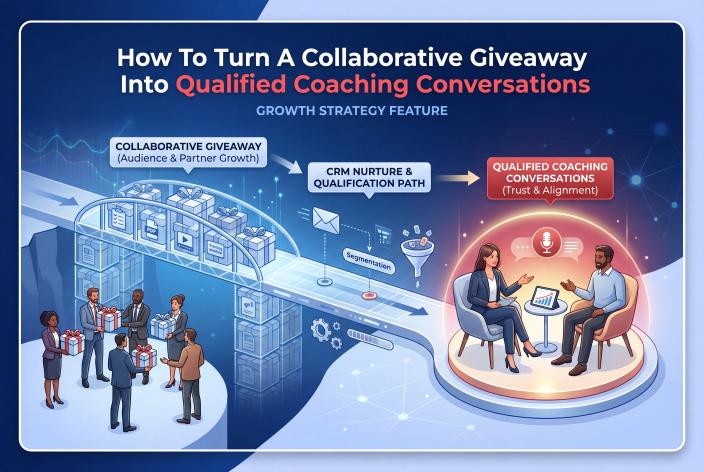
If your referrals have slowed down and your content is taking too long to produce sales conversations, a collaborative giveaway can be a smart next move.
Especially if you're not quite ready for a full summit.
A giveaway gives you partner-powered visibility without asking you to produce a large multi-day event, manage a heavy speaker lineup, or create a full podcast season. You bring together aligned contributors, each person offers a useful gift, and the audience gets a clear reason to opt in.
Simple idea.
But here's where many coaches miss the bigger opportunity.
The giveaway itself is only the front door. The real client attraction value comes from what happens after someone registers, clicks, downloads, engages, and raises their hand.
That's where you turn attention into trust.
And trust into qualified coaching conversations.
When A Collaborative Giveaway Makes Sense
A collaborative giveaway works best when you want audience growth, partner relationships, and warm lead capture, but you do not need the full authority stage of a summit yet.
Think of it as a lighter collaborative campaign.
A summit usually asks more from everyone. Speakers create sessions. Attendees commit to showing up for a schedule. The host manages presentations, timing, reminders, replays, speaker assets, and a more involved event experience.
A webinar is usually simpler, but it depends more heavily on your own audience, your own promotion, and your own conversion process.
A podcast campaign can build deep authority over time, but it is slower by nature. It also requires consistency before the growth compounds.
A giveaway sits in a useful middle ground.
It can help you:
- Grow an owned audience through partner promotion
- Build relationships with contributors in adjacent niches
- Give prospects a low-friction way to experience your world
- Test which topics, offers, and partners attract aligned leads
- Create a follow-up path without running a larger event
So when does it make sense?
Use a giveaway when you have a clear audience and offer, but you want more people entering the top of your client attraction system. It also fits when you want to strengthen your network before hosting a summit, workshop series, or partner-led campaign.
EventRaptor supports this kind of campaign with giveaway management tools such as contributor workflows, gift management, registration setup, giveaway dates, leaderboards, and data exports. It also supports public giveaway directories and contributor performance tracking, which makes the campaign easier to organize as more partners get involved.
The key is to treat the giveaway as a relationship and follow-up campaign, not just a list-building activity.
Choose Contributors By Audience Fit First
A collaborative giveaway rises or falls on contributor alignment.
Big audiences can look tempting. But for a coach, audience fit matters far more than raw reach.
You want contributors whose people are likely to care about the problem your coaching solves.
For example, if you're a leadership coach for new managers, useful contributors might include:
- A workplace communication trainer
- A career coach who serves emerging leaders
- A productivity expert for corporate professionals
- A consultant who helps teams reduce burnout
- A facilitator who works with HR or people operations teams
Those audiences overlap with your buyer's world.
That matters.
A random wellness influencer with a large list may bring registrations, but those leads may never become qualified coaching conversations if the audience does not match your offer.
Use A Simple Contributor Fit Filter
Before inviting someone, ask these questions:
- Does their audience include people who could realistically need my coaching?
- Do they have trust with that audience?
- Does their gift complement my work without directly competing with it?
- Would I feel good introducing this person to my own audience?
- Could this relationship grow beyond one campaign?
That last question is important.
Partner-powered growth works better when you stop thinking in one-off promotions and start building a network of aligned relationships. The giveaway can be the first collaboration. Later, that same relationship might lead to a podcast interview, webinar swap, summit invitation, referral, or joint workshop.
You are not only collecting gifts.
You are building a small authority ecosystem around the problem your audience already wants solved.
Design The Giveaway Around Your Coaching Position
A weak giveaway is usually a pile of random lead magnets.
A stronger giveaway has a clear theme that points toward your coaching offer.
If you help health coaches reduce emotional eating, the giveaway should not be a generic health bundle. It could be focused on rebuilding trust with food, calming stress patterns, improving evening routines, or creating a healthier relationship with the body.
If you help business owners sell high-ticket services, the giveaway could focus on consultative selling, offer clarity, buyer trust, follow-up, and sales call confidence.
See the difference?
The theme pre-frames the audience.
It tells the right people, "This is for me."
It also makes your follow-up easier because you already know why they opted in. They were not chasing a random freebie. They entered through a topic connected to the transformation you sell.
Your Host Gift Should Create A Next Step
As the host, your gift should be more than a nice PDF.
It should help people move one step closer to understanding their problem and seeing why your work matters.
Good host gifts for coaches include:
- A diagnostic checklist
- A short training
- A planning worksheet
- A scorecard
- A guided self-assessment
- A mini workshop replay
- A decision map
The best host gift creates useful insight and leads naturally into your next step.
For example, if your coaching helps executives communicate better under pressure, your giveaway gift might be a "Difficult Conversation Readiness Scorecard." After someone completes it, your follow-up can speak directly to the gaps they discovered.
That makes the next conversation feel relevant, not forced.
Build The Follow-Up Before You Launch
This is the part most coaches leave too late.
They put their energy into recruiting contributors, building the registration page, and getting the campaign live. Then the giveaway ends, the spreadsheet fills up, and everyone gets busy.
Warm interest cools quickly when there is no follow-up path.
So build the path before the first person registers.
At minimum, you need follow-up for 4 groups:
- New registrants who joined the giveaway
- Engaged leads who clicked, downloaded, or visited your host gift
- Highly aligned leads who answered qualifying questions or showed stronger intent
- Contributors who promoted, participated, or could become future partners
Each group needs a different next step.
New registrants may need orientation and helpful education.
Engaged leads may need a deeper training, story, checklist, or invitation.
Highly aligned leads may be ready for a planning call, webinar, workshop, or application.
Contributors may need a thank-you sequence, results summary, and future collaboration invitation.
This is where a giveaway becomes part of a real client attraction system.
EventRaptor can help organize registration, contributor activity, gift management, leaderboards, and exports. When connected with GHL/CRMRaptor, the CRM side can support contact records, tags, calendar paths, funnels, workflows, and follow-up automation.
EventRaptor manages the giveaway and event activity. GHL/CRMRaptor supports the CRM and follow-up layer.
Together, the campaign has a better chance of becoming a managed path instead of a pile of names.
Track Contributors So You Know What Worked
Partner campaigns get messy fast when tracking is weak.
You want to know who promoted, who registered, which contributors created momentum, and which audiences seemed most aligned.
This matters for 2 reasons.
First, you want to thank and reward the people who helped.
Second, you want better data for your next campaign.
A contributor who sends fewer leads but highly engaged prospects may be more valuable than a contributor who sends a large number of poor-fit registrations. Without tracking, those differences are easy to miss.
Useful contributor tracking includes:
- Unique contributor or promoter links
- Registration attribution
- Contributor leaderboards
- Gift performance
- Exportable campaign data
- Notes on partner quality and audience fit
EventRaptor includes giveaway leaderboards, contributor management, gift management, registration setup, and data exports. It also supports promoter tracking and performance reporting for event campaigns.
That means you can stop trying to reconstruct the campaign from memory, inbox threads, and scattered spreadsheets.
And you can make smarter decisions next time.
Move Engaged Leads Into CRM Nurture
A giveaway lead is rarely ready to buy just because they registered.
They raised their hand for a topic.
Now your job is to guide them.
That means your CRM should not treat every giveaway registrant the same. Use tags, custom fields, or segments to separate people based on what they did and what they appear to care about.
For example, you might tag leads by:
- Giveaway registration
- Gift downloaded
- Host gift viewed
- Topic interest
- Contributor source
- VIP or upgraded status, if relevant
- Planning call interest
- Webinar or workshop invitation clicked
This gives you a cleaner nurture path.
Someone who downloaded your diagnostic can receive education connected to that diagnostic. Someone who clicked your planning call link can receive more direct pre-call content. Someone who came through a specific contributor can receive messaging that acknowledges the theme or problem that brought them in.
Good automation does not make the relationship colder.
It helps you follow up while the interest is still fresh.
That is a big shift for many coaches. They worry automation will sound robotic, so they leave follow-up to memory, mood, and spare time. Then good leads disappear.
A thoughtful CRM nurture sequence can feel personal because it is timely, relevant, and based on what the person actually did.
Give The Giveaway A Clear Conversion Path
You do not need to pitch coaching aggressively during a collaborative giveaway.
But you do need a visible next step.
The next step could be:
- A workshop
- A private training
- A webinar
- A consultation application
- A short diagnostic call
- A scorecard result review
- A planning call
- A nurture sequence leading to a launch
Choose the step based on your offer, price point, sales process, and audience readiness.
If you sell a premium coaching package, the goal is usually not instant checkout. The goal is a qualified conversation with someone who already understands the problem, trusts your perspective, and sees a reason to talk.
Your giveaway follow-up should help them answer a few simple questions:
- What problem am I actually dealing with?
- Why does it matter now?
- What would a better path look like?
- Why is this coach a credible guide?
- What should I do next if I want help?
When your follow-up answers those questions calmly and clearly, the sales conversation starts warmer.
You spend less time convincing.
You spend more time diagnosing fit.
Keep The Contributor Relationship Alive
The contributor side matters too.
After the giveaway, do not just send a quick thank-you and disappear.
Send contributors a simple follow-up that includes:
- Appreciation for their participation
- Any relevant campaign data you can share responsibly
- Their contribution status or performance
- A reminder of where their gift was featured
- A next-step invitation if there is a natural fit
That next step might be a podcast interview, summit invitation, workshop swap, referral conversation, or another collaborative campaign.
This is how one giveaway becomes a relationship asset.
And for coaches, relationships are often where the best growth comes from. Not random exposure. Not vanity list growth. Real aligned relationships with people who already have trust in nearby audiences.
A Simple Giveaway-To-Conversation Flow
Here is a practical structure you can adapt.
| Stage | What Happens | What To Track | Next Step |
|---|---|---|---|
| Contributor Invite | You invite aligned partners to contribute a useful gift | Acceptance, gift topic, audience fit | Confirm assets and promo expectations |
| Registration | Attendees opt in for the giveaway | Source, contributor link, topic interest | Send welcome and access details |
| Gift Engagement | Leads view or download gifts | Clicks, downloads, host gift engagement | Segment based on interest |
| Host Follow-Up | You educate around the problem your coaching solves | Opens, clicks, replies, call interest | Invite to workshop, diagnostic, or planning call |
| CRM Nurture | Leads continue receiving relevant follow-up | Tags, behavior, readiness | Move warm leads toward qualified conversation |
| Contributor Follow-Up | You thank partners and review participation | Promotion, registrations, fit | Explore future collaboration |
This does not need to be complicated.
But it does need to be intentional.
A giveaway with no follow-up is a temporary attention spike. A giveaway with tracking, segmentation, contributor relationships, and nurture can become a repeatable audience growth asset.
What To Fix Before You Run One
Before you launch a collaborative giveaway, make sure these pieces are clear:
- Your audience: Who should the giveaway attract?
- Your theme: What problem or desire ties the gifts together?
- Your host gift: How will your gift create insight and trust?
- Your contributor criteria: Who has an audience that matches your offer?
- Your registration path: Where will people opt in and what will they receive?
- Your tracking: How will you know which contributors and gifts performed?
- Your CRM tags: How will you segment leads for follow-up?
- Your conversion step: What is the next meaningful action after the giveaway?
If any of those are fuzzy, pause and tighten them.
That small strategic work can save you from attracting a list of people who never engage again.
Turn The Giveaway Into A Client Attraction Asset
A collaborative giveaway can be a useful first step into partner-powered growth.
It is lighter than a summit. It is more collaborative than a solo webinar. It can build new relationships faster than waiting for content to compound on its own.
But the value comes from the system around it.
Choose contributors whose audiences match your offer. Design the theme around the problem your coaching solves. Track where people came from. Segment based on engagement. Follow up while the interest is warm. Move the right people toward a clear next step.
That is how a giveaway starts to support qualified coaching conversations.
And if you want help mapping that kind of system around your offer, audience, partners, CRM, and follow-up path, the next step is simple.
Book your Client Attraction Planning Call
On the call, we can look at where your current client flow is getting stuck and whether a giveaway, summit, webinar, funnel, CRM nurture path, or done-for-you implementation plan makes sense for your coaching business.