If you're a coach, there's a good chance you've been told to post more.
Post daily. Share more stories. Make more reels. Comment more. Be everywhere.
And yes, content can help. Visibility matters.
But if your client flow still depends on waking up each morning and feeding the content machine, that doesn't feel like a business system. It feels like a treadmill.
Especially when you're already good at what you do.
You can help clients. You can sell when the right person gets on a call. You may even have referrals, a small audience, a network, or past client wins.
So why does growth still feel so fragile?
Often, the missing piece is a partner-powered client pipeline.
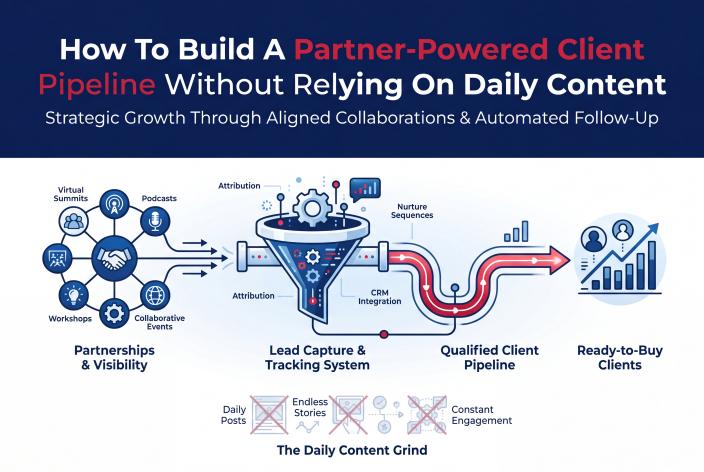
That means using aligned partners, speakers, podcast hosts, workshops, summits, giveaways, and collaborative campaigns to get in front of the right people, then connecting that visibility to capture, nurture, follow-up, and qualified conversations.
Let's walk through how to build it.
Visibility Activity And A Real Client Pipeline Are Different
Visibility activity is anything that gets you seen.
That might include:
- Posting on social media
- Being interviewed on a podcast
- Speaking at a workshop
- Joining a summit
- Hosting a webinar
- Running a collaborative giveaway
- Attending networking events
- Sending guest content to someone else's list
All of that can be useful.
But visibility by itself is only the front door.
A real client pipeline has a path behind the visibility. It helps the right person move from noticing you, to trusting you, to raising their hand for a next step.
That path usually includes:
- A clear audience and message
- A reason to engage now
- A simple lead capture point
- Follow-up that continues while interest is warm
- A way to identify the right prospects
- A next step that leads toward a qualified conversation
This is where many coaches get stuck.
They get attention, but they don't capture it.
They get registrations, but they don't follow up.
They get introduced to someone else's audience, but they don't know which partner actually created momentum.
They host an event, but the event ends and the pipeline goes quiet.
The goal is to stop treating visibility like a random burst of exposure and start treating it like the first step in a managed client attraction system.
Why Partner-Powered Growth Works So Well For Coaches
Partner-powered growth works because trust can travel.
When someone your ideal client already listens to introduces you, interviews you, hosts you, or shares your event, you are no longer walking into the room cold.
You are arriving with borrowed trust.
That matters for coaches because your work is personal. People are often buying judgment, guidance, safety, confidence, transformation, and the belief that you understand their world.
A cold post may be helpful.
A trusted introduction can feel different.
Partner-powered growth can include:
- Being a guest on aligned podcasts
- Inviting speakers to a virtual summit
- Co-hosting workshops with complementary experts
- Running a giveaway with contributors who serve the same audience
- Creating referral relationships with service providers
- Speaking inside another expert's community
- Building a recurring interview series
EventRaptor's positioning fits this kind of strategy because it treats virtual events as authority-building client attraction assets, not just online sessions. The system is designed to help coaches and experts manage events, speakers, partner promotion, registration, attendee data, reminders, and follow-up in one organized process.
And that organization matters.
Because the more partners you involve, the more moving parts you create.
Choose Partners Who Already Reach Your Ideal Coaching Audience
The best partners are not always the people with the biggest audience.
The better question is simple.
Who already has trust with the people you want to serve?
A smaller partner with the right audience can be more useful than a large partner whose people are not aligned with your offer.
Look for partners who match at least 3 of these signals:
- They serve the same audience you serve
- Their audience has the problem your coaching helps solve
- Their values and tone fit yours
- They are active enough to promote reliably
- Their audience trusts their recommendations
- Their offer complements yours without creating direct conflict
- They have a list, community, podcast, event, or referral base
- They understand collaboration and follow-through
For example, if you're a leadership coach for burned-out executives, useful partners might include executive recruiters, HR consultants, leadership podcast hosts, workplace wellness experts, executive assistants, or consultants who serve growing companies.
If you're a health coach for women in midlife, aligned partners might include functional medicine practitioners, hormone educators, fitness specialists, nutritionists, menopause podcast hosts, or community leaders who already gather that audience.
Notice the pattern.
You're not looking for random exposure. You're looking for relationship-based access to people who are already gathered around a relevant problem, identity, or goal.
That makes your visibility more focused and your follow-up much cleaner.
Build One Clear Lead Capture Path Before The Collaboration Goes Live
Here's a practical rule.
Before you go live with any partner collaboration, decide exactly where interested people should go next.
Not 5 places.
One clear path.
That path could be:
- A summit registration page
- A workshop sign-up page
- A webinar registration page
- A checklist or guide opt-in
- A diagnostic quiz
- A consultation application
- A podcast listener bonus page
- A waitlist for a group program
The key is that the next step should match the intent of the collaboration.
If you're being interviewed on a podcast, a simple listener resource may work well.
If you're hosting a summit, the registration page becomes the capture point.
If you're co-leading a workshop, the workshop sign-up page should collect the information needed to segment and follow up properly.
This is where many coaches unintentionally leak opportunity.
They do a great interview and say, "Find me on Instagram."
They speak at an event and send people to a generic homepage.
They run a workshop and forget to create a follow-up path for people who attended, registered but missed it, or clicked but did not book.
A better lead capture path answers these questions:
- What is the specific promise of this collaboration?
- Who is it for?
- What should an interested person do next?
- What information do we need to collect?
- What follow-up should happen after they register?
- How will we know which partner or campaign brought them in?
This is much easier when your registration pages, attendee data, CRM tags, reminders, and follow-up are connected.
EventRaptor can manage the event side, including pages, registration, speaker workflows, promoter links, attendee dashboards, reminders, and event data. GHL/CRMRaptor can support the CRM, funnel, calendar, workflow, automation, and follow-up side.
Together, they help turn collaboration into a trackable path instead of a pile of links, spreadsheets, and good intentions.
Give Partners A Simple Promotion Job
Your partners are busy.
They may like you. They may believe in the event or workshop. They may genuinely want to support you.
But if promotion feels confusing, heavy, or last-minute, they probably won't do as much as they intended.
Make the promotion job simple.
Give them:
- A clear registration link
- A short description of the event or resource
- A few email swipe options
- A few social post options
- The dates and timing
- A simple explanation of who it's for
- Any speaker or contributor assets they can share
- A reminder schedule
The easier you make it, the more likely they are to follow through.
This is especially important for summits, multi-speaker workshops, and giveaways because partner promotion is one of the main ways the campaign grows.
But you need more than enthusiasm.
You need visibility into what is actually happening.
Track Partner Links And Attribution So You Know What Created Momentum
Partner-powered growth gets messy when you don't track it.
If 12 people promote your event and registrations come in, you need to know which relationships helped create movement.
Not because you want to reduce relationships to numbers.
Because good tracking helps you make better decisions.
Partner links, attribution, registration tracking, and promoter reporting can show you:
- Which partners drove registrations
- Which audiences responded to the topic
- Which messages seemed to create interest
- Which relationships may be worth deepening
- Which partners need better support next time
- Which campaigns are worth repeating
Without this, you're guessing.
And guessing makes growth feel personal.
You wonder if the topic was wrong, if the partner forgot, if the audience was not aligned, if the page was weak, or if the timing was off.
Tracking gives you cleaner feedback.
EventRaptor supports promoter links, partner attribution, performance reporting, leaderboards, registration management, exports, and CRM sync. That matters because partner-powered campaigns need a way to see who promoted, who registered, and where momentum came from.
The point is not to obsess over dashboards.
The point is to learn which relationships create trust and which campaigns deserve more attention.
Follow Up While Interest Is Still Warm
The collaboration gets attention.
The follow-up turns attention into opportunity.
This is where a lot of good campaigns quietly lose money.
Someone registers for your workshop, attends part of it, likes what you say, then gets busy. If your follow-up depends on you remembering to email them 4 days later, the relationship can cool fast.
Good follow-up keeps the conversation moving.
It can include:
- Confirmation emails
- Calendar reminders
- Pre-event value emails
- Attendance reminders
- Replay emails
- Segment-specific follow-up
- Invitations to book a call
- Nurture emails for people who are interested but not ready
- Partner-specific follow-up where relevant
And yes, automation can support this without making it cold.
Good automation protects relationships by making sure people hear from you at the right time, with the right message, while they still remember why they cared.
For a coach, that matters.
You don't want to manually chase every lead. You also don't want interested people disappearing because the system went quiet.
EventRaptor supports welcome emails, scheduled reminders, follow-up communications, personalization placeholders, email status tracking, and CRM syncing. GHL/CRMRaptor can then support the CRM workflows, calendar path, and ongoing nurture that help move the right prospects toward a conversation.
That's the bridge.
Visibility becomes registration. Registration becomes nurture. Nurture becomes a qualified next step.
Create A Partner-Powered Pipeline You Can Repeat
A partner-powered pipeline does not need to be complicated at the start.
Start with one focused campaign.
A simple version might look like this:
- Choose a specific audience and problem
- Select 5 to 10 aligned partners or speakers
- Create one clear registration or opt-in path
- Give partners simple promotion assets
- Track partner links and registrations
- Deliver a useful event, workshop, or resource
- Follow up based on engagement and fit
- Invite qualified prospects into the next conversation
- Review what worked
- Repeat the best parts
That last step is important.
Your first campaign gives you feedback.
You learn which partners were aligned, which audience responded, what questions came up, what objections appeared, and which follow-up messages created replies or bookings.
That feedback helps the next campaign become sharper.
This is how you move from scattered visibility to a real growth asset.
The Pipeline Needs Strategy And Structure
Partner-powered growth can feel exciting because it creates movement.
But movement without structure can still leave you exhausted.
If you're trying to manage speaker details in your inbox, registrations in one tool, reminders in another, Zoom links in a document, partner links in a spreadsheet, and follow-up from memory, you're putting too much pressure on yourself.
A serious client pipeline needs a cleaner operating rhythm.
That includes:
- Clear positioning for the campaign
- A strong promise for the right audience
- Organized partner and speaker management
- One clean registration path
- Attendee communication before and after the event
- CRM tagging and segmentation
- Follow-up that matches engagement
- Tracking so you know what worked
- A next step for qualified prospects
This is the stage where many proven coaches realize they don't need to become louder online.
They need a system behind the visibility they already can create.
Your Next Step
If daily content has been carrying too much of your client attraction, partner-powered growth can give you a calmer and more leveraged path.
You can borrow trust through aligned relationships. You can build authority through useful events and conversations. You can capture interest, follow up consistently, and create more qualified conversations without trying to be everywhere every day.
But the strategy needs to fit your offer, audience, comfort with visibility, and current business stage.
If you want help applying this to your coaching business, Book your Client Attraction Planning Call.
On the call, we'll look at where your client flow is getting stuck, what kinds of partners or events could make sense, and whether a summit, workshop, funnel, CRM, follow-up system, or done-for-you implementation path is the right next move.