If client flow feels inconsistent, it’s tempting to ask one big question.
What should I do next?
Should you run a workshop? Start a podcast? Host a summit? Organize a giveaway? Create a recurring event?
Good question.
But the best answer depends on what’s actually stuck in your business right now.
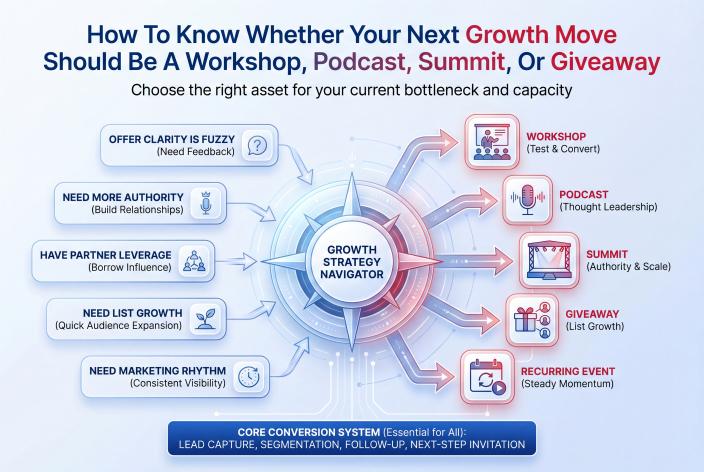
A workshop can help you convert warm prospects. A podcast can help you build authority over time. A summit can help you borrow authority and grow through partners. A giveaway can grow your list quickly when the offer and audience fit. A recurring event can create rhythm, trust, and repeated chances to invite the right people into conversation.
The format matters.
But the format is only one piece of the system.
If you don’t have lead capture, nurture, follow-up, and a clear next-step invitation behind the visibility, even a successful event can leave you wondering, “Okay, now what?”
So let’s slow down and choose the right move on purpose.
The Real Question Behind Your Next Growth Move
Most coaches ask, “Which format will get me more leads?”
A better question is, “Which format matches my current bottleneck?”
Because different growth assets solve different problems.
If people don’t understand your offer, a small workshop may help you test and clarify your message faster than a large summit.
If you need more authority in your niche, a podcast or recurring interview series can help you become more visible and remembered.
If you already have a clear topic and can bring partners together, a summit can help you create a bigger authority-building moment.
If you have contributors with aligned audiences and a simple lead magnet or gift, a giveaway can help you grow your owned audience.
And if you want consistent visibility without reinventing the campaign every time, a recurring event can give your marketing a rhythm.
Here’s the key takeaway.
Your next growth move should be chosen by strategy, not by excitement, pressure, or whatever someone else is launching this month.
A Simple Comparison Of Workshops, Podcasts, Summits, Giveaways, And Recurring Events
Each format has a different job.
Use this table as a starting point.
| Growth Asset | Best For | Strongest Advantage | Watch For |
|---|---|---|---|
| Workshop | Testing a message, teaching a clear problem, inviting warm prospects into a next step | Fast feedback and direct conversion path | Needs a specific promise and follow-up after the session |
| Podcast | Building authority, relationships, and long-term trust | Consistent thought leadership and networking | Takes patience and needs a listener-to-lead path |
| Summit | Building authority, growing an audience, and leveraging speakers or partners | Partner-powered visibility and trust through association | Needs speaker management, registration, reminders, and strong post-event follow-up |
| Giveaway | List growth through contributors and shared promotion | Simple participation and fast audience expansion when aligned | Needs qualified contributors and a nurture plan after opt-in |
| Recurring Event | Creating a repeatable visibility rhythm | Builds familiarity and can become a reliable trust-building stage | Needs consistency, clear positioning, and a simple operating system |
None of these are automatically better.
They each become powerful when they fit your audience, offer, bandwidth, and follow-up readiness.
When A Workshop Is The Right Next Move
A workshop is usually the cleanest choice when you need a focused conversion event.
It works well when you can teach one specific problem and naturally invite people into a deeper conversation or offer.
Think of a workshop as a guided taste of how you think, coach, diagnose, or solve.
It’s especially useful when:
- You already have some warm audience, referral traffic, or social visibility.
- Your offer is reasonably clear.
- You can explain one painful problem in plain language.
- You want feedback on your message before building a larger campaign.
- You’re comfortable making a next-step invitation at the end.
A workshop does not need to be complicated.
The best version is usually simple:
- Name a specific problem your right-fit client already knows they have.
- Teach a useful framework or diagnostic.
- Show them what is missing in their current approach.
- Invite qualified people into the next conversation.
- Follow up with everyone who registered, attended, or showed interest.
Here’s a practical example.
A leadership coach might run a workshop on how to handle difficult executive conversations without losing authority or damaging trust. The workshop gives the coach a chance to demonstrate expertise, answer real questions, and invite attendees to talk about their own situation.
That’s different from posting advice into the void.
The coach can see who raised their hand.
When A Podcast Is The Right Next Move
A podcast is often a good fit when your biggest gap is authority and relationship-building.
It gives you a reason to have meaningful conversations with partners, peers, prospects, and other experts in your space.
And over time, it gives your market a consistent place to hear how you think.
A podcast can be a smart move when:
- You want to become known for a specific point of view.
- You’re comfortable having useful conversations in public.
- You want to build relationships with potential referral partners.
- Your offer needs trust before people are ready to book a call.
- You can commit to a repeatable publishing rhythm.
But here’s where coaches often miss the opportunity.
They create the podcast, publish episodes, and hope listeners magically become clients.
You need a clear listener path.
That path might include:
- A useful opt-in related to the episode topic.
- A workshop invitation.
- A simple diagnostic page.
- A planning call invitation.
- Follow-up emails that help listeners connect the topic to their own problem.
A podcast works best when it becomes part of your client attraction system, not a separate content project sitting off to the side.
If you like conversations and you need more authority in your niche, this format deserves a serious look.
When A Summit Is The Right Next Move
A summit is a bigger authority move.
It can help you bring experts together around a clear theme, grow your audience through speaker and partner promotion, and become more visible as the person leading the conversation.
That’s why summits can be so useful for coaches and expert-led service providers.
They let you build authority while also borrowing authority from the speakers, partners, and conversations you organize.
A summit may be the right move when:
- You have a clear niche or theme.
- Your offer connects naturally to the event topic.
- You can identify aligned speakers or partners.
- You want to grow your audience through collaboration.
- You’re ready for a campaign with more moving parts.
- You have, or can build, a follow-up path after registration and attendance.
A summit has more operational weight than a workshop.
You may need speaker applications, invitations, bios, session details, registration pages, reminders, schedules, partner links, attendee dashboards, CRM updates, and follow-up emails.
This is where many coaches get buried.
The event happens, but the host is exhausted. They’re chasing details from inboxes, copying links between tools, wondering who promoted, and trying to remember who needs follow-up.
That’s the wrong kind of busy.
The stronger version is a managed path from visibility to registration to attendance to follow-up to qualified conversation.
That’s where EventRaptor fits well. EventRaptor helps coaches and experts run authority-building events with event pages, registration management, speaker workflows, reminder emails, promoter tracking, attendee data, CRM syncing, and reporting. It supports more than large summits too, including meetings, workshops, giveaways, recurring events, and speaker-led campaigns.
And when the event activity connects into GHL/CRMRaptor, the CRM and follow-up layer can support tags, calendars, funnels, workflows, automation, and ongoing nurture.
The point is simple.
A summit should not end when the final session ends.
It should become an authority asset and pipeline asset you can keep using.
When A Giveaway Is The Right Next Move
A giveaway can be a smart list-building campaign when you have contributors with aligned audiences and a clear reason for people to register.
The appeal is simple.
Multiple contributors offer useful gifts. Each contributor shares the giveaway. Registrants join to access the gifts. The host grows an owned audience and gets new people into a follow-up path.
A giveaway may make sense when:
- Your main goal is audience growth.
- You have access to partners or contributors.
- The gifts are aligned with your niche.
- You can create a simple registration experience.
- You have a nurture sequence ready after the campaign.
The danger is collecting a broad list that does not care about your offer.
So the theme matters.
A giveaway for “wellness resources” is much broader than a giveaway for “busy professionals who want to reduce stress without adding another hour to their schedule.”
The second one gives you better targeting.
It also makes your follow-up easier because the problem is clearer.
After the giveaway, don’t disappear.
Send useful follow-up. Segment where possible. Invite people into the next logical step, such as a workshop, a consultation, a diagnostic, or a planning call.
The list is only useful if the relationship keeps moving.
When A Recurring Event Is The Right Next Move
A recurring event is a good fit when you want consistency and trust-building over time.
It could be a monthly expert panel, weekly coaching lab, recurring workshop, interview series, roundtable, or niche community session.
This works well when your audience needs repeated exposure before they act.
It also helps when you’re tired of one-off launches that create a burst of activity and then go quiet.
A recurring event may be the right move when:
- You want a dependable visibility rhythm.
- Your prospects need education before booking a call.
- You can lead a repeated conversation around a specific niche problem.
- You want to create reusable content and follow-up opportunities.
- You prefer steady momentum over occasional big campaigns.
The best recurring events have a clear promise.
For example:
- “Monthly Client Attraction Clinic For Health Coaches”
- “Executive Decision Lab For New Senior Leaders”
- “Weekly Sales Confidence Workshop For Service-Based Coaches”
Each title tells the audience who it is for and why they might care.
A recurring event also gives your CRM and follow-up system more chances to work.
Someone might register once and not attend. They might attend the second time. They might reply to the third follow-up. They might book a call after hearing the same idea explained in a new way.
That kind of relationship requires consistency.
The Decision Tree For Choosing Your Next Growth Move
Let’s make this practical.
Start with your biggest current bottleneck.
If Your Offer Is Still Fuzzy
Choose a workshop first.
You need fast market feedback. A focused workshop helps you hear the questions, objections, words, and pain points your audience actually uses.
Keep it small and specific.
Your goal is learning plus conversion, not perfection.
If You Need More Authority And Better Relationships
Choose a podcast or recurring interview-style event.
This gives you a reason to build relationships with experts, referral partners, and people your audience already trusts.
Make sure every episode or session points back to a relevant next step.
If You Have A Clear Theme And Good Partner Potential
Choose a summit.
A summit can create a stronger authority moment because you’re gathering voices around a topic your audience cares about.
But be honest about the moving parts.
If you don’t have the capacity to manage speakers, pages, registrations, emails, schedules, reminders, and follow-up, get help or simplify the format.
If You Need List Growth And Have Contributors
Choose a giveaway.
This is strongest when the contributors are aligned and the gifts attract the same kind of person who might later value your offer.
Plan the nurture sequence before the campaign starts.
If You Need A Steadier Marketing Rhythm
Choose a recurring event.
This gives you a repeatable stage where prospects can experience your thinking more than once.
It also makes your follow-up more natural because you always have another useful invitation.
Every Format Needs The Same 4 Conversion Pieces
No matter which asset you choose, the backend matters.
Visibility without a path creates leakage.
People see you, register, listen, attend, click, or download. Then life gets busy. Their attention fades. Your follow-up gets delayed. The moment goes cold.
So every format needs these 4 pieces.
1. Lead Capture
You need a way to know who raised their hand.
That might be a registration page, podcast opt-in, giveaway entry, workshop signup, or event RSVP.
The point is to move attention into an owned audience you can communicate with.
2. Segmentation Or Context
The more you know about why someone registered, the better your follow-up can be.
Even a simple registration question can help.
What are they struggling with? What do they want help with? What best describes their current situation?
This helps you avoid sending the same message to everyone when their needs are different.
3. Follow-Up While Interest Is Warm
Good automation does not make your business colder.
Used well, it makes your follow-up more timely and consistent.
That matters because many coaches lose opportunities when follow-up depends on memory, mood, or an open hour at the end of the day.
Your follow-up should continue the relationship before, during, and after the event or content experience.
4. A Clear Next-Step Invitation
Every growth asset should answer this question.
What should the right person do next?
That might be:
- Book a planning call.
- Register for a workshop.
- Complete an application.
- Watch a related training.
- Reply with a specific question.
- Join a consultation or diagnostic.
You don’t need to pressure people.
You do need to guide them.
How To Choose Based On Your Bandwidth
Be honest about capacity.
A workshop is usually lighter than a summit. A podcast can be simple to start, but it requires consistency. A giveaway can look simple from the outside, but contributor coordination and follow-up still matter. A recurring event can be efficient once the process is built, but the first few rounds need attention.
Ask yourself:
- Do I have the time to manage this well?
- Do I have help with pages, emails, CRM, reminders, and data?
- Can I follow up with registrants and attendees after the event?
- Do I have a next-step offer that makes sense?
- Will this asset build authority with the right audience?
If the honest answer is “I can create attention, but I’m not sure I can manage what happens after,” fix that before you go bigger.
This is exactly where connected systems matter.
EventRaptor can help organize the event side: pages, registration, speakers, attendees, emails, promoter tracking, schedules, and reporting. GHL/CRMRaptor can support the CRM side: contact records, tags, calendars, funnels, workflows, automation, and follow-up.
Together, the visibility asset has somewhere to go.
The Best Growth Move Is The One You Can Convert
A workshop, podcast, summit, giveaway, or recurring event can all work.
But each one needs to match the season of your business.
If you need clarity, start smaller.
If you need authority, create a stage.
If you need partner leverage, build a collaborative campaign.
If you need consistent trust, create a rhythm.
And if you’re ready to turn visibility into more qualified conversations, make sure lead capture, nurture, CRM, follow-up, and your next-step invitation are connected before you put more energy into getting attention.
That’s how your marketing starts feeling less random.
You stop asking, “What tactic should I try next?”
You start asking, “What part of my client attraction system needs strengthening now?”
That question leads to much better decisions.
The Practical Next Step
If you’re still unsure which growth asset makes sense for your coaching business, don’t guess.
Look at your current bottleneck.
Is it offer clarity? Authority? Audience growth? Partner leverage? Follow-up? Conversion? Implementation capacity?
That answer should guide the move.
And if you want help mapping it out, Book your Client Attraction Planning Call.
On the call, we’ll look at where your client flow is getting stuck, what you’re trying to sell, how your audience currently finds you, and whether a workshop, podcast, summit, giveaway, recurring event, funnel, CRM, or follow-up system makes the most sense next.