If you're a proven coach with an offer that works, you probably don't need another random visibility tactic.
You need clearer market feedback.
That's where a podcast guest sprint can help.
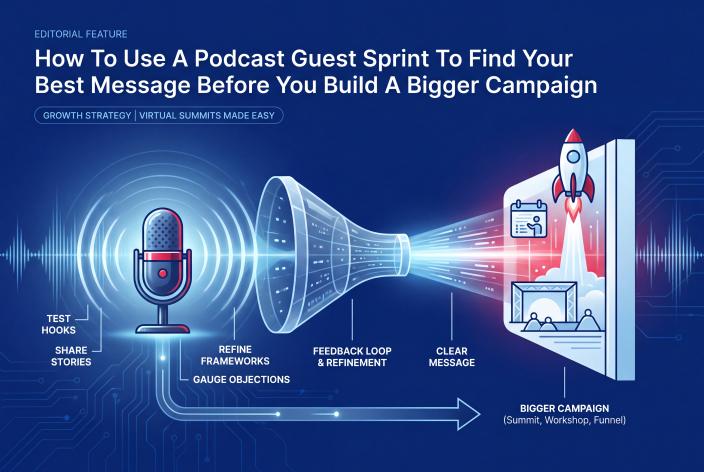
Before you build a summit, webinar, giveaway, workshop, or full funnel, you can use a short run of aligned podcast interviews to test how your message lands with real people.
You get to hear which ideas create curiosity. You notice which stories make people lean in. You find out which questions keep coming up. And you can see whether your call to action actually moves people into the next step.
That's useful.
Because bigger campaigns work better when the message has already been sharpened in conversation.
What A Podcast Guest Sprint Is
A podcast guest sprint is a focused 30 to 60 day visibility test where you appear on a small group of aligned podcasts with one clear purpose.
You are testing your message before you build something bigger.
That means you're not trying to be everywhere. You're not chasing famous shows just because they sound impressive. And you're not showing up with 12 different topics hoping something sticks.
You choose 5 to 10 aligned shows, pitch a specific topic, share a consistent framework, invite listeners into one next step, then track what happens.
Simple. Focused. Measurable.
A sprint usually makes sense when:
- You have a coaching offer that has sold before.
- You can help clients, but your lead flow is inconsistent.
- You're considering a bigger campaign and want more message clarity first.
- You're refining your niche, hook, story, or lead magnet.
- You want to build authority without immediately managing a large event.
This is especially helpful if you've been thinking, "I know I can help people, but I don't know which message will actually get them to respond."
That question deserves real market feedback.
Why A Sprint Helps Before A Bigger Campaign
A bigger campaign has more moving parts.
A workshop needs a strong promise. A webinar needs a clear conversion path. A summit needs a theme, speakers, registration pages, reminders, follow-up, and a plan for turning attention into qualified conversations.
EventRaptor's own positioning treats the right event format as dependent on your audience, offer, and growth strategy. It can support summits, meetings, workshops, giveaways, recurring events, and speaker-led campaigns, but the strategy comes first.
A podcast guest sprint gives you a smaller testing ground before you commit to that larger build.
On podcasts, your message has to work in plain English.
You can't hide behind a polished landing page. You have to explain the problem, tell the story, teach the framework, and make the next step feel natural.
That pressure is useful.
It shows you where your message is clear and where it's still foggy.
How To Choose 5 To 10 Aligned Shows
The best podcast sprint starts with audience fit.
Downloads can matter, but they're not the first filter. A smaller show with the exact audience you serve can be far more useful than a large show full of people who will never buy your offer.
You want shows where the listener is likely to recognize the problem you solve.
Use These Show Selection Filters
Before you pitch, look at:
| Filter | What To Look For |
|---|---|
| Audience Fit | Does the show attract people who match your best clients? |
| Problem Fit | Do listeners care about the problem your offer solves? |
| Buyer Maturity | Are they aware enough to take a next step? |
| Topic Fit | Has the host covered related subjects before? |
| Trust Fit | Does the host's style match how you want to be introduced? |
| CTA Fit | Would your lead magnet or planning call make sense for this audience? |
Here's a tip.
Listen to at least part of 2 episodes before you pitch.
You'll hear the host's rhythm, the audience assumptions, the kinds of stories that work, and whether your topic would add something useful.
Then build a short list of 5 to 10 shows where you can genuinely help the audience.
That keeps the sprint focused.
What To Test During The Sprint
A podcast guest sprint works best when you test a few things on purpose.
You don't need a complicated research project. You need a repeatable message and a simple tracking process.
Test Your Hook
Your hook is the first way you frame the problem.
For a coach, this might sound like:
- "Why referrals create feast-or-famine client flow."
- "How strong coaches lose prospects because follow-up is too manual."
- "Why visibility doesn't turn into clients without a trust path behind it."
Say the hook in different ways across interviews.
Then watch what happens.
Does the host ask a follow-up question? Do they repeat the idea back? Do listeners message you about it later?
A good hook makes the right person feel seen quickly.
Test Your Signature Story
Your story should explain why you care about this problem and why your method exists.
Keep it tight.
A useful signature story often includes:
- The pattern you noticed.
- The mistake smart people were making.
- The shift that created a better path.
- The lesson listeners can apply.
You don't need a dramatic life story if that isn't your voice.
You need a story that makes your point memorable.
Test Your Framework
Your framework is the mental model you want people to remember after the episode.
For example, if you help executive coaches improve client flow, your framework might include:
- Authority positioning.
- Partner-led visibility.
- Lead capture.
- Nurture and follow-up.
- Qualified sales conversations.
That's more useful than telling people to "get more leads."
It shows them the system underneath the result.
And that's the kind of thinking serious buyers respect.
Test Your Lead Magnet
Your lead magnet should match the conversation.
If the episode is about message clarity, offer a message checklist or positioning worksheet. If the episode is about client flow, offer a client attraction audit. If the episode is about event strategy, offer a summit or workshop planning resource.
The goal is to continue the conversation while the listener's interest is warm.
Make the invitation simple:
"If this is useful, I've put together a short worksheet that helps you identify where your client attraction path is getting stuck."
Clear beats clever.
Test Your Planning Call Invitation
Some listeners may be ready for a conversation.
That doesn't mean you need a hard pitch at the end of every interview. It means your invitation should be direct, calm, and connected to the topic.
For example:
"If you're a coach and you want help figuring out whether your next step should be a workshop, summit, funnel, or follow-up system, you can book a Client Attraction Planning Call. We'll look at where your client flow is getting stuck and what kind of system could make sense."
That feels natural because it follows the teaching.
How To Track What Happens
The sprint becomes valuable when you track response.
Otherwise, you're relying on memory. And memory gets fuzzy fast.
Create a simple tracker with these columns:
| Item To Track | Why It Matters |
|---|---|
| Show Name | Helps you compare audience fit. |
| Topic Angle | Shows which hook you tested. |
| Host Questions | Reveals what created curiosity or confusion. |
| Listener Responses | Captures the language people use back to you. |
| Objections | Shows what future content or sales pages need to address. |
| Lead Magnet Opt-Ins | Indicates whether the next step matched the topic. |
| Planning Call Bookings | Shows which interviews created real buying intent. |
| Sales Conversations | Helps you evaluate lead quality, not just volume. |
| Follow-Up Needed | Keeps warm opportunities from slipping away. |
You can do this in a spreadsheet at first.
But as soon as you start treating visibility as part of a serious client attraction system, you need the responses, contacts, tags, reminders, and follow-up to live somewhere more reliable.
This is where a CRM matters.
GHL/CRMRaptor can support the CRM, funnel, calendar, workflow, automation, and follow-up side. EventRaptor manages the virtual event side when you move into workshops, summits, giveaways, meetings, or speaker-led campaigns.
Together, the point is simple.
Your visibility should connect to capture, nurture, and qualified conversations.
How To Read The Results
After 5 to 10 interviews, look for patterns.
Ask yourself:
- Which hook did hosts respond to most strongly?
- Which story created the most emotional recognition?
- Which framework was easiest to explain?
- Which objections came up again and again?
- Which lead magnet got the clearest response?
- Which shows produced the most aligned conversations?
- Which listeners seemed curious but not ready yet?
You are looking for signal.
Maybe people love your story but don't understand your offer. Maybe the audience understands the problem but doesn't feel urgency. Maybe your lead magnet gets opt-ins, but the planning call invitation needs clearer positioning.
That's not failure.
That's useful feedback before you spend time building a bigger campaign.
How The Sprint Connects To Bigger Next Steps
Once you know which message is getting traction, you can build the next campaign with more confidence.
The sprint might point you toward:
- A workshop for a focused problem people already want help solving.
- A webinar when you have a clear teaching path into your offer.
- A giveaway when partner list growth and lead capture are the priority.
- A virtual summit when authority, relationships, and audience growth need to work together.
- A recurring event when your market needs repeated education and nurture.
This is where the broader system matters.
EventRaptor helps coaches and experts build authority, grow an audience, manage professional virtual events, and follow up with right-fit prospects through one organized system. It brings together pieces like event pages, registration, speaker management, reminders, partner tracking, attendee data, CRM syncing, and follow-up paths.
That matters because a bigger campaign should not end when the live session ends.
The summit, workshop, or giveaway should create a path from visibility to trust to conversation.
A Simple Podcast Guest Sprint Plan
Here's a practical version you can use.
Week 1 Choose The Message And Shows
Pick one core problem, one audience, one framework, one lead magnet, and one planning call invitation.
Then shortlist 5 to 10 shows based on audience fit.
Week 2 Pitch The Shows
Send a short, useful pitch.
Focus on the host's audience, the problem you can help them understand, and the practical takeaway listeners will get.
Weeks 3 To 6 Record And Track
Show up prepared.
Teach generously. Tell the story. Use the framework. Invite listeners into the next step.
Then track host questions, listener responses, opt-ins, objections, and booked calls.
Week 7 Review The Signal
Look at what worked.
Tighten the hook. Adjust the story. Improve the lead magnet. Rewrite the planning call invitation if needed.
Then decide whether the next move is a workshop, summit, giveaway, webinar, recurring event, or stronger follow-up system.
The Bigger Lesson
A podcast guest sprint gives you a smart way to test before you build.
You get real conversations, real questions, and real market language. You also reduce the risk of building a bigger campaign around a message that still needs work.
If your coaching works but your client flow is inconsistent, this is the kind of practical step that can reveal where the system needs attention.
And if you want help applying this to your own business, Book your Client Attraction Planning Call.
On the call, we'll look at where your client flow is getting stuck, what you've already tried, and whether a podcast sprint, workshop, summit, funnel, CRM, follow-up system, or done-for-you implementation path makes sense next.