You know that uneasy feeling when another coach posts about their huge audience?
The 50,000 followers. The giant email list. The big launch screenshots. The packed comment section.
And then you look at your own list and think, "Maybe that's why client flow still feels inconsistent. Maybe I just need more people."
Maybe.
But often, that isn't the real issue.
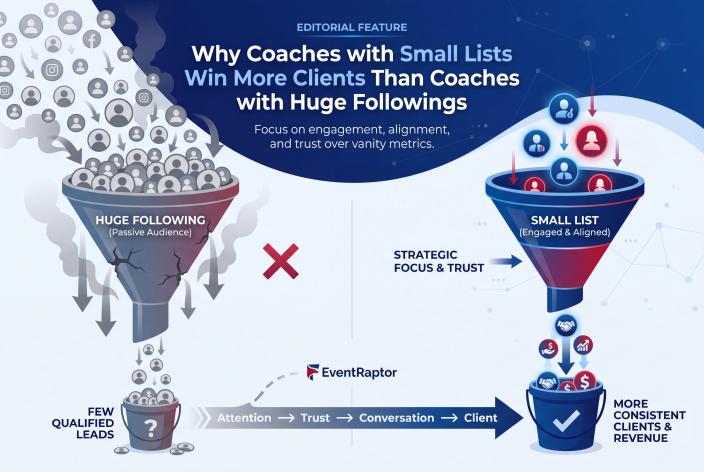
A 5,000-person email list of raving fans can be more useful than a 50,000-person list of random followers who barely remember why they opted in. The smaller list may have fewer names, but it has something far more valuable.
Recognition.
Trust.
Relevance.
And for a coach selling through conversations, those matter more than vanity metrics.
If your coaching is strong but your client flow is still up and down, the next move is not simply to get louder. It's to build a client attraction system that brings the right people closer, keeps them warm, and turns trust into qualified conversations.
Let's walk through what that really means.
List size creates illusions when the people are not aligned
A big list feels impressive.
It also creates a false sense of safety.
You can have thousands of names in a CRM and still wake up wondering where the next client is coming from. You can have social followers, summit registrants, podcast listeners, and webinar attendees, but if those people are not connected to your niche, your offer, and your sales path, the numbers sit there like decorations.
They look good.
They don't move the business.
Past summit strategy discussions have made this point clearly. Hosts were encouraged to stop chasing list-grabber strategies and focus on qualified, engaged audiences. Inflated, non-engaged lists can cost money to host every month without converting.
That's the part many coaches miss.
A list is an asset when the people on it:
- Know what problem you help solve
- See themselves in your message
- Trust your point of view
- Have a reason to keep engaging
- Are being guided toward a useful next step
A list becomes dead weight when it is filled with people who came for a freebie, a broad topic, or a one-time event with no real connection to your work.
So here's the first question to ask yourself.
If you emailed your list today with a clear invitation to a conversation, would the right people understand why it matters?
If the answer is "probably not," you don't only have a list-size issue. You have an alignment issue.
List quality compounds into revenue because trust compounds
Small lists can win because trust gets stronger with repeated, relevant contact.
Think about your best clients.
They usually don't hire you because they saw one post. They hire because something clicked. They heard you explain their problem clearly. They saw you in a workshop. They attended a summit session. They received an email that sounded like you understood them. They had enough contact with your work to feel safe taking the next step.
That is why an engaged list is so powerful.
Every useful touchpoint compounds:
- They understand the problem better.
- They begin to trust your diagnosis.
- They see your process as credible.
- They imagine themselves getting help.
- They become more ready for a conversation.
This is where many coaches accidentally break the path.
They create visibility, but they don't capture it well.
They capture leads, but they don't nurture them consistently.
They nurture with general tips, but they don't lead people toward a clear sales conversation.
So the audience grows, but the pipeline still feels thin.
A smaller list with stronger trust behaves differently. People reply. They show up. They click. They book calls. They refer. They remember what you do.
And because the list is built around a specific audience and a specific problem, your follow-up has weight.
You are not trying to wake up a cold crowd.
You are continuing a conversation they already care about.
The targeting strategy that attracts buyers instead of browsers
Here’s a tip.
Your list gets better when your entry point gets narrower.
Broad topics attract curious people. Specific problems attract motivated people.
For example, a leadership coach could run content around "better leadership." That may attract managers, founders, HR professionals, team leads, and people who simply enjoy leadership ideas.
Useful? Maybe.
But if the coach specializes in helping newly promoted directors lead difficult teams without burning out, the growth strategy should reflect that.
The summit theme, lead magnet, workshop, emails, and sales call invitation should all point to that problem.
That is how you attract buyers instead of browsers.
A stronger targeting filter looks like this
| Weak audience filter | Stronger audience filter |
|---|---|
| Anyone interested in wellness | Women in midlife dealing with stress, sleep, and energy crashes |
| Business owners who want growth | Service providers stuck between referrals and a real sales pipeline |
| Leaders who want confidence | New executives preparing for high-stakes visibility and decision-making |
| People who want better relationships | Divorced parents rebuilding trust and communication after conflict |
See the difference?
The stronger filter makes the person feel seen. It also helps you decide what content to create, which partners to approach, what follow-up to send, and what call to invite them to book.
This is where your client attraction system starts to mature.
You are no longer collecting random attention. You are building a path for a specific person with a specific reason to care.
Niche summits beat broad audience-building because relevance does the heavy lifting
Virtual summits can be powerful for coaches, but only when they are built with intention.
The strongest summit strategy is not to grab every possible lead. It is to create a useful resource for a defined audience, build relationships with aligned speakers, and guide attendees into the next step after the event.
That is why niche speaker selection matters so much.
A broad summit may look bigger on paper. More topics. More speaker variety. More potential reach.
But a niche summit creates a tighter room.
The audience hears the same core problem explored from multiple useful angles. The speakers are more likely to share overlapping values and audiences. The host becomes associated with a clear transformation.
That is authority-building.
Build summits around something specific, unique, and meaningful. Speaker relationships matter too, because promotion tends to work better when speakers believe in the host and the event, not when they are treated like list machines.
Another podcast conversation with Sasha Bytchoff described a baby sleep summit built from no existing email list. The focus was not on chasing famous speakers. It was on choosing speakers who fit the community and the message. That event reportedly attracted over 1,000 subscribers.
The lesson is simple.
Fit beats fame when your goal is long-term trust.
What makes a niche summit work
A good summit for a coach should have 5 ingredients:
- A clear audience with a real problem
- A theme that matches the coach's paid offer
- Speakers who serve the same or adjacent audience
- Follow-up that continues after the summit ends
- A next-step invitation for people who want help applying the ideas
Without that path, a summit becomes a burst of activity.
With that path, it becomes an authority asset and a pipeline asset.
Your summit should feed a relationship system after the event
One of the biggest mistakes coaches make is treating a summit like a finish line.
They promote hard. They run the sessions. They send replay emails. They rest for a week.
Then the list goes quiet.
That is where a lot of revenue and relationship value gets lost.
Past summit strategy material recommends thinking long term. Create a relaunch plan. Build a legacy plan. Reuse the summit. Put it into automated sequences. Keep the resource alive.
That matters because your best prospects may not be ready during event week.
Some are still diagnosing the problem.
Some are comparing options.
Some need to see your thinking several more times before they trust you.
Some will become ready 30, 60, or 90 days later.
If your CRM and follow-up are weak, those people disappear into the fog.
A strong post-summit system keeps the relationship warm:
- Segment attendees by interest or behavior
- Send useful follow-up tied to the event topic
- Invite people to a workshop, diagnostic, or planning call
- Share speaker highlights and related content
- Follow up personally with high-intent prospects
- Continue building partner relationships with speakers
This is where automation supports the human relationship.
Good automation does not replace care. It helps you follow up when your calendar is full, your energy is low, or your attention is on client delivery.
That is how coaches protect trust at scale.
Measure growth by booked calls and revenue movement
Follower count is easy to see.
Client attraction health is a little more honest.
If you want a steadier business, you need to measure the journey that creates clients. Not just the audience number at the top.
Track things like:
- How many right-fit people joined your list
- Where those people came from
- Which topics created replies or clicks
- How many people attended the event or workshop
- How many booked calls
- How many showed up prepared
- How many became clients
- Which partners referred the best-fit prospects
These numbers tell you what is actually happening.
A large following with few qualified calls is a signal. A small list that produces consistent conversations is also a signal.
The goal is not to become obsessed with dashboards. The goal is to stop guessing.
When your visibility, funnel, CRM, and follow-up are connected, you can see where the path is strong and where it is leaking.
Maybe your summit topic attracts the wrong people.
Maybe people register but don't attend.
Maybe they attend but don't understand the next step.
Maybe they book calls, but they are not qualified.
Each answer tells you what to fix first.
The long-term advantage of a small engaged community
A small engaged community gives you leverage that a huge passive audience cannot.
People in that community know your voice. They understand what you stand for. They have heard your ideas enough times that your sales conversation does not start from zero.
That changes the feel of your business.
Sales calls become calmer.
Follow-up feels less like chasing.
Your content has a job.
Your events have a purpose.
Your partnerships become more strategic.
And your list becomes a living audience of people who are either ready now, warming up, referring others, or staying connected until the timing is right.
That is a much stronger position than constantly trying to pour more strangers into a leaky system.
For proven coaches, this is the real growth edge.
You already know how to help people. You may already know how to sell when the right person gets on a call. Now the business needs the infrastructure that creates more of those right conversations.
What to build if your list is small right now
If your list is small, don't panic.
Use the small-list stage wisely.
You can build cleanly before complexity creeps in.
Start here:
-
Clarify the specific client you want more of. Get beyond demographics. Name the problem, moment, desire, and urgency that makes someone a strong fit.
-
Create one authority-building entry point. This could be a niche summit, one-day summit series, webinar, workshop, interview series, or partner event.
-
Connect that entry point to your offer. The topic should naturally lead to the problem your coaching solves.
-
Build the follow-up before you need it. Email, SMS reminders where appropriate, call booking, segmentation, and pre-call education should be mapped before the visibility arrives.
-
Measure the path to conversations. Watch registrations, attendance, engagement, call bookings, show-ups, and clients. Use the numbers to improve the system.
This is how a small list becomes a serious business asset.
Not overnight. Not by magic.
But through a clear path from attention to trust to conversation.
Your next step
If your coaching works but your client flow still depends on referrals, random content, or the occasional good month, your list may not be the real problem.
Your system may need attention.
You need the right audience, a strong authority-building path, a clear offer connection, and follow-up that does not depend on memory or spare time.
That is exactly what we look at on a Client Attraction Planning Call.
We will talk through where your current client attraction is strong, where the gaps are, and what a practical plan could look like for your business. That may include a summit, a workshop, CRM follow-up, better conversion paths, or a more focused authority strategy.
If you want help turning your visibility into more qualified conversations, Book your Client Attraction Planning Call and let's map the next version of your system together.