If you're a good coach with a small audience, borrowed audiences can feel like oxygen.
A podcast host introduces you to their listeners. A summit host puts you in front of attendees who already care about your topic. A partner emails their list about your workshop. Suddenly you're no longer trying to pull attention out of thin air.
But here's where a lot of coaches lose the opportunity.
They treat borrowed visibility like exposure.
They show up, teach something useful, maybe get a few nice comments, and then... nothing much happens. No clear opt-in. No tagged follow-up. No calendar path. No reason for the warmest people to continue the conversation.
So the appearance feels good, but it doesn't turn into client flow.
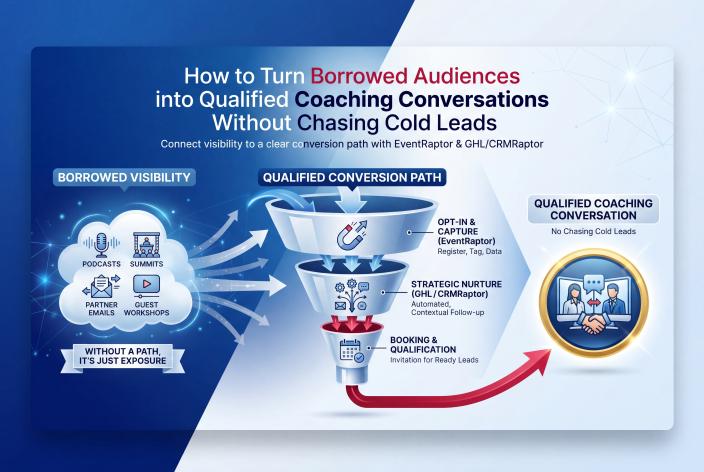
Borrowed audiences work best when you connect the visibility moment to a simple conversion path. The goal is to borrow trust, earn attention, capture interest, follow up like a human, and guide the right people toward a qualified conversation.
Let's walk through how to do that.
Why borrowed audiences work so well for coaches
If you're a coach, consultant, or expert-led service provider, your business runs on trust.
People don't hire you just because they saw a post. They hire you because they believe you understand their problem, can help them move forward, and are safe enough to talk to about something that matters.
Borrowed audiences help because trust is already present.
The podcast host has trust. The summit host has trust. The community leader has trust. The partner with the email list has trust.
When they invite you onto their stage, some of that trust transfers to you.
That matters, especially when your own reach is still limited.
A summit is a strong example of this. The summit model has long been described as a collaborative marketing strategy because it helps you start conversations with a new audience, build partnerships, create authority, and move people into the next step of the customer journey.
And the audience size doesn't have to be massive to be useful.
A smaller audience with strong fit and high engagement can be more valuable than a large audience that doesn't care about your work. The quality of the room matters.
The key question is simple.
Are you being seen by people who could realistically need, want, and value the work you do?
If yes, borrowed audiences can create warmer conversations than cold outreach ever could.
Generic visibility feels good but qualified visibility creates movement
Visibility by itself is slippery.
You can be on 10 podcasts and still have no pipeline. You can speak at 3 summits and still wonder where the clients are. You can teach a beautiful guest workshop and still watch the energy fade by Monday morning.
The issue is usually the missing path behind the appearance.
Qualified visibility has 4 pieces:
- The right audience hears you.
- The right message makes their problem feel clear.
- The right opt-in captures the people who want more.
- The right follow-up moves warm interest into a next step.
That last part is where many coaches get quiet.
They don't want to be pushy. They don't want to annoy people. They don't want to sound like a funnel robot.
Good follow-up doesn't have to feel that way.
Good follow-up says, "You raised your hand. Here's the next useful thing. And if this is the problem you're trying to solve, here's how we can talk."
That's it.
Helpful. Timely. Specific.
The borrowed audience conversion path
Here's the simple path I like coaches to think through before they borrow any audience.
| Stage | What happens | What you need |
|---|---|---|
| Partner promotion | A host, speaker, affiliate, or partner introduces you | A clear promise and audience fit |
| Visibility moment | You teach on a podcast, summit, webinar, workshop, or guest stage | A signature message that earns trust |
| Opt-in | Interested people raise their hand | A landing page, lead magnet, or event registration path |
| CRM capture | Leads are stored and segmented | Tags, source tracking, and contact records |
| Nurture | People receive useful follow-up | Email, SMS where appropriate, and content that continues the conversation |
| Booking path | Qualified prospects are invited to talk | Calendar link, pre-call questions, and a clear reason to book |
| Sales conversation | You diagnose fit and next steps | A grounded sales process, not pressure |
Notice how practical this is.
You're not trying to become famous. You're trying to create a path from borrowed trust to a real conversation with someone who is already leaning in.
That path can be simple.
For example:
- A partner promotes your guest workshop to their list.
- Their audience registers on your opt-in page.
- Registrants are tagged by source in your CRM.
- They receive a reminder sequence before the workshop.
- After the workshop, they receive a recap, a useful resource, and a soft invitation to book a call.
- The people who click, reply, attend live, or visit your booking page get more specific follow-up.
- The right prospects book a conversation.
That's the system.
And when that system is missing, even a great appearance can leak opportunity.
How to choose the right borrowed audiences
You don't need every stage.
You need the right stages.
A borrowed audience is worth pursuing when the people in the room match the problem you solve, the stage of awareness you serve, and the values of your offer.
Before saying yes to a podcast, summit, partner email, or guest training, ask these questions:
- Who exactly is in this audience?
- What problem are they already trying to solve?
- Are they beginners, advanced buyers, peers, or potential clients?
- Do they invest in coaching, consulting, education, or support?
- What does the host's audience already trust them for?
- Will your message feel relevant in that context?
- Is there a natural next step you can offer after the appearance?
A health coach who works with high performing executives doesn't need general wellness exposure. They need stages where stressed, ambitious professionals are already paying attention.
A business coach who helps service providers improve sales conversations doesn't need every entrepreneur audience. They need communities where people already have offers, leads, and messy follow-up.
A relationship coach who helps divorced professionals rebuild confidence doesn't need a broad personal development audience. They need a room where that life stage and pain point are already present.
Audience fit is leverage.
When the fit is strong, your message lands faster. Your examples feel more personal. Your invitation feels more natural.
What to prepare before you borrow an audience
Borrowed visibility magnifies what you already have.
So before you step onto someone else's stage, you want a few things in place.
A clear offer
You should be able to explain who you help, what problem you help them solve, and what kind of result or movement they can expect from working with you.
This doesn't mean your offer has to be perfect.
But it does need enough shape that someone can hear you and think, "That's for me."
A signature message
Your signature message is the idea you want people to remember.
For many coaches, this is a simple reframe:
- The reason their referrals are inconsistent
- The real reason their follow-up feels hard
- The hidden cost of waiting for motivation
- The pattern keeping them stuck in the same cycle
- The better way to approach the problem they care about
Your message should make the audience feel understood before you ever invite them to do anything.
A useful lead magnet or registration path
You need a reason for people to raise their hand.
That could be:
- A checklist
- A short assessment
- A planning worksheet
- A private training
- A summit registration
- A workshop replay
- A practical guide tied to your talk
Keep it close to the topic you just taught.
If your podcast interview is about reducing sales call friction, don't send people to a general newsletter. Send them to a sales conversation checklist, a follow-up template, or a call readiness assessment.
Specific wins.
A booking path
If your business sells through conversation, give the right people a clear way to book one.
That doesn't mean every person should be pushed to a call immediately.
Some need nurture. Some need education. Some are curious, but not ready. Some aren't a fit.
Your booking path should make sense for the warmest leads.
Use a calendar page, a short pre-call form, and language that frames the call as a practical next step.
For example:
"If you're trying to solve this in your own business and want help mapping the next step, you can apply for a planning call here."
Simple. Clean. No pressure.
How summits and collaborative events create more than leads
A summit gives you several forms of leverage at once.
You can reach attendees. You can build relationships with speakers. You can create useful content. You can grow your list. You can become more visible in your niche.
And those speaker relationships can become valuable long after the event ends.
Summit hosts are encouraged to follow up with speakers, ask how to support them, and explore collaborations like partner webinars, email swaps, and live sessions. Those opportunities are much easier after you've already created value for the speaker by giving them a platform.
This is one reason a summit can become more than a calendar date.
It can become a relationship engine.
A service based summit host once explained that the summit helped start warmer conversations with attendees because there was already a shared context. They could ask what people thought about the event, listen for pain points, and identify who was a better fit for deeper support. Some speakers may also be strong prospects or partners, depending on the offer and niche.
That doesn't happen by accident.
It happens when the summit is connected to qualification, nurture, and follow-up.
Where EventRaptor fits when the borrowed audience strategy includes events
When you're running a summit, speaker event, giveaway, webinar series, or collaborative campaign, the operational side can get heavy fast.
You have speakers, registration pages, session details, reminders, promoter links, attendee data, emails, replays, and follow-up paths.
That's a lot to hold together manually.
EventRaptor supports the event infrastructure side of this strategy. It can help with collaborative events, speaker and session management, registration pages, attendee data, promoter tracking, affiliate or partner links, event dashboards, reminder workflows, and reporting around promotions and registrations.
That matters because borrowed audience campaigns need attribution.
You want to know:
- Which partner sent registrants
- Which speakers promoted
- Which audience segments engaged
- Which attendees raised their hand for more
- Which leads should receive specific follow-up
When your event data is organized, your follow-up gets smarter.
And smarter follow-up feels more personal.
Where GHL and CRMRaptor fit after the visibility moment
EventRaptor manages the event side. GHL/CRMRaptor supports the CRM and follow-up side.
That includes contact records, tags, custom fields or values, calendars, funnels, workflows, automation, and nurture.
This is where the borrowed audience becomes a managed pipeline instead of a spreadsheet full of names.
For example, you might tag contacts based on:
- Partner source
- Event registration
- Session attended
- Lead magnet requested
- Booking page visit
- Call booked
- No show
- Not ready yet
Then your follow-up can match the relationship.
Someone who attended your workshop live and clicked the booking link deserves a different message than someone who registered but never showed up.
Someone who came through a trusted partner may need a different opening than someone who found you from a public summit page.
This is where automation can become more human, not colder.
It helps you remember what happened, respond at the right time, and keep the conversation moving without manually checking every contact.
Practical follow-up examples that don't feel pushy
Follow-up works best when it continues the conversation people already entered.
Here are a few simple examples.
After a podcast appearance
Subject: The checklist I mentioned on the podcast
Hi [First Name],
Thanks for listening to the conversation with [Host Name].
I mentioned a simple checklist for spotting where your client flow is getting stuck, so here it is.
As you go through it, pay attention to the section on follow-up. That's where a lot of good coaches quietly lose warm prospects.
If you want to talk through what this looks like in your business, you can book a planning call here.
After a summit session
Subject: A quick recap from today's session
Hi [First Name],
Thanks for joining my session today.
The main idea was simple: visibility only helps when there's a path behind it. If the people who hear you don't know what to do next, the momentum fades.
Here's the worksheet I mentioned during the session.
And if your own visibility is creating interest but not enough qualified conversations, you're welcome to book a planning call and we can look at where the path is breaking.
After a partner workshop
Subject: Your next step from the workshop
Hi [First Name],
I'm glad you joined the workshop through [Partner Name].
We covered a lot, so here's the short version:
- Choose stages where the audience already fits
- Give people one useful next step
- Follow up based on what they did, not generic timing
- Make the booking path clear for people who are ready
If you'd like help mapping that for your coaching business, here's the planning call link.
Notice the tone.
It's specific. It's useful. It references the context. It gives the reader a choice.
That's how follow-up protects trust.
The simple borrowed audience checklist
Before your next podcast, summit, guest workshop, or partner campaign, walk through this checklist.
Audience fit
- Do these people have the problem I solve?
- Are they at the right stage for my offer?
- Do they trust the host or partner?
- Is there a natural reason for them to want my next step?
Message fit
- Can I teach one clear idea in the time available?
- Will my examples feel relevant to this audience?
- Does my message lead naturally to my lead magnet or call path?
Conversion path
- Is the opt-in page ready?
- Is the thank-you page clear?
- Are CRM tags set up?
- Are reminders and follow-up messages ready?
- Is the calendar connected?
- Do I know what qualifies someone for a call?
Follow-up fit
- Does the first email reference the appearance or partner?
- Do I have a useful resource to send?
- Do I have a soft call invitation for warmer leads?
- Do I have nurture for people who aren't ready yet?
This is the work that turns borrowed audiences into qualified conversations.
Your next borrowed audience should feed a system
Borrowed audiences can be powerful because they let you step into rooms where trust already exists.
But the appearance is only the beginning.
The real value comes from what happens next: the opt-in, the tags, the nurture, the calendar path, the conversation, and the ongoing relationship with the partner or speaker.
If you want help mapping your own borrowed audience strategy, including the right stages, summit or webinar path, CRM setup, follow-up, and booking flow, Book your Client Attraction Planning Call.
On the call, we'll look at where your client flow is getting stuck and what kind of authority, funnel, CRM, follow-up, or event strategy could make sense for your coaching business.