If you've ever run, planned, or even seriously considered a virtual summit, you already know the speaker promotion question can create a little knot in your stomach.
Will they actually promote?
Will they use the right link?
Will you have to chase everyone the week before the summit starts?
This is where many summit hosts get into trouble. They recruit good speakers, have a strong topic, and build a useful event. But the promotion system lives in 6 different places. A spreadsheet here. A Google Doc there. A few emails. A Slack message. A Facebook group post. A folder of graphics nobody can find.
Then promotion week arrives and everything feels louder than it should.
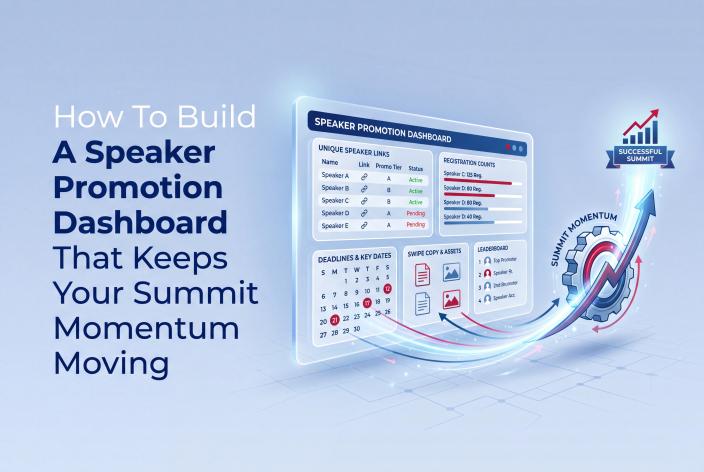
A speaker promotion dashboard gives you one clear place to manage the moving parts. It helps your speakers know what to do, helps you see what's happening, and helps the whole campaign keep momentum without depending on your memory.
Let's walk through what to build.
Why Speaker Promotion Breaks Down
Speaker promotion usually breaks down for simple reasons.
Not because your speakers are bad people.
Not because your summit is weak.
Most of the time, the system around the speakers is too scattered.
Here are the usual friction points:
- Speakers don't know exactly what they're expected to do.
- Their unique promotion link is buried in an old email.
- Swipe copy and graphics are hard to find.
- Deadlines are unclear.
- Nobody knows who is promoting and who is quiet.
- Follow-up reminders feel awkward because there's no shared visibility.
- The host waits too long to check the numbers.
You see the problem?
The summit depends on partner momentum, but the promotion process is being managed like a side conversation.
That creates stress for you and confusion for speakers.
A dashboard fixes this by making the promotion plan visible, trackable, and easier to talk about.
What A Speaker Promotion Dashboard Should Do
A good speaker promotion dashboard is not fancy for the sake of being fancy.
It answers 5 practical questions:
- Who is promoting?
- What link should they use?
- What materials do they need?
- What deadlines are coming up?
- What results are being generated?
That's it.
If your dashboard answers those questions, you're already ahead of most summit hosts.
What To Include In Your Speaker Promotion Dashboard
Here are the core pieces I would include if you're building this for a coaching summit, expert interview series, webinar collaboration, or partner campaign.
Unique Speaker Promotion Links
Every speaker needs their own unique link.
This is non-negotiable if you want to understand what's working.
Without unique links, you're guessing. You might know total registrations went up, but you won't know which partner created the lift.
Your dashboard should show each speaker:
- Their name
- Their unique registration link
- Their assigned promotion tier or commitment
- Their agreed promotion dates
- Their current registration count
- Their leaderboard position, if you're using one
This gives speakers clarity and gives you attribution.
And attribution matters because the best summit partnerships are not only about reach. They're about who brings the right people into your world.
Registration Counts By Speaker
Your dashboard should track registrations by speaker or promoter.
This helps you see momentum early.
If 1 partner is bringing aligned registrants, you may want to thank them quickly, give them extra visibility, or invite them into a deeper collaboration later.
If another speaker committed to promote and nothing is showing up, you can follow up while there's still time to help.
A simple version might look like this:
| Speaker | Promo Link | Commitment | Registrations | Status |
|---|---|---|---|---|
| Speaker A | Unique Link | 2 Emails | Active | Promoting |
| Speaker B | Unique Link | 1 Email And Social | Quiet | Needs Reminder |
| Speaker C | Unique Link | Partner Level | Active | Strong Momentum |
You don't need to make this complicated.
You do need to make it visible.
Promo Deadlines And Key Dates
Speakers are busy.
They have clients, launches, inboxes, families, and their own content calendars.
If you want them to promote well, make the timing easy.
Include:
- Promotion kickoff date
- First email send date
- Second email send date, if applicable
- Social post windows
- Summit start date
- Replay or all access pass promotion dates, if relevant
- Final reminder deadlines
The goal is to remove mental friction.
When a speaker can open one page and know exactly what to send and when to send it, you increase the chances they actually do it.
Swipe Copy And Graphics
Jenn Zellers, who ran summits for creative entrepreneurs, used speaker promotion materials such as email swipe copy, social copy, and graphics. She also emphasized communication as a key factor in summit success.
That's a lesson worth keeping.
Your dashboard should include speaker-ready assets:
- Email swipe copy
- Short social posts
- Longer social posts
- Suggested subject lines
- Graphics or image links
- Speaker bio language
- Event description
- Hashtags, if useful
- The speaker's session title and date
Here's a tip.
Give speakers copy they can quickly personalize.
The best swipe copy sounds human enough to use, but flexible enough that the speaker can make it sound like them.
Leaderboard Updates
Leaderboard contests can be powerful when they're used with care.
A leaderboard usually tracks promotion performance among speakers or affiliates. It can be structured around lead generation, sales, or both. The lead contest typically counts registrations during the promotion window, while the sales contest tracks sales during the event and follow-up period.
Why does this work?
Because it turns promotion into a shared campaign instead of a private task.
Speakers can see momentum. They can see who is participating. They can feel the friendly energy of the group.
But keep this grounded.
A leaderboard should create energy, not pressure or embarrassment.
Use it to celebrate action:
- "Top 5 promoters this week"
- "Biggest mover since yesterday"
- "First 3 speakers to cross a milestone"
- "Most engaged partner this round"
You can also use small prizes, sponsor bonuses, extra visibility, or simple recognition. If you're running your first summit, keep the prizes simple and set reasonable minimums so you're not overcommitting before you know how the campaign will perform.
And always be clear about the rules.
What counts? When does tracking start? When does it end? When will winners be announced? What minimums apply?
Clear rules protect the relationship.
How To Talk About Promotion Without Sounding Pushy
This is the part many coaches dread.
You don't want to nag people. You don't want to sound transactional. You don't want to make speakers feel like you only invited them for their list.
Good.
That instinct protects the relationship.
But silence creates its own problems.
The better path is to set expectations early, then communicate from shared agreement.
Set The Expectation Before They Say Yes
Promotion should not be a surprise after the speaker has already agreed.
When you invite someone, explain:
- Who the summit is for
- Why their voice is a strong fit
- What kind of visibility they will receive
- What promotion support you'll provide
- What promotion commitment you're asking for
You might say:
"We're building this as a collaborative authority event, so each featured speaker will receive their own promotion link, swipe copy, graphics, and dashboard access. We're asking speakers to send 1 to 2 emails and share during the promotion window, depending on the speaker tier. Does that feel realistic for you?"
Simple. Clear. Respectful.
Follow Up From The Agreement
If someone said they would promote and the numbers show nothing has happened, your reminder can be direct without being awkward.
Try this:
"Hey [Name], quick reminder that your first promo window is this week. I don't see any registrations through your link yet, so I wanted to make sure you had everything you need. Your link, swipe copy, and graphics are all in the speaker dashboard here: [link]."
No guilt.
No drama.
Just clarity.
Celebrate Publicly And Coach Privately
Use group updates to celebrate momentum.
Use private messages to help people who are behind.
A speaker group, email update, or dashboard announcement can highlight active promoters and create shared energy. Then if someone needs a nudge, send a personal message.
This keeps the tone collaborative instead of confrontational.
How Promoter Attribution Helps You Find Better Partners
Promoter attribution is more than a scoreboard.
It helps you make better business decisions.
When you know which speakers are generating registrations, you can start asking better questions:
- Which partners are bringing the most aligned people?
- Which topics are attracting the strongest interest?
- Which speakers are engaged and easy to collaborate with?
- Which audiences are responding to your summit promise?
- Which relationships should you nurture after the event?
This is where a summit becomes a pipeline asset.
The registration data tells you who is helping create attention. Your CRM and follow-up system help you turn that attention into trust, booked calls, and future opportunities.
That second part matters.
If all the data sits in a spreadsheet after the summit, you're leaving relationship value on the table.
How EventRaptor Supports Speaker Promotion Tracking
This is much easier when your event setup, registration data, speaker organization, promoter links, and follow-up path are connected.
EventRaptor supports the event management side of this process with tools for speaker and session organization, registration management, promoter and affiliate tracking, unique promoter links, performance reporting, leaderboards, and registration exports.
That means you can manage more of the summit campaign in one place instead of duct-taping the whole thing together across disconnected tools.
For a coach running a summit, that can include:
- Speaker profiles and session details
- Unique promoter links
- Registration lists and filtering
- Promoter attribution
- Performance reporting
- Leaderboard visibility
- Event pages and attendee dashboards
- Email reminders and follow-up workflows
Then GHL/CRMRaptor can support the CRM, calendar, funnel, workflow, automation, and follow-up side.
Together, the event activity and the follow-up system become easier to manage. Your summit doesn't have to end when the final session ends. It can feed a more intentional client attraction path.
A Simple Speaker Promotion Dashboard Checklist
Before promotion starts, make sure your dashboard includes:
- Speaker name and contact details
- Speaker tier or promotion commitment
- Unique registration link
- Session title and event date
- Email swipe copy
- Social copy
- Graphics or media links
- Promotion calendar
- Registration count by speaker
- Leaderboard status, if used
- Reminder schedule
- Notes on follow-up or special commitments
Then review it weekly before promotion begins and daily during the active promotion window.
You don't need to hover over every speaker.
You do need to know what's happening soon enough to respond.
The Real Goal Is Momentum You Can Manage
A speaker promotion dashboard is not just an operations tool.
It's a relationship tool.
It helps speakers feel supported. It helps you communicate clearly. It helps your summit create more useful data. And it helps the whole campaign feel less like a frantic scramble.
Remember this.
Your speakers are more likely to promote when the path is clear, the materials are ready, the reminders are timely, and the results are visible.
That is how you keep summit momentum moving.
And if you want help mapping a summit promotion system that fits your coaching business, your audience, and your offer, Book your Client Attraction Planning Call.
On the call, we'll look at where your current client flow is getting stuck and whether a summit, funnel, CRM, follow-up system, or done-for-you implementation path makes sense next.