You know that little voice that says, “I should wait until my audience is bigger”?
It sounds reasonable.
Wait until you have 5,000 subscribers. Wait until your social following looks impressive. Wait until your brand feels polished. Wait until you feel more “known.”
But here’s the truth.
A virtual summit can be the thing that helps you become known.
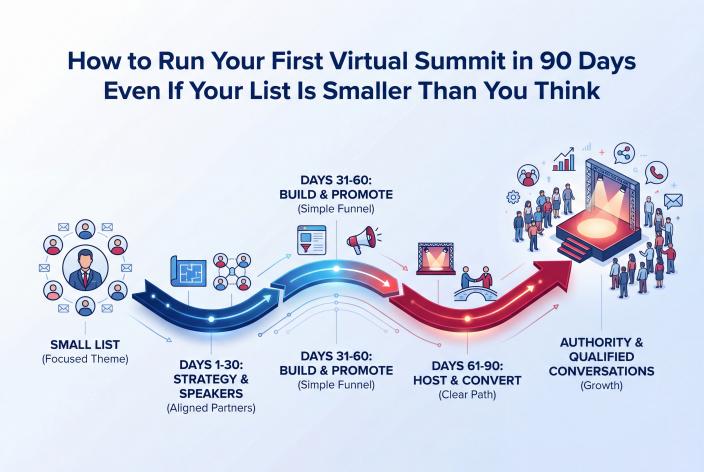
You don’t need a giant list before you host your first summit. You need a clear topic, the right speakers, a simple registration funnel, and a follow-up path that turns attention into qualified conversations.
And yes, you can build that in 90 days.
Let me explain.
Your small list is not the problem
Most coaches think their list has to do all the heavy lifting.
So if they only have 200, 500, or 1,000 people on their email list, they assume a summit is out of reach.
That’s a costly assumption.
A summit is built on collaboration. Your speakers bring reach, credibility, relationships, and borrowed authority. That’s why summits are so powerful for coaches who are still building visibility.
You’re creating a platform.
And when you create a platform, you’re no longer just posting into the noise hoping someone notices. You’re gathering experts around a meaningful problem your audience already cares about.
That changes the energy fast.
According to the Virtual Summits training material, a one-day summit can work with as few as 5 speakers when the goal is list building, with the sweet spot often around 8 to 10 speakers. That’s a manageable first event.
You don’t need 50 speakers.
You don’t need a giant production team.
You need focus.
The real advantage of starting early
Running a summit early gives you 4 big advantages:
- You borrow trust from respected speakers in your niche.
- You grow your audience through partner promotion instead of relying only on your own list.
- You create authority content you can repurpose for months.
- You build relationships with peers and potential referral partners.
That’s why waiting can slow you down.
If you’re a coach with real expertise, a clear audience, and an offer that helps people, your first summit can become the visibility asset that helps the market understand why you matter.
The 90-day summit plan
A 90-day timeline gives you enough room to plan, recruit, promote, host, and follow up without turning your business into a stress factory.
Here’s a simple structure.
| Timeline | Main focus | What happens |
|---|---|---|
| Days 1 to 15 | Strategy | Pick the theme, audience, promise, format, and offer path |
| Days 16 to 35 | Speaker recruitment | Invite 20 to 40 possible speakers and confirm 5 to 10 strong fits |
| Days 36 to 55 | Funnel build | Create registration page, speaker assets, emails, schedule, and CRM tracking |
| Days 56 to 75 | Promotion | Speakers promote, you email your list, social posts go live, reminders begin |
| Days 76 to 83 | Event delivery | Host the summit, engage attendees, make your next step clear |
| Days 84 to 90 | Follow-up | Invite attendees into your offer path, book calls, and nurture the rest |
Simple? Yes.
Effortless? No.
But it’s very doable when the moving parts are organized.
The Virtual Summits material suggests a one-day summit can be prepared in 30 to 60 days minimum, with a realistic time investment of 20 to 30 hours for a first-time host. A 90-day window gives you more breathing room and a cleaner launch.
And that matters because your audience can feel the difference between a rushed event and a well-held experience.
Pick a summit theme speakers want to share
Your theme is everything.
A vague theme makes promotion harder. A specific theme gives speakers a reason to say yes and attendees a reason to register.
Here’s the key question:
What urgent, specific problem does your ideal client already want help solving?
For example:
- A health coach could host “The 5-Day Energy Reset Summit for Women Over 40”
- A business coach could host “The Consistent Clients Summit for Solo Coaches”
- A wealth coach could host “The Calm Money Plan Summit for Entrepreneurs”
- A leadership coach could host “The Better Team Conversations Summit for First-Time Managers”
Notice what these have in common?
They’re not trying to attract everyone.
They speak to a clear person with a clear problem and a clear desired outcome.
That’s what makes your summit promotable.
Use the problem to shape your speaker list
Once the theme is clear, build your speaker list around the transformation.
Ask yourself:
- Who can help attendees understand the problem better?
- Who can give them a quick win?
- Who brings a complementary perspective?
- Who already serves this audience but does not directly compete with my core offer?
- Who has an audience that would genuinely benefit from this summit?
This is where many coaches get stuck.
They chase famous names.
You want aligned names.
A speaker with a smaller but engaged audience can outperform a bigger name who won’t promote, won’t show up with energy, or doesn’t care about your topic.
Recruit speakers who will actually promote
Speaker promotion does the heavy lifting when your own list is small.
But promotion should be part of the conversation from the beginning.
Not in a pushy way. In a clear way.
When you invite speakers, make the event feel valuable for them too.
You’re offering:
- Visibility to a relevant audience
- Association with other credible experts
- A polished event page and speaker profile
- Promotional assets they can easily share
- A chance to build trust through teaching
- Potential affiliate or partner opportunities, if you include them
Here’s a simple speaker invitation structure:
- Personal opening
- Why you thought of them
- The summit theme and audience
- What their session could cover
- What you’ll provide
- What you ask from them, including promotion
- A simple yes or no next step
Here’s a sample:
Hi Sarah, I’m putting together a one-day virtual summit for women coaches who want steadier client flow without living on social media. Your work around messaging and buyer psychology would be a great fit. I’d love to feature you in a 25-minute interview on how coaches can explain their value more clearly. We’ll provide the event page, promotional graphics, email swipe copy, and registration tracking. We’re asking each speaker to share the summit with their audience during the promo window so everyone benefits from the collaboration. Would you be open to taking a quick look?
Clear. Warm. Professional.
And notice this part.
You mention promotion before they say yes.
That prevents awkwardness later.
Make promotion easy
Most speakers are busy.
If you want them to promote, give them everything they need.
Create a simple speaker promo kit with:
- 2 to 3 email swipe options
- 5 social post captions
- Square and vertical graphics
- Their personal registration link
- Key dates
- Short summit description
- Suggested send dates
By the way, don’t bury this in a 17-page PDF.
Make it simple. Make it copy-and-paste friendly. Make it obvious.
The easier you make promotion, the more likely it happens.
Build a simple funnel that turns attendees into clients
A summit should feed your client attraction system.
That means the registration page is only the beginning.
You need a journey.
The Virtual Summits training calls this the post-summit profit strategy, or the customer journey. It’s the path that moves someone from cold prospect to warm lead to hot customer and eventually to a raving fan.
For coaches, the funnel can be very simple.
The basic first summit funnel
Use this structure:
-
Registration page
Promise the summit outcome clearly. Tell attendees who it’s for, what they’ll learn, and why the speakers are credible.
-
Confirmation page
Invite them to mark their calendar, join the reminder list, and look for emails.
-
Reminder emails and SMS
Keep people excited. Remind them why they registered. Highlight the sessions most relevant to their problem.
-
Summit sessions
Deliver useful teaching. Build trust. Make your point of view visible.
-
Host offer bridge
Invite the right attendees to take the next step with you. For many coaches, that next step is a planning call, workshop, diagnostic, or application.
-
Post-summit follow-up
Segment attendees based on interest. Follow up with those who clicked, watched, replied, or booked. Nurture everyone else.
Here’s a tip.
Your summit offer should feel like the natural next step from the event theme.
If your summit helps coaches understand why their client flow is inconsistent, your offer might be a Client Attraction Planning Call.
If your summit helps women improve energy, your offer might be a private health assessment.
If your summit helps business owners fix team communication, your offer might be a leadership diagnostic.
The summit creates trust. The offer gives that trust a place to go.
What numbers can you expect from a first summit?
Let’s talk numbers carefully.
Results vary based on your niche, speaker promotion, topic, offer, follow-up, audience quality, and sales process.
But the Virtual Summits training gives useful benchmarks for one-day summits.
For a one-day summit, typical planning guidelines include:
- 5 to 16 speakers, with 8 to 10 as a strong sweet spot
- 30 to 60 days minimum prep time
- 20 to 30 hours of your time if you’re new to running summits
- $1,000 to $5,000 in ad spend if you choose to support promotion with paid traffic
Outcome expectations depend on audience fit, speaker alignment, offer strength, follow-up, and how well the summit is positioned.
That means the better question is not, "How big can this get?"
The better question is, "What kind of platform am I building?"
A small-list summit can still create useful list growth, stronger authority, clearer market feedback, and qualified conversations when it is treated as a client attraction platform rather than a webinar with extra speakers.
There’s also a useful case example from the Virtual Summits material. Brandy and Natalie already had successful businesses and wanted to use a summit to kick start a new partnership. In 120 days, their summit was built from none to done, launched successfully, and generated a highly targeted list that supported a profitable business afterward.
The lesson?
The summit itself is only one piece. The real value comes from the audience, authority, relationships, and follow-up path you build around it.
Why your first summit should lead to conversations
If you’re selling coaching, your summit does not have to close every attendee immediately.
The first goal is to create qualified conversations.
That’s especially true for higher-value coaching offers.
A good summit warms people up before they get on your calendar. They hear your voice. They see your framework. They watch you guide the conversation. They feel your point of view.
By the time they book, they’re not starting from zero.
That changes your sales calls.
Instead of spending 45 minutes proving you’re credible, you can spend more time diagnosing fit.
And that’s where better clients come from.
The follow-up most coaches forget
Most of the money is in the follow-up.
Not because you’re hammering people with endless emails.
Because trust takes time.
Some attendees will be ready now. Some will need 2 weeks. Some will need 3 months. Some will watch one replay and come back later when their problem gets more urgent.
Your CRM and email follow-up should help you stay present without manually chasing everyone.
A simple post-summit follow-up might include:
- Day 1: Replay and thank-you email
- Day 2: Best insights recap
- Day 3: Invitation to book a call or attend a next-step workshop
- Day 5: Case study, client story, or teaching email
- Day 7: “Who this is for” email that qualifies the right people
- Day 10: Final direct invitation
- Ongoing: Weekly nurture emails tied to the summit theme
This is where EventRaptor and CRMRaptor fit so naturally.
The summit builds the authority. The funnel and CRM turn the attention into a managed pipeline.
You get the visibility and the follow-up working together.
Your 90-day summit checklist
If you want to run your first summit in the next 90 days, start here.
Strategy checklist
- Choose one specific audience
- Choose one urgent problem
- Name the summit around the outcome
- Decide if it will be free, paid, or hybrid
- Choose your next-step offer before promotion begins
Speaker checklist
- Build a list of 20 to 40 possible speakers
- Prioritize aligned speakers over famous speakers
- Ask about promotion expectations early
- Provide swipe copy and graphics
- Track who confirms, submits materials, and promotes
Funnel checklist
- Registration page
- Confirmation page
- Calendar link
- Reminder emails
- SMS reminders, if appropriate
- Speaker tracking links
- Replay page
- Booking or application page
- Post-summit email sequence
Conversion checklist
- Mention your next step during the event
- Make the invitation clear and low-pressure
- Follow up based on attendee behavior
- Book calls with the most engaged prospects
- Keep nurturing everyone who is not ready yet
Don’t overcomplicate this.
A clean first summit beats a perfect summit that never launches.
The next step if you want help building it
If your coaching works but your client flow still feels inconsistent, a summit can be one of the fastest ways to build authority, grow your audience, and create warmer sales conversations.
But the summit needs the system around it.
The theme. The speaker outreach. The registration funnel. The CRM. The reminders. The follow-up. The call booking path. The post-event nurture.
That’s what turns a virtual summit from a busy project into a real client attraction asset.
If you’d like help mapping that out, Book your Client Attraction Planning Call.
On that call, we’ll look at your audience, offer, visibility, and current client flow. Then we’ll talk through what a personalized summit and follow-up system could look like for your business.
No pressure. No hype.
Just a practical conversation about how to turn your expertise into more qualified conversations with the right people.