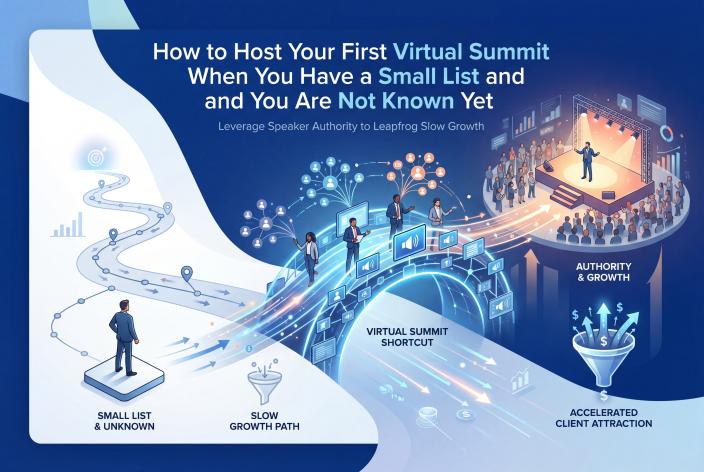
You've heard it before. Build your list first. Get a few thousand followers. Establish yourself as an authority. Then, maybe, you can think about hosting a virtual summit.
Sounds logical, right?
Here's the problem. That advice keeps coaches stuck in a holding pattern for months, sometimes years, waiting for a moment that never quite arrives. The list never feels big enough. The credibility never feels solid enough. And meanwhile, the coaches who ignored that advice are already booking clients and building real businesses.
So let's set the record straight on what you actually need to host your first virtual summit. Spoiler: it's a lot less than you think.
The "Wait Until You're Ready" Trap
Most coaches believe they need to hit some invisible milestone before they can host a summit. Maybe 2,000 email subscribers. Maybe three years of coaching experience. Maybe a polished brand with a professional website.
This belief feels responsible. It feels like wisdom. But it's actually the single biggest thing keeping you from accelerating your growth.
Why? Because the strategies most coaches use to build that list are painfully slow. Create a lead magnet, drive traffic to it, convert visitors one by one. At three subscribers per day, you're looking at six months just to reach 546 people. And that's if you're consistent every single day.
Meanwhile, a single virtual summit can help you reach a larger, more relevant audience faster than one-post-at-a-time list building.
The coaches who wait are playing a game they can't win fast enough. The coaches who launch are building momentum while everyone else is still "getting ready."
You Don't Build the List. Your Speakers Do.
Here's the part that changes everything once you understand it.
When you host a virtual summit, you invite speakers who serve the same audience you do. Those speakers promote your event to their email lists, their social media followers, their communities. They do this because it serves them too. They get exposure to a new audience, a chance to demonstrate their expertise, and an opportunity to grow their own reach.
So your 25-person email list? It becomes almost irrelevant.
If you bring in aligned speakers who are willing to promote, their audiences can become your first meaningful registration source. Those people arrive because someone they already trust recommended the event.
And here's something most people miss. You don't only need speakers with enormous lists. You need speakers with audience fit, energy, and willingness to participate. The size of a speaker's audience matters less when they do not actively promote.
The Authority Transfer Effect
This is what we call the authority paradox. Most coaches believe you earn authority by creating great content consistently over a long period of time. Post on LinkedIn every day. Publish weekly blog articles. Record podcast episodes. And eventually, people will see you as an expert.
That approach works. Slowly. And now that AI can generate content for anyone, consistent content alone is even less of a differentiator than it used to be.
A virtual summit shortcuts the entire process.
When you host a summit, you stand on the same stage as established experts. Your speakers have audiences who already trust them. When those audience members see their trusted expert speaking at your event, something powerful happens. They automatically transfer a portion of that trust and credibility to you.
You're the person who organized this. You're the one who brought all these experts together. You must know what you're doing.
Steve Eriksen, our founder, experienced this firsthand. When he launched his first summit, his business was eight weeks old. He had no list, no credibility in his new niche, and no connections. He brought in 27 speakers for that first Solopreneur Accelerator Summit. By the second summit just a few months later, more than half of the 37 speakers came to him asking to participate.
That's the authority transfer effect in action. You borrow credibility from your speakers, and it compounds with every event you host.
What You Actually Need to Get Started
Let's strip away the assumptions and look at the real requirements for your first summit.
What you need:
- A clear understanding of who your ideal audience is and what they're struggling with
- A theme that speaks directly to that audience's desires and challenges
- 15 to 25 speakers who serve a similar audience and are willing to promote
- A registration page, a simple agenda, and a way to deliver the event (Zoom works perfectly)
- A VIP offer so you can generate revenue from the event itself
- Your own talk where you share genuine value and invite attendees to a conversation
What you don't need:
- A big email list
- Years of coaching experience
- A perfect website or brand
- Paid advertising
- A complicated tech stack
- Permission from anyone
The bar is lower than you think. And every piece of the puzzle has a straightforward solution once you stop overcomplicating it.
Start Small And Build The System As You Go
The point is not that every first summit creates the same outcome.
It won't.
The point is that waiting for perfect conditions keeps many good coaches invisible. A focused summit gives you a practical project that can build authority, start relationships, grow your list, and create useful market feedback at the same time.
That is enough to make the first version worth taking seriously.
Your Minimum Viable Summit
If you're ready to stop waiting and start building, here's the simplest path from idea to live event.
-
Define your audience promise. What transformation will attendees experience by the end of your summit? What will they know, believe, or feel that they didn't before?
-
Choose a focused theme. Keep it specific enough to attract the right people and repel the wrong ones. "Lead Generation and Conversion Summit" is better than "Business Growth Summit."
-
Recruit your speakers. Start with people you know, then expand. Look in Facebook groups, LinkedIn, speaker directories, and at other summits in your space. Aim for twice the number you need, because some will say no.
-
Set up the basics. A registration page, a thank you page with your VIP offer, an event schedule, and a Zoom account. That's the core infrastructure.
-
Create your signature talk. This is where you share real value, demonstrate your expertise, and invite attendees to take the next step with you, whether that's a planning call, a useful resource, or a direct offer.
-
Launch and promote. Give your speakers the swipe copy and assets they need. Set a registration deadline. Let the momentum build.
A first summit can often be planned in 8 to 12 weeks when the scope is simple and the offer path is clear.
The Real Question
The question was never "Am I ready to host a summit?"
The real question is: how many more months are you willing to spend building your list three subscribers at a time while your calendar stays unpredictable?
A virtual summit can help you build your list, establish your authority, and create a clearer path toward qualified conversations.
You don't need a big list to start. You need a decision to start. The list comes after.
If you want help deciding whether a first summit makes sense for your coaching business, Book your Client Attraction Planning Call. We’ll look at your audience, offer, authority position, and the system that would need to support the event.