You've lined up 20 speakers. Your registration page looks sharp. The emails are loaded and ready to fire. And then the summit wraps, you make your offer, and the room goes quiet.
What happened?
Nine times out of ten, the answer is the same. The theme was wrong. The content was genuinely valuable, the speakers were fantastic, and the audience still walked away thinking, "That was great," instead of thinking, "I need to work with this coach."
Your summit theme is the single most important strategic decision you'll make in the entire planning process. Get it right, and your offer feels like the obvious next step. Get it wrong, and you're left wondering why 500 people loved your event but nobody booked a call.
Start With Your Offer, Then Work Backward
Here's where most coaches go sideways. They pick a theme they find interesting or one that sounds impressive. Then they build out topics, recruit speakers, and create content around that theme. Somewhere near the end of the process, they try to bolt their coaching offer onto the summit.
That's backward.
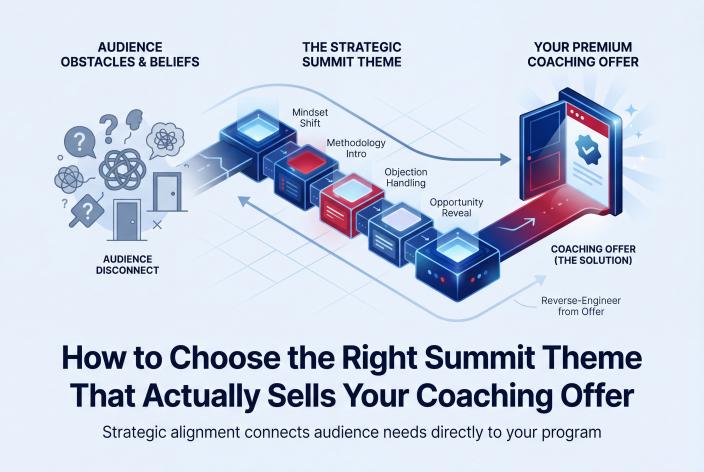
Your summit exists to serve one purpose: moving your ideal audience from "I'm not ready" to "I need this." Every decision you make about your theme, your topics, your speakers, and your content should flow backward from your coaching offer.
So the very first question is: what are you selling?
If you're selling a six-month group coaching program on building a referral system, your summit theme should address the beliefs and challenges that stop someone from investing in that program. If you're selling one-on-one health coaching, your theme should surface the exact frustrations that make someone realize they can't solve this alone.
When we plan summits for our clients, the offer is always the starting point. We map out the objections, the mindset gaps, and the knowledge gaps that sit between the audience and a "yes." Then we design the entire summit experience to close those gaps. By the time the offer lands, it feels like a natural next step rather than a pitch.
The Difference Between a Theme That Educates and a Theme That Converts
A theme that educates teaches your audience how to solve a problem. A theme that converts teaches your audience why they need help solving that problem.
This is a critical distinction. If your summit solves the exact problem your coaching solves, your audience walks away feeling capable and satisfied. They learned what they needed. They don't need you anymore.
But if your summit addresses the challenges that sit just before your offer, the ones that block people from saying yes, something very different happens. Your audience realizes the full scope of what's involved. They see the path clearly. And they recognize that having a guide for the next part of the journey would change everything.
Think about it this way. A relationship coach who helps couples strengthen their marriage could run a summit about "How to Fix Your Marriage in 30 Days." That summit solves the problem the coach gets paid to solve. The audience takes the tips, tries them at home, and never calls.
Now imagine that same coach runs a summit called "The Millennial Dating Summit." The audience learns about dating, starts relationships, and then experiences the inevitable friction that comes with building something real. Who do they turn to? The relationship coach who's been guiding them all along.
The theme didn't solve the coach's core problem. It solved the problem right before it. And that's what created the demand.
Identify the Beliefs Your Audience Needs Before They'll Buy
Every coaching offer has a set of prerequisite beliefs. These are the things your prospect needs to believe before they'll invest. If even one of those beliefs is missing, the sale stalls.
Here are a few common ones we see with the coaches we work with:
- "This is possible for someone like me." They need to believe they can actually achieve the outcome you promise.
- "Now is the right time." They need to feel urgency, not someday motivation.
- "I can't do this alone." They need to see the gap between where they are and where they want to be, and recognize they need support to bridge it.
- "This person can help me." They need to trust your expertise and your process.
Your summit theme should be engineered to install these beliefs through every session, every speaker, and every interaction. When a speaker shares how they went from zero to a full client roster in 90 days, that installs "this is possible for someone like me." When another speaker breaks down the complexity of building a funnel from scratch, that installs "I can't do this alone."
You're not manipulating anyone. You're educating them about reality. And reality is that growing a coaching business requires systems, support, and strategy. Your summit simply makes that visible.
The Three-Question Theme Validation Test
Before you commit to any summit theme, run it through these three questions. If you can't answer yes to all three, go back to the drawing board.
1. Will this theme attract the people who are most likely to buy my offer?
Your theme is a filter. The right theme pulls in your ideal clients and naturally repels everyone else. If your theme is too broad, you'll fill the room with people who enjoy free content but would never invest in coaching. If it's too narrow, you won't get enough registrations to make the math work.
2. Will the content under this theme make my audience more ready to buy, without solving the problem I get paid to solve?
This is the balance point. You want your audience to walk away with genuine value, real takeaways they can implement. But that value should make them hungrier for your offer, not satisfied without it. Each session should remove a block that was preventing them from saying yes.
3. Does this theme position me as the obvious authority to help with the next step?
If your summit is about LinkedIn strategies but your coaching offer is about mindset transformation, there's a disconnect. Your theme should naturally lead your audience to see you as the person who can take them further. The summit is the appetizer. Your offer is the main course. They should be on the same menu.
When Theme Misalignment Kills Conversions
We've troubleshot summits where the host had 600 registrants, great speakers, high engagement in the chat, and zero sales. Every single time, the root cause was the same: misalignment between the theme and the offer.
One coach ran a summit about productivity hacks for entrepreneurs. The content was excellent. Attendees loved it. But her coaching offer was about building a high-ticket sales process. The people who showed up wanted to manage their time better, not overhaul their sales system. The audience and the offer were speaking different languages.
Another coach hosted a summit on wellness strategies for busy professionals. Her offer was a 12-week nutrition coaching program. The summit attracted people interested in general wellness, meditation, stress management, and sleep optimization. Only a small fraction cared specifically about nutrition. The theme was too broad to filter for buyers.
The content quality was never the issue. The strategic alignment was.
When we build summits for our clients, we check alignment at every stage. Does the audience promise connect to the offer? Do the topics support the transformation the offer delivers? Does each speaker session remove a specific objection? If anything is out of alignment, we adjust before a single email goes out.
Name Your Summit So Your Ideal Client Self-Selects
Your summit name is the first filter. It should make your ideal client think, "That's for me," and everyone else think, "That's not my thing."
Keep it to three words or fewer, excluding the word "summit." Use language your audience already uses to describe their situation or aspiration. And whenever possible, use alliteration. It sticks in the brain.
A few principles that work:
- Be specific about who it's for. "The Solopreneur Accelerator Summit" tells a solopreneur this event is built for them. A generic "Business Growth Summit" could be for anyone.
- Signal the transformation, not the tactic. "Lead Generation and Conversion Summit" tells people what they'll walk away understanding. It's about the outcome, not a specific tool.
- Test it with real people. Ask five people in your target audience what they think the summit is about based on the name alone. If they can't articulate it in one sentence, simplify.
The name should do the heavy lifting of pre-qualifying your audience before they even read the registration page.
Your Theme Is Your Strategy
Choosing a summit theme isn't a creative exercise. It's a strategic one. The right theme turns your summit into a conversion engine that warms up your audience, removes their objections, and positions your offer as the logical next step.
The wrong theme gives you a room full of people who enjoyed the show and moved on.
If you're planning a summit and want to make sure every piece of it, from the theme to the speakers to the offer, is aligned to actually generate clients, that's exactly what we help coaches build. We reverse-engineer the entire experience from your offer and handle the execution so you can focus on showing up and serving your audience.
If you want help checking whether your summit theme, speakers, offer, and follow-up path actually fit together, Book your Client Attraction Planning Call. We'll map what a summit strategy could look like for your specific coaching business and where the pieces may need tightening.