A summit registration can feel like a win.
Someone saw your topic, recognized a need, trusted the promise enough to enter their name and email, and raised their hand.
That matters.
But registration is only the first step. The real question is what happens between that moment and the first session.
Do they feel welcomed?
Do they understand why this event matters?
Do they remember to attend?
Do they start to see you as a trusted guide before day one?
That is what your pre-event nurture path is for.
A good pre-event nurture path turns a simple registration into the beginning of a relationship. It gives attendees clarity, builds anticipation, reminds them why they signed up, and gently guides the right people toward the next step.
And when you are a coach or expert-led service provider, that next step might include a planning conversation, a workshop invitation, a VIP upgrade, or a deeper follow-up path after the event.
Let me show you how to build it.
Why The Pre-Event Window Matters
Most coaches put most of their energy into getting people registered.
That makes sense. Registration is visible. It feels measurable. You can see the list grow.
But the pre-event window is where trust starts to form.
A person who registers and then hears nothing for several days may forget why they cared. A person who gets clear, useful communication before the event is more likely to show up with context, attention, and interest.
The difference is simple.
You are not just reminding them about a date. You are helping them feel like they made a good decision.
That matters because your summit, workshop, or virtual event is part of a bigger client attraction system. It should help people move through a path like this:
- They notice the topic.
- They register because it feels relevant.
- They receive useful pre-event communication.
- They begin to trust the host and speakers.
- They attend with more intention.
- They get invited into the right next step.
- They continue receiving helpful follow-up after the event.
That path is much easier to manage when your registration pages, reminders, attendee dashboards, access links, CRM tags, and follow-up are connected.
This is where EventRaptor fits well. It supports the virtual event side with registration pages, thank-you pages, attendee dashboards, reminders, VIP messaging, access links, and attendee data. Then GHL/CRMRaptor can support the CRM, calendar, funnel, workflow, and follow-up side.
The strategy is human. The system keeps it consistent.
Map The Attendee Journey Before You Write The Emails
Before you write a single reminder email, map the experience from the attendee's point of view.
Not from your admin checklist.
From their actual day.
They may register while making lunch. They may be between client calls. They may be on their phone. They may like the topic but still be distracted, skeptical, or overloaded.
So your nurture path needs to answer 5 quiet questions:
- Did my registration work?
- Why did I sign up again?
- When is this happening?
- Where do I go to attend?
- What should I do next?
If those questions are answered clearly, the attendee relaxes.
And relaxed people pay better attention.
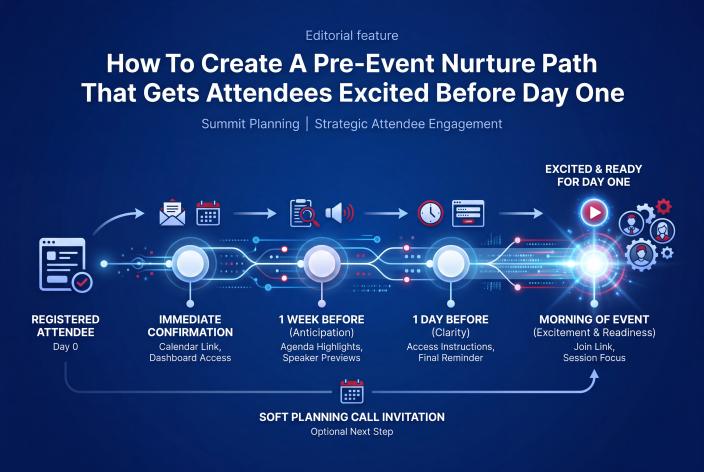
The Simple Pre-Event Journey Map
Use this as your starting point:
| Stage | What The Attendee Needs | What You Send Or Show |
|---|---|---|
| Immediately After Registration | Confirmation and confidence | Thank-you page, confirmation email, calendar link, dashboard access |
| One Week Before | Relevance and anticipation | Agenda highlights, speaker previews, useful prep content |
| One Day Before | Clarity and commitment | Reminder email, access instructions, what to expect |
| Morning Of The Event | Simple action | Join link, start time, session focus, light excitement |
Notice what is missing?
There is no heavy selling here.
The job before day one is to increase trust, attention, and readiness. If you include an invitation to a planning conversation, keep it soft and relevant. More on that shortly.
What To Send Immediately After Registration
The first message should arrive right away.
This is not the moment for a long newsletter, a full manifesto, or 7 different offers.
The attendee just wants to know, "Am I in?"
Give them a clean yes.
Include These Elements Right Away
Your confirmation email should include:
- A clear subject line that confirms registration
- The event name
- The event date and time
- A calendar link or instructions
- The attendee dashboard or access page link
- A short reminder of why the event matters
- A simple note about what they will receive next
Your thank-you page should do similar work.
It should confirm the registration, give them the next step, and make the event feel organized. If you have an attendee dashboard, send them there. EventRaptor supports attendee dashboards, registration pages, thank-you pages, dashboard messaging, and access links, which helps keep this first experience clean and clear.
Here is a simple structure:
You're registered for [Event Name].
Watch your inbox for reminders and event updates. You can access the attendee dashboard here: [link].
Add the event to your calendar now so you don't miss the sessions most relevant to you.
Simple. Calm. Useful.
That first experience sets the tone.
What To Send One Week Before The Event
One week before the event, your goal is to rebuild the reason they registered.
People forget.
Not because they don't care. Because their lives are full.
This email should help them reconnect with the promise of the event and start choosing what they want to attend.
Give Them A Reason To Look Forward To It
Send an email that includes:
- The main problem the event helps them think through
- 2 or 3 session highlights
- A link to the agenda or attendee dashboard
- A short note about who the event is for
- One useful preparation prompt
For example:
One week from today, we will be looking at how coaches can create more consistent client conversations without relying only on referrals and random content.
A few sessions you may want to mark on your calendar are...
Then list the sessions.
You can also ask a simple question:
Before the event starts, take 2 minutes and write down this question: where does your client attraction path feel weakest right now?
That little prompt changes the attendee's posture.
They are no longer just showing up to consume content. They are showing up with a business question in mind.
And that makes the event more useful.
What To Send One Day Before The Event
The day-before message should reduce friction.
This is where you remove uncertainty.
Do not make them search. Do not assume they remember the details. Do not bury the access link under a giant block of copy.
Make The Next Action Obvious
Your day-before email should include:
- The start time and time zone
- The attendee dashboard link
- The join link or instructions on where to find it
- A quick agenda reminder
- Any instructions for VIP attendees if relevant
- A short note about replays if you offer them
If you have different attendee types, such as general admission and VIP, this is where dashboard messaging and VIP messaging help. EventRaptor supports attendee dashboards and VIP dashboard messaging, which can make it easier to show the right instructions to the right people.
Here is the feel you want:
We start tomorrow.
Your attendee dashboard is here: [link]
That is where you will find the schedule, access details, and any updates before we begin.
Short. Clear. No drama.
The day before is also a good moment to remind them what kind of person this event is designed for.
For example:
If you are a coach who can serve clients well but still feels too dependent on referrals, networking, or inconsistent content, this event will help you see where the client attraction path may be breaking down.
That kind of sentence helps the right attendee self-identify.
What To Send The Morning Of The Event
The morning-of message has one job.
Get them to the right place.
Keep it short.
Use A Simple Morning Reminder
Include:
- "We start today"
- Start time and time zone
- Join link or dashboard link
- First session or opening focus
- A friendly encouragement to arrive a few minutes early
For example:
We start today.
Join us here: [link]
The first session begins at [time]. Come a few minutes early so you can get settled and make the most of the event.
That is enough.
If you want to include excitement, keep it grounded. You do not need hype. You need clarity and energy.
Something like this works:
We are looking forward to helping you think through a more reliable path from visibility to trust to qualified conversations.
That reminds the attendee why the event matters without turning the reminder into a sales page.
How To Add A Soft Planning Call Invitation Without Overwhelming Attendees
Now let's talk about the part many coaches get wrong.
They either avoid inviting people into a next step because they do not want to feel pushy, or they promote the next step so heavily that the event starts to feel like a pitch before it even begins.
There is a better rhythm.
Your pre-event invitation should be soft, specific, and optional.
The planning conversation should feel like help applying the event topic to their own business.
Where The Invitation Fits Best
You can place a soft invitation in 2 places before the event:
- In the one-week email, after the agenda preview
- On the attendee dashboard, below the main event details
Keep it short.
For example:
Want help thinking through your own client attraction path?
If you are a coach and you already know client flow is too inconsistent, you can Book your Client Attraction Planning Call. On the call, we will look at where your current path may be getting stuck and what kind of authority, funnel, CRM, follow-up, or event strategy could make sense next.
That is enough.
You are not asking everyone to buy. You are inviting the right person to raise their hand.
And because the invitation is connected to the event topic, it feels natural.
What To Avoid In The Pre-Event Invitation
Keep the pre-event invitation clean.
Do not promise guaranteed clients.
Do not imply one call will solve the whole business.
Do not stack multiple offers into the same message.
Do not make the planning call compete with attending the event.
The main pre-event goal is still attendance, trust, and readiness. The planning call is there for people who already know they want help applying the ideas.
How Connected Registration And CRM Follow-Up Make This Easier
A pre-event nurture path sounds simple when you list it out.
Then real life happens.
Someone registers through a partner link. Someone upgrades to VIP. Someone asks a question on the registration form. A speaker shares the event. A registrant clicks but does not attend. Another person attends the first session and should be invited into a follow-up path.
If all of that lives in separate spreadsheets, inboxes, page builders, and email tools, the host ends up doing too much manual coordination.
That is where the system matters.
EventRaptor helps organize the event side: registrations, attendee data, pages, reminders, dashboards, promoter attribution, speaker details, and follow-up communications. It can also sync contacts with connected CRM systems.
GHL/CRMRaptor supports the CRM and follow-up side: contact records, tags, custom fields or values, calendars, funnels, workflows, automation, and ongoing nurture.
Together, they help the event activity connect to the relationship path.
That means you can think more clearly about questions like:
- Who registered?
- Where did they come from?
- Which attendees are VIP?
- Who should receive which reminder?
- Who clicked, attended, or engaged?
- Who should be invited into a planning conversation?
- Who needs longer-term nurture after the event?
You still need the right message, offer, and event strategy.
But connected systems reduce the chance that warm interest gets lost because someone forgot to export a list, send a reminder, tag a contact, or follow up after the event.
Good automation protects relationships by making the next touch timely and consistent.
A Simple Pre-Event Nurture Checklist
Use this checklist before your next summit, webinar, or workshop.
Immediately After Registration
- Confirmation email is active
- Thank-you page confirms they are registered
- Calendar instructions are included
- Attendee dashboard or access page link is clear
- The email reminds them why the event matters
One Week Before
- Agenda highlights are sent
- Speaker or session previews are included
- Attendee dashboard link is included
- One simple preparation question is included
- Soft planning call invitation is optional and relevant
One Day Before
- Start time and time zone are clear
- Access instructions are obvious
- VIP or special attendee instructions are included if needed
- The email is short enough to scan quickly
Morning Of
- Join link or dashboard link is near the top
- First session time is clear
- The reminder creates calm focus, not confusion
- Attendees know what to do next
Behind The Scenes
- Registrants are captured cleanly
- CRM sync or export process is ready
- Tags or segments are planned
- Follow-up paths are mapped before the event starts
- The next step after the event is already decided
Do this before you promote heavily.
Because attention without follow-up is fragile.
The Real Win Is Trust Before The First Session
A strong pre-event nurture path does not need to be complicated.
It needs to be thoughtful.
Confirm the registration. Remind people why they cared. Show them where to go. Help them prepare. Give the right attendees a gentle way to ask for help.
That is how your event starts feeling professional before day one.
And for a coach trying to create more consistent client flow, that matters. Your summit or workshop should help you become more visible, more trusted, and easier to remember. Then your funnel, CRM, reminders, and follow-up should keep the relationship moving.
If you want help mapping this out for your own coaching business, Book your Client Attraction Planning Call.
On the call, we will look at where your client attraction path is getting stuck and what kind of summit, funnel, CRM, follow-up, or done-for-you implementation support could make sense next.