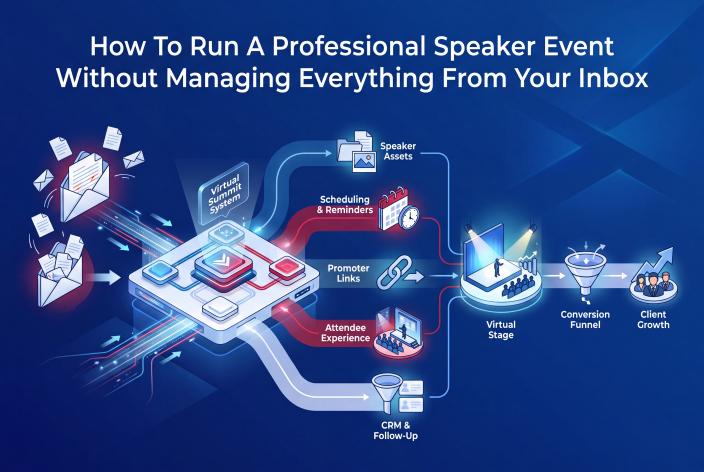
You can have a great event idea, a strong coaching offer, and a list of speakers who are excited to participate.
And still end up buried in your inbox.
Speaker events look simple from the outside. Invite some smart people. Put them on a schedule. Promote the event. Send the replay. Follow up with attendees.
Easy, right?
Then the real work starts.
One speaker sends a headshot but no bio. Another changes their session title after the page is live. Someone asks for their promo link. Someone else wants to know when their interview airs. Attendees need reminders. The Zoom link needs to be correct. Your CRM needs the right tags. And after the event, the warmest people need a clear next step.
This is where a lot of good coaches lose momentum.
The issue usually isn't the event idea. It's the lack of an organized event system behind the idea.
A professional speaker event should build your authority, grow your audience, create trust, and support better client conversations. That gets much harder when every detail lives in email threads, spreadsheets, notes, calendar invites, and memory.
So let's walk through how to run a speaker event like a serious growth asset, without turning your inbox into the command center.
Why Speaker Events Feel Heavier Than They Look
A speaker event has 2 sides.
The public side is what your audience sees:
- The registration page
- Speaker names and photos
- Session titles
- Event reminders
- The schedule
- The event dashboard or access page
- Replays or follow-up messages
The private side is what you and your team have to manage:
- Speaker outreach
- Speaker applications or invitations
- Bios, headshots, titles, links, and topic descriptions
- Session timing
- Promotion links
- Email reminders
- Zoom access
- Calendar details
- Attendee lists
- CRM tags
- Post-event follow-up
- Reporting and exports
That second list is where the stress lives.
You can run those pieces manually. Plenty of coaches do. But once your event has multiple speakers, multiple sessions, partner promotion, attendee reminders, VIP options, and follow-up, the manual process starts creating hidden costs.
Not just software costs. Attention costs.
You spend your energy copying links, checking spreadsheets, updating pages, chasing missing speaker assets, sending reminders, and wondering whether the right people are being followed up with.
By the time the event goes live, you're not leading from calm authority. You're trying to keep the machine from wobbling.
Here's the takeaway: speaker events feel heavy when the event is managed as a collection of tasks instead of a connected journey.
What To Organize Before You Invite Speakers
Speaker outreach should not be the first operational step.
Before you invite speakers, get the event foundation clear. Otherwise, every speaker conversation creates more open loops.
Start with these decisions.
Clarify The Event Promise
Your event needs a clear reason to exist.
What problem does it help your audience understand or solve? Why would the right person register? Why would a good speaker want to be associated with it?
A clear event promise helps with:
- Speaker invitations
- Session topics
- Registration page copy
- Promotional language
- Follow-up messaging
- Sales conversations after the event
If your event promise is fuzzy, the speaker lineup can feel random. And random events are harder to promote, harder to position, and harder to connect to your offer.
Define The Right Audience
A speaker event should attract people you can genuinely help.
That does not mean every attendee is ready to buy. It means the event should bring together people who care about the problem your coaching solves.
Ask:
- Who is this event for?
- What are they struggling with right now?
- What do they already believe?
- What do they need to understand before they are ready for the next step?
- What kind of speakers would increase trust with this audience?
This matters because audience clarity shapes everything else.
When the audience is clear, your speaker invitations become more specific. Your registration page gets sharper. Your follow-up feels more relevant. And your sales calls tend to start from a better place.
Choose The Event Format
You do not have to run a huge summit for a speaker event to be useful.
Depending on your audience, offer, and capacity, your format might be:
- A focused half-day expert panel
- A multi-day virtual summit
- A workshop series
- A speaker-led campaign
- A private roundtable
- A recurring interview event
- A giveaway or collaborative campaign
The right format should fit your growth strategy.
If you're trying to build authority quickly in a niche, a multi-speaker summit can create a strong public stage. If you're nurturing a more intimate audience, a smaller panel or workshop series may feel more aligned.
The point is to choose the format before you invite speakers, so everyone understands the commitment.
Map The Attendee Journey
Before speakers enter the picture, map what happens for the attendee.
A simple version looks like this:
- They hear about the event from you, a speaker, or a partner.
- They visit the registration page.
- They register and receive a confirmation.
- They get reminders before the event.
- They attend sessions or access the dashboard.
- They receive replays or next-step content.
- They are invited into a relevant follow-up path.
- The best-fit prospects are guided toward a conversation.
That journey should not be improvised after registrations start coming in.
A professional event feels smooth because the path has already been thought through.
The Hidden Moving Parts That Need A Home
Here is where inbox-based event management starts to fall apart.
Every speaker event creates dozens of small assets and decisions. None of them seems difficult by itself. Together, they become a fog.
Use this table as a quick diagnostic.
| Moving Part | What Needs To Be Organized | What Goes Wrong When It Lives In The Inbox |
|---|---|---|
| Speaker Details | Bio, headshot, title, session description, links | Pages go live with missing or outdated information |
| Session Timing | Date, time, track, order, duration, time zone | Speakers and attendees get confused |
| Promotion Links | Unique links for speakers and partners | You don't know who drove registrations |
| Speaker Communication | Invitations, acceptance, reminders, deadlines | You repeat yourself and miss follow-ups |
| Event Pages | Registration, thank-you page, dashboard, session pages | Updates happen in too many places |
| Attendee Access | Zoom links, calendar details, replay access | Attendees ask the same questions again and again |
| CRM And Tags | Registrant data, VIP status, source, engagement | Follow-up gets delayed or too generic |
| Post-Event Follow-Up | Replay emails, nurture messages, sales invitation | Warm interest cools before you respond |
You see the pattern?
The problem is not one missing headshot. It's the pileup of details with no central place to manage them.
A speaker event needs an operational home base. Somewhere you can see what has been submitted, what still needs attention, who has promoted, who registered, and what follow-up should happen next.
How To Manage Speaker Assets Without Chasing Everything Manually
Speaker assets are one of the first places an event starts to feel messy.
You need a consistent process for collecting:
- Speaker name
- Bio
- Headshot
- Session title
- Session description
- Website or social links
- Gift or bonus details, if relevant
- Agreement status, if used
- Presentation files or uploads, if needed
- Promotional swipe copy
The key is to stop treating every speaker as a separate custom project.
Create one speaker asset process and use it for everyone.
Give Speakers One Clear Submission Path
Speakers should not have to guess where to send things.
Give them one clear place to submit their materials, confirm their session details, and understand what happens next.
This protects your time. It also makes the event feel more professional.
Good speakers pay attention to how organized the host is. When the process is clear, they feel safer promoting the event to their audience.
Set Asset Deadlines Early
Do not wait until the event page is almost live to collect key speaker materials.
Set deadlines for:
- Speaker acceptance
- Bio and headshot
- Session title and description
- Promo commitments
- Presentation files, if needed
- Final schedule confirmation
And make the deadlines visible from the beginning.
This helps you avoid the frantic final week where you're still chasing bios while also writing emails, testing pages, and preparing to host.
Keep Speaker Data Connected To The Event Page
If speaker information lives in a spreadsheet and the event page lives somewhere else, updates become risky.
Someone changes a title, but the registration page still shows the old one. A bio gets shortened in one place but not another. A speaker is moved to a different time slot, but the promotional email still has the previous schedule.
This is where EventRaptor becomes useful.
EventRaptor supports speaker profiles, speaker applications, invitation workflows, presentation review, speaker files, schedules, agreement tracking, and speaker status management. Instead of coordinating every detail from your inbox, you can keep the speaker side of the event tied to the event itself.
That matters because a speaker event is not only a marketing idea. It's an experience people judge in real time.
How To Manage Session Timing And Reminders
Session timing seems simple until you have multiple speakers, multiple time zones, a live host, session access links, calendar reminders, and attendees who need to know where to go.
The goal is to make the schedule obvious.
For speakers, that means they know:
- When they are speaking
- How long the session is
- Whether it is live, recorded, or hybrid
- Where to join
- What to prepare
- When to promote
- What happens after their session
For attendees, that means they know:
- When the event opens
- Which sessions are available
- How to access the event
- Whether replays are available
- What to do if they miss a session
- What the next step is after the event
This is why reminders are not just admin.
Reminders protect attendance, reduce confusion, and help your audience stay engaged. They also protect your reputation. A clear reminder system tells people, "This host knows what they're doing."
EventRaptor supports schedules, calendars, attendee dashboards, event access links, reminder emails, dashboard messaging, and event timing controls. GHL/CRMRaptor can support the CRM, calendar, funnel, workflow, automation, and follow-up layer around that journey.
Together, that helps the event move from scattered notices to a more connected attendee experience.
How To Make Promoter Links Useful Instead Of Confusing
One of the best parts of a speaker event is partner-powered visibility.
Your speakers and partners can introduce you to people who already trust them. That borrowed trust is valuable, especially when you're working to become known in your niche.
But partner promotion gets confusing fast when links are manual.
You need to know:
- Which speakers received their links
- Which links were used
- Which partners drove registrations
- Which campaigns created momentum
- Which relationships may be worth deepening after the event
If you don't track this, you're left guessing.
And guessing weakens your follow-up with partners.
A strong promoter system gives each speaker or partner a unique link, tracks attribution, and lets you see which promotion activity is working. EventRaptor supports promoter links, partner attribution, performance reporting, exports, leaderboards, and cross-event attribution.
That means your speaker event can become more than a visibility burst. It can show you which relationships are helping you grow.
Here's a tip.
After the event, do not only follow up with attendees. Follow up with speakers and partners too.
Thank them. Share what you can about their contribution. Ask what they noticed. Explore whether a deeper collaboration makes sense.
A well-run speaker event can open doors that one more solo content post never would.
How Event Operations Shape The Attendee Experience
Attendees do not see your spreadsheet.
They feel the effects of it.
If the registration page is clear, the confirmation arrives quickly, the reminders are useful, the dashboard is easy to understand, and the follow-up makes sense, the event feels professional.
If links are wrong, reminders are missing, session details are confusing, or follow-up arrives too late, trust leaks out of the experience.
This is especially important for coaches.
Your marketing is part of your client experience. A messy event can make a good coach look less ready than they are. A smooth event can help right-fit prospects feel that you are organized, thoughtful, and serious about helping them.
A strong attendee experience usually includes:
- A registration page that clearly explains the event promise
- A thank-you page that confirms what happens next
- Reminder emails with the right timing and access details
- An attendee dashboard or access page that is easy to navigate
- Calendar details so people can plan
- Replay or next-step communication after the event
- Follow-up that continues the conversation while interest is warm
This is where the operational work becomes strategic.
Every clear touchpoint builds trust before the sales conversation.
Why Post-Event Follow-Up Should Be Planned Before The Event Starts
The biggest missed opportunity in speaker events often happens after the final session.
The host feels relieved. The speakers are thanked. The replays go out. Then the event energy fades.
But attendees who registered, attended, clicked, asked questions, upgraded, or watched specific sessions have given you useful signals.
They raised their hand.
So what happens next?
Your follow-up should be mapped before the event begins.
At minimum, plan:
- A replay or recap message
- A useful follow-up email connected to the event topic
- A clearer explanation of who you help and how
- A soft invitation to the next step
- A longer nurture path for people who are interested but not ready yet
- A CRM process for tagging, segmenting, and tracking leads
This is where EventRaptor plus GHL/CRMRaptor can work together naturally.
EventRaptor handles the virtual event management side: event pages, registration, speaker workflows, reminders, promoter tracking, attendee data, schedules, and follow-up communications.
GHL/CRMRaptor supports the CRM and conversion path: contact records, tags, custom fields or values, calendars, funnels, workflows, automation, and ongoing follow-up.
That connection matters because your event should not end as a folder of recordings and a tired host.
It should feed a living client attraction system.
A Simple Speaker Event Operating Plan
If you're planning a speaker event, use this sequence.
Step 1: Set The Strategy
Clarify the audience, event promise, offer connection, event format, and next step you want right-fit attendees to take.
Step 2: Build The Event Foundation
Create the registration path, thank-you page, attendee access plan, schedule structure, reminder plan, and CRM tagging approach.
Step 3: Prepare The Speaker Process
Create the speaker invitation, asset collection process, speaker deadlines, promo expectations, session guidelines, and agreement workflow if needed.
Step 4: Organize Promotion
Give speakers and partners clear promotional language, unique links, calendar dates, and simple instructions.
Step 5: Manage The Event Experience
Keep session timing, reminders, access links, dashboards, and speaker communication organized so attendees can focus on the content.
Step 6: Follow Up While Interest Is Warm
Send replays, nurture messages, invitations, and partner follow-up. Move the right people into the next step instead of letting the event go quiet.
Step 7: Review What Worked
Look at registrations, promoter activity, attendee engagement, speaker status, email activity, and follow-up response. Use what you learn to improve the next campaign.
That is how a speaker event becomes repeatable.
Not perfect. Repeatable.
And repeatable is what gives you a calmer path to authority and client attraction.
The Real Goal Is A Speaker Event That Builds Trust
A professional speaker event is not about looking fancy.
It's about making the path easier for everyone involved.
Speakers know what to submit, when to promote, and where to show up. Attendees know why the event matters, how to access it, and what happens next. You know who registered, where they came from, how to follow up, and which conversations deserve more attention.
That is a very different feeling from waking up to a crowded inbox and hoping nothing important got missed.
If you're a coach with real expertise, a speaker event can help you borrow authority, build relationships, grow your audience, and create trust before the sales call.
But the event needs a system behind it.
EventRaptor gives the event side one organized place to live. GHL/CRMRaptor supports the CRM, funnel, calendar, workflow, automation, and follow-up side. Together, they help turn event attention into a managed path from visibility to trust to qualified conversations.
If you want help applying this to your coaching business, Book your Client Attraction Planning Call.
On the call, we can look at where your client flow is getting stuck, whether a speaker event makes sense, and what kind of authority, funnel, CRM, follow-up, or implementation support could be the next practical move.