If you've been thinking about hosting a virtual summit, you may already feel the pull of the big vision.
Multiple speakers. A polished registration page. Partner promotion. A growing list. A stronger position in your niche.
That's exciting.
But here's a practical question worth asking first.
Do you know, with enough confidence, that your summit theme is the one your audience actually wants?
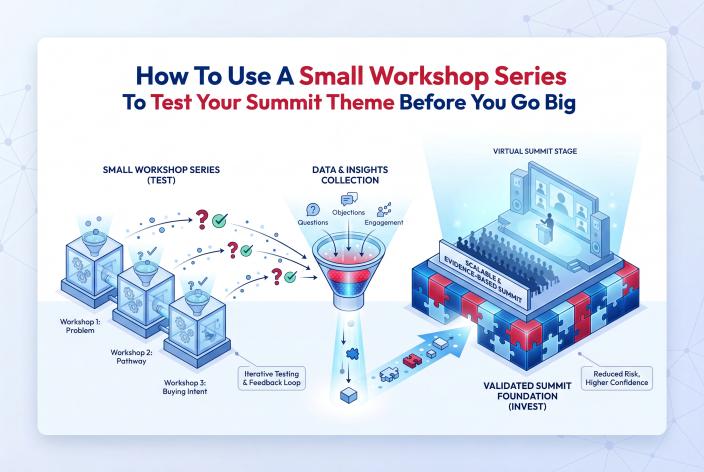
A small workshop series can help you find out before you commit to a larger event.
You can use 3 focused workshops to test your audience promise, hear real questions, notice objections, and see where people lean in. Then, when you do build the bigger summit, you're not guessing from a blank page.
You're building from evidence.
Why A Small Workshop Series Reduces Risk
A virtual summit can be a powerful authority-building asset. It can help you bring experts together, grow your audience, create partnerships, and build trust around a specific problem.
But the format needs to match your goal.
A multi-day summit may make sense when you're trying to build an audience. A smaller workshop, one-day event, summit series, or mastermind-style event may fit better when your goal is to deepen trust, test an offer, or sell a higher-touch coaching program. The important decision is not simply, "Should I run a summit?" It is, "What kind of event fits my audience, offer, timeline, and business goal?"
That's where a workshop series becomes useful.
It gives you a smaller stage where you can test:
- Whether people care about the topic enough to register
- Which promise creates the strongest response
- What questions people ask before they trust you
- Which objections appear again and again
- Whether the topic leads naturally into your paid offer
- Which partners, speakers, or collaborators may be a fit later
Think of it as a live diagnostic.
You're not trying to create the perfect event. You're trying to create useful conversations with your market.
And for a coach, that's gold.
Start With The Summit Theme You Want To Test
Before you pick workshop topics, write your possible summit theme in one clear sentence.
Use this simple structure:
This event helps [specific audience] solve [specific problem] so they can [desired outcome].
For example:
- This event helps new health coaches create a steady client attraction system without relying only on referrals.
- This event helps executive coaches become more visible and trusted in a niche before trying to scale their content.
- This event helps relationship coaches turn scattered visibility into more qualified consultation calls.
Notice the shape.
Audience. Problem. Outcome.
If your theme feels vague, your event will feel vague. And vague events are harder to promote, harder to partner around, and harder to connect to a paid offer.
So sharpen the sentence first.
Then use your workshop series to see whether the market responds.
Choose 3 Workshop Topics That Reveal Demand
A good workshop series should not feel like 3 random classes.
It should feel like 3 windows into the same buyer journey.
You want each workshop to reveal something different about your audience's pain, motivation, and readiness.
Workshop 1 Should Test The Main Problem
The first workshop should focus on the pain your summit theme is built around.
Ask yourself:
- What problem does my audience already know they have?
- What are they tired of dealing with?
- What would make them say, "Yes, that's me"?
For a business coach, this might be inconsistent sales calls.
For a wellness coach, it might be clients who start strong but fall off after a few weeks.
For a leadership coach, it might be high-performing managers who are burning out quietly.
This workshop tells you whether the pain is clear enough to attract attention.
Watch the registration response. Watch the questions people submit. Watch whether attendees describe the problem in the same language you used, or whether they say it differently.
That language matters.
Your audience will often hand you better copy than anything you could invent alone.
Workshop 2 Should Test The Pathway
The second workshop should test how your audience thinks the problem gets solved.
This is where you introduce a framework, process, or set of decision points.
You are listening for something very specific.
Do people understand the path?
Do they see themselves in it?
Do they believe the first step is realistic?
For example, if your larger summit theme is about predictable client attraction for coaches, a second workshop might teach the path from authority to registration to nurture to qualified conversations.
That kind of topic helps you see whether your audience is ready to think in systems, or whether they are still stuck looking for isolated tactics.
This is useful information before you build a bigger event.
Because your summit sessions should meet people where they actually are.
Workshop 3 Should Test Buying Intent
The third workshop should sit closest to your offer.
This does not mean you turn the whole thing into a pitch.
It means the topic should naturally reveal who is ready for help.
Good buying-intent workshop topics often sound like:
- How To Choose The Right Client Attraction Strategy For Your Coaching Business
- How To Know Whether A Summit, Webinar, Or Workshop Makes Sense Next
- How To Turn Event Registrations Into Better Sales Conversations
- How To Build A Follow-Up System Before You Drive More Visibility
These topics help people make a decision.
And when people are deciding, they reveal what they value, what they fear, and what they need to believe before they move forward.
Listen closely.
Their questions will show you whether your summit should focus more on authority, offer clarity, partnerships, CRM, follow-up, or sales conversion.
Collect More Than Names And Emails
A workshop series becomes much more useful when you collect the right information.
You want more than a registration count.
You want clues.
Ask Better Registration Questions
Add 2 or 3 simple questions to your registration form.
For example:
- What is the biggest challenge you're trying to solve right now?
- What have you already tried?
- What would make this workshop worth your time?
- Are you currently looking for help with this, or just gathering ideas?
Keep it short.
If the form feels like homework, fewer people will finish it. But a few good questions can tell you which topics, promises, and examples deserve more attention.
EventRaptor supports registration pages, custom registration questions, registrant lists, search and filtering, exports, VIP indicators, promoter attribution, and CRM sync. That matters because your workshop data should not disappear into a spreadsheet you never open again.
The more organized your data is, the easier it is to see what your audience is telling you.
Track Questions And Objections During The Workshop
During each workshop, pay attention to the questions people ask live.
Especially these:
- "Will this work if my audience is small?"
- "How much time does this take?"
- "What if I don't have speakers yet?"
- "What should I do first?"
- "How do I follow up without sounding pushy?"
Those questions are not interruptions.
They are research.
They show you where your summit content needs to build trust.
If 5 people ask some version of the same question across the series, that question probably deserves a session, panel, checklist, email, or follow-up resource in the larger campaign.
Watch Engagement Signals
Engagement is not only attendance.
Look at:
- Who registers but does not show up
- Who attends live
- Who stays until the end
- Who asks questions
- Who replies to follow-up emails
- Who clicks to book a call or request more information
- Who shares the workshop with someone else
These signals help you separate casual interest from real demand.
And they help you decide whether your bigger event needs a sharper topic, stronger partners, better pre-event nurture, or clearer post-event next steps.
Use Follow-Up To Learn While Interest Is Warm
The follow-up after a workshop is where many coaches quietly lose momentum.
People attend. They like it. They feel helped.
Then nothing happens.
A few days later, the energy fades.
Good follow-up keeps the relationship moving while the topic is still fresh.
Send a short email after each workshop asking:
- What was most useful?
- What question is still unanswered?
- Which topic would you want next?
- Are you working on this now, or later?
You can also segment people based on behavior.
Someone who attended all 3 workshops and asked offer-related questions is in a different place than someone who registered once and never showed up.
This is where CRM and automation support the relationship.
EventRaptor supports welcome emails, scheduled reminders, nurture emails, follow-up emails, personalization placeholders, email status tracking, and CRM syncing. GHL/CRMRaptor can support the CRM, calendar, funnel, workflow, automation, and follow-up side around that activity.
Used well, automation does not make the experience colder.
It helps you follow up on time, with the right message, while the person still remembers why they cared.
Turn The Workshop Series Into A Bigger Campaign
Once you've run the 3 workshops, do a simple review.
Ask:
- Which topic got the strongest registration response?
- Which topic created the best questions?
- Which topic led most naturally into your offer?
- Which audience segment seemed most engaged?
- Which objections need to be addressed before a sales conversation?
- Which partners or speakers would strengthen the next version?
Now you have options.
Turn It Into A Larger Summit
If the theme created strong engagement, you can expand it into a multi-speaker summit.
Each workshop can become a track, theme, or session category.
For example:
- Workshop 1 becomes the problem-awareness track
- Workshop 2 becomes the strategy and framework track
- Workshop 3 becomes the implementation and conversion track
Now your summit has a natural flow.
It helps people understand the problem, see the path, and decide what kind of help they may need next.
Turn It Into A Podcast Or Interview Series
If the topic is promising but you're not ready for a larger summit, you can turn the workshop themes into a podcast-style interview series.
Invite experts to discuss the questions that came up during the workshops.
This gives you authority-building content and potential partner relationships without needing to produce a larger event immediately.
Turn It Into A Partner Campaign
If certain people shared, replied, or brought others into the workshops, pay attention.
Those may be early partner signals.
A future campaign could include guest experts, referral partners, affiliates, or collaborative promotion.
EventRaptor supports promoter links, promoter dashboards, performance reporting, leaderboards, and attribution, which can make partner promotion easier to manage once you're ready to expand.
Build The Bigger Event Around What You Learned
The best summit themes feel obvious to the right people.
They make someone think, "This is exactly the conversation I need to be in."
A workshop series helps you get closer to that clarity.
You learn what people register for, what they ask, where they hesitate, what they want next, and whether your offer fits the conversation.
That's a calmer way to build.
And it respects your time, your budget, your audience, and your reputation.
You do not need to make the first version massive. You need it to teach you something useful.
Then you can decide whether the next step is a summit, webinar, podcast series, partner campaign, or a more focused follow-up funnel.
Get Help Choosing The Right Event Format
If you're wondering whether your idea should become a workshop series, summit, webinar, podcast-style series, or partner campaign, the next step is to map it against your audience, offer, and current client flow.
That's exactly the kind of conversation we have on a Client Attraction Planning Call.
We'll look at where your client flow is getting stuck, what you're trying to sell, how people currently find you, and what kind of authority-building and follow-up system could make sense next.
If you want help applying this to your coaching business, Book your Client Attraction Planning Call.