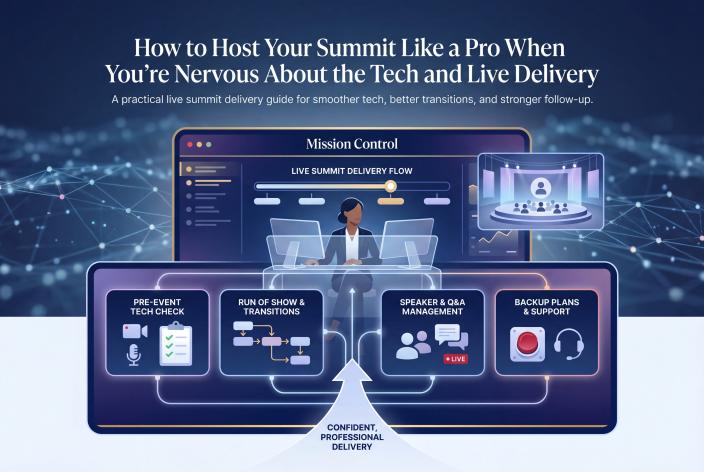
The fear is real when you’re the coach and the producer
You can be brilliant with clients and still feel your stomach tighten when you think about hosting a live summit.
Why?
Because coaching and producing are different muscles.
When you’re coaching, you’re present. You’re listening. You’re guiding the person in front of you.
When you’re producing a summit, you’re thinking about Zoom links, speaker timing, intros, chat questions, slides, reminders, attendees, Q&A, VIP mentions, replays, and what to say if someone’s internet dies 3 minutes before they’re supposed to go live.
That’s a lot to hold in your head.
And if you’re already worried that your summit will feel messy, you’re not alone. The fear usually sounds like this:
- “What if the speaker doesn’t show up?”
- “What if I don’t know what to say between sessions?”
- “What if the tech breaks?”
- “What if the chat is dead?”
- “What if people leave before my offer?”
Here’s the relief.
You don’t need to become a broadcast producer overnight. You need a simple live delivery system.
A system that tells you what happens before the session, during the session, after the session, and when something goes sideways.
Start with the pre-event tech checklist
The day of the summit is not when you want to discover that your camera is blurry, your speaker has the wrong link, or your Zoom settings block screen sharing.
Do a tech check before the event. Then do a shorter version before each live day.
Your host setup checklist
Use this as your basic pre-event checklist:
| Area | What to check |
|---|---|
| Internet | Use a hardwired connection when possible, or test your Wi-Fi from the exact room where you’ll host |
| Zoom settings | Confirm waiting room, recording, screen sharing, chat, captions if used, and host permissions |
| Camera | Check framing, focus, background, and eye line |
| Lighting | Put light in front of you, not behind you |
| Audio | Test your microphone and have backup earbuds nearby |
| Power | Plug in your laptop and keep chargers close |
| Backup device | Have a second device logged in or ready if your main device freezes |
| Speaker access | Confirm each speaker has the correct personal link and knows when to arrive |
| Recording | Confirm who is responsible for recording and where files will be saved |
| Support | Assign someone besides you to watch chat, troubleshoot, and track timing |
That last point matters more than most coaches realize.
When you’re live, your attention needs to be on the audience and the speaker. If you’re also trying to fix audio, answer chat questions, find the next speaker, and paste links, you’ll feel scattered.
In one summit conversation, Natalie Luneva described having speakers arrive 15 minutes early and recommended having support available during live events so the host is not the one solving every technical problem while trying to stay present. That’s smart production.
Your job is to lead the room. Support helps protect that focus.
Create a run of show so you always know what to say
A run of show is simply the plan for what happens, in what order, and who says what.
It does not need to be complicated.
In fact, the best version for a coach-host is usually simple enough to follow when you’re tired, excited, or dealing with a small tech hiccup.
A simple session run of show
For each speaker session, create a short script like this:
- Welcome attendees back.
- Remind them what session they’re in.
- Mention how to participate in chat or Q&A.
- Introduce the speaker.
- Hand off clearly.
- Watch time and chat during the session.
- Return at the end with 1 or 2 takeaways.
- Invite questions if there is a Q&A segment.
- Mention the next session or next step.
- Transition to break, VIP offer, replay access, or the next speaker.
Here’s a practical example:
“Welcome back, everyone. We’re about to move into our next session on building a coaching offer that attracts better-fit clients. As we go, drop your questions in the chat. I’ll bring a few of them forward at the end if we have time. Our next speaker helps coaches clarify their message and turn that message into stronger sales conversations. Please welcome [Speaker Name].”
That’s enough.
You don’t need to perform. You need to guide.
Build transition phrases before you need them
The moments between sessions are where many hosts get nervous.
So prepare a few transition lines in advance:
- “That was such a useful point about [topic]. If you’re taking notes, write this down.”
- “We’re going to take a short break. When we come back, we’ll look at [next topic].”
- “If this session opened a question for you, put it in the chat now.”
- “For those who want the replays and bonus resources, I’ll share the VIP link again during the break.”
- “If you’re using this summit to think through your own client attraction system, pay close attention to the next session.”
These little lines reduce panic.
And they keep the summit feeling held, not random.
Make speakers feel supported before they go live
Your speakers may be experts, but that does not mean they know your event flow.
Give them clarity before the summit starts.
Send each speaker:
- Their session time
- Their arrival time
- Their Zoom or session link
- The length of their session
- Whether there is Q&A
- Whether you’ll introduce them or they introduce themselves
- What to do if they have trouble joining
- A support contact for urgent issues
One summit production example described messaging every speaker the night before their session with their time, personal Zoom link, and a request to reply and confirm they would be there. That kind of follow-up sounds simple, but it protects the live experience.
You want speakers to know exactly where to go and when.
No guessing. No scrambling.
Know how you’ll manage Q&A and chat engagement
Live engagement can make a summit feel alive.
But it needs boundaries.
If you invite attendees to ask questions live, tell them how it will work. If you plan to bring someone on camera, be clear about what is acceptable and what is not. Set expectations upfront so someone does not use the moment to pitch their own business.
A simple version could be:
“During Q&A, keep your question focused on the session topic. We won’t be doing self-promotion or pitching from the audience. If we bring you on camera, please keep your question to about 30 seconds so we can help as many people as possible.”
That protects the room.
Engagement options that work well
You can vary your live format so the summit feels more human:
- Chat questions during speaker sessions
- Host-led Q&A after a teaching session
- Speaker panels
- Fireside chats
- Meet and greet sessions
- Roundtables with 2 or 3 sessions happening at the same time
- Small mastermind groups of 4 to 8 people
- Hot seats where one attendee gets coaching while others learn by watching
Use these thoughtfully.
For example, workshops work best when attendees actually create something during the session. Workshop-style summit sessions often run longer, anywhere from 1 to 4 hours, with 2 hours being a strong length when the format is truly interactive. The key is that attendees leave with something completed, such as a draft talk, funnel outline, or worksheet.
Hot seats can also increase participation because attendees get the chance for personal attention from the host or speaker. Speaker panels can also be easy to run and highly engaging when the host keeps the conversation focused.
The format matters because people remember experiences differently than passive content.
Prepare for the speaker who is late, missing, or having tech trouble
This is the part every nervous host thinks about.
Good.
Think about it now, not while 200 people are staring at a blank screen.
Your backup plan should include at least 4 options.
Backup option 1 is extend the current speaker
If your next speaker is late and the current speaker is still available, extend the Q&A.
This happened during a real summit. A speaker did not show, so the host kept the previous speaker on for an extra 10 to 15 minutes, then asked the following speaker to come on a little early. The event kept moving.
That’s the goal.
Keep the room moving.
Backup option 2 is use a pre-recorded session
Have at least one backup presentation ready.
It can be:
- Your own teaching session
- A pre-recorded speaker session
- A bonus training
- A replay from an earlier session, if appropriate
One summit production example described having backup presentations ready to play at any time in case a speaker did not show.
That’s a simple insurance policy.
Backup option 3 is teach a short masterclass yourself
As the host, you should have a short session you can teach with little notice.
Keep it simple.
For a coaching summit, this might be:
- “3 questions to clarify your next client attraction move”
- “How to choose the right summit topic”
- “What to fix before you invite people to a sales call”
- “How to turn summit notes into your next action plan”
You don’t need slides for every backup. You need a clear teaching point and a calm voice.
Backup option 4 is move into a structured audience activity
If the delay is short, use the audience.
Try prompts like:
- “Drop your biggest takeaway from the last session in the chat.”
- “What’s one thing you’re going to apply this week?”
- “If you could ask our next speaker one question, what would it be?”
- “What part of your client attraction system feels most unclear right now?”
This can create useful engagement while you fix the issue behind the scenes.
Use breaks and between-session moments strategically
Breaks are not dead space.
They are part of the experience.
Use them to help attendees breathe, take action, and stay connected to the summit promise.
During breaks, you can:
- Recap the strongest takeaway from the previous session
- Preview the next session
- Invite attendees to post a takeaway in chat or a community space
- Remind people how to access replays
- Mention the VIP option if you have one
- Invite qualified attendees to book a planning call
- Point people to worksheets or bonus resources
If you have a VIP offer, give it a real reason to exist.
One summit VIP pass gave purchasers “front row seats” during live components by letting them join the Zoom call with the host and speakers. That made the VIP experience feel more tangible than replay access alone.
For your summit, the VIP offer might include:
- Replay access
- Worksheets
- Bonus trainings
- Live implementation sessions
- Speaker bonuses
- Hot seat eligibility
- Small group networking
The point is to make the offer connected to the summit experience.
And if your broader business goal is booked sales conversations, your between-session moments can also invite attendees into the next step.
For example:
“If this summit is helping you see that your client attraction system has missing pieces, we do offer planning calls where we look at your current path from visibility to qualified conversations. I’ll share that link during the break for those who want help applying this.”
Calm. Clear. Relevant.
Connect registration, reminders, attendee data, and follow-up before you go live
This is where a lot of summits lose momentum.
The event goes well. People attend. The chat is active. The host feels good.
Then the follow-up gets messy.
Registrants sit in one tool. Attendee data is somewhere else. VIP buyers are in a spreadsheet. Speaker links are in email threads. Call bookings are in another calendar. Nobody is sure who attended what, who clicked what, or who should receive which follow-up.
That’s exhausting.
Before your summit begins, map the data path.
Ask:
- Where does a registrant go after they sign up?
- What tags or fields are applied in the CRM?
- Who gets reminder emails or texts?
- How are VIP buyers marked?
- How are no-shows followed up with?
- How are attendees invited to the next step?
- How will sales call interest be tracked?
- Who reviews the numbers after the summit?
A summit is much easier to improve when your event activity and follow-up system are connected.
This is where EventRaptor and GHL/CRMRaptor fit together.
EventRaptor supports the virtual event management side, including event pages, schedules, registration management, speaker and session organization, reminders, attendee dashboards, run of show planning, and attendee organization.
GHL/CRMRaptor supports the CRM, calendar, funnel, workflow, automation, and follow-up layer.
Together, they help turn the summit from a pile of moving parts into a managed client attraction path.
The summit creates attention and trust. The CRM and follow-up help you continue the conversation after the live energy fades.
Give yourself a day-of control room
You’ll feel more confident if you can see the whole event in one place.
Create a day-of control room document or dashboard with:
- The full schedule
- Speaker names and contact details
- Session links
- Backup links
- Intro scripts
- Offer links
- Planning call link
- Replay instructions
- Support contacts
- Emergency backup plan
- Notes for each session
Then assign roles.
For example:
| Role | Responsibility |
|---|---|
| Host | Welcome, introduce, facilitate, transition, lead the room |
| Tech support | Zoom, recordings, speaker access, troubleshooting |
| Chat support | Questions, links, attendee help, engagement prompts |
| Speaker wrangler | Confirms speakers are present and ready |
| Timekeeper | Tracks session timing and break timing |
In one production example, co-hosts divided roles during the live event. One handled speaker intros and connection with speakers, while the other watched the Zoom setup, sound, and platform flow. That kind of role clarity keeps the host from being pulled in 5 directions at once.
If you’re running a smaller summit, one support person can cover several roles. Just don’t leave every role sitting on your shoulders.
Your summit does not need to feel perfect to feel professional
A professional summit is not one where nothing ever goes wrong.
A professional summit is one where the host knows what to do next.
If a speaker is late, you extend Q&A.
If Zoom acts up, support handles it while you stay calm.
If the chat slows down, you ask a better question.
If people need a break, you give them one and tell them when to come back.
If the summit creates interest, your follow-up path is already ready.
That’s what creates confidence.
And remember, live delivery is only one part of the bigger client attraction system. Your summit should build authority, grow trust, capture interest, organize attendee data, and create a path to qualified conversations after the event.
When those pieces are connected, the summit becomes more than a live production.
It becomes an asset.
A simple next step
If you’re planning a summit and want help thinking through the live delivery, tech flow, speaker management, event pages, CRM tags, reminders, and follow-up path, we can help you map it out.
Book your Client Attraction Planning Call
On the call, we’ll look at where your client attraction system is now, what kind of summit or event strategy could make sense, and how the follow-up should support qualified conversations after the summit ends.