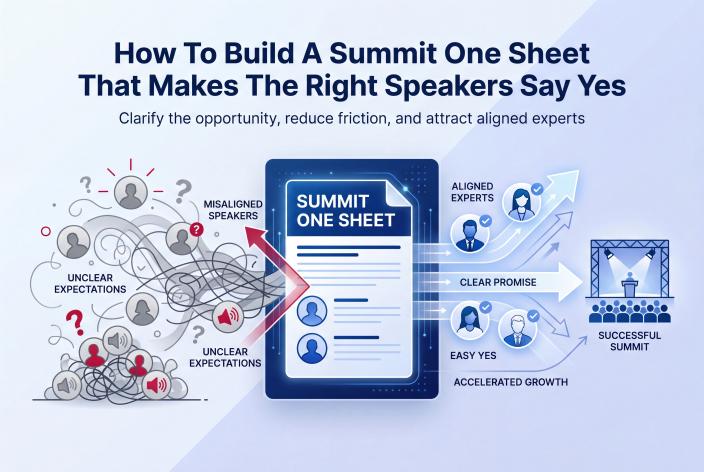
If you want strong speakers for your summit, your invitation has to do more than sound exciting.
It has to make the opportunity easy to understand.
The right speaker is asking a few quiet questions before they say yes:
- Is this audience a fit for my work?
- Does the topic match what I want to be known for?
- Will this event be professionally run?
- What exactly am I expected to do?
- Is this worth my time, energy, and promotion?
If your invitation leaves those questions unanswered, you create friction.
And friction does 2 things. It makes good speakers hesitate, and it attracts people who say yes without understanding the event.
That is where a summit one sheet helps.
A good summit one sheet is a simple speaker-facing document that explains the event, the audience, the speaker opportunity, the expectations, and the next step. It helps aligned speakers say yes faster. It helps misaligned speakers self-select out. And it makes the entire speaker process feel more professional from the first touch.
Let me explain how to build one.
Why Your Summit One Sheet Matters More Than You Think
A summit with speakers has a lot of moving parts.
You are collecting applications, reviewing topics, confirming bios, gathering images, managing session details, tracking speaker status, scheduling presentations, sending reminders, sharing links, and following up after the event.
That is a lot to hold together manually.
EventRaptor was built around those realities, with speaker profiles, speaker applications, invitation workflows, presentation review, tags, speaker files, schedules, speaker agreements, and speaker status tracking supporting the speaker management process.
But even with good infrastructure, your first message still matters.
If your speaker opportunity is vague, you invite confusion into the whole campaign.
Here is what usually happens:
- Speakers pitch topics that do not fit the summit promise.
- You spend more time explaining the audience over and over.
- People agree to participate, then disappear when promotion starts.
- Bios, headshots, links, and session details arrive in messy waves.
- Your event feels more like inbox management than authority building.
A summit one sheet reduces that drag.
It gives speakers a clean snapshot of the opportunity before they apply, book a call, or submit their session idea.
The takeaway?
Your one sheet is not just a nice PDF. It is a filter, a positioning tool, and the first proof that your summit will be professionally run.
What A Strong Summit One Sheet Should Do
The goal is simple.
Your one sheet should help a right-fit speaker quickly understand the event and decide whether they want to be part of it.
That means it should answer 5 questions clearly:
- Who is this summit for?
- What transformation or promise is the summit built around?
- What kinds of sessions are a fit?
- What does the speaker get from participating?
- What are the expectations and next steps?
Notice what is happening here.
You are not begging for speakers. You are presenting a clear opportunity.
That shift matters.
Strong speakers are usually busy. They do not want a 14-message back-and-forth just to understand whether your event makes sense for them.
Give them the core information up front, and you make the yes easier.
The Must-Have Sections Of A Summit One Sheet
You do not need a giant media kit.
In most cases, 1 or 2 pages is enough if the structure is clear.
Here are the sections I would include.
Summit Name And Positioning Statement
Start with the name of the summit and a short positioning statement.
This should tell the speaker what the event is about in plain English.
For example:
"A virtual summit for experienced wellness coaches who want to build calmer, more consistent client attraction systems without relying only on referrals and daily content."
That tells a potential speaker 3 useful things:
- The audience is experienced wellness coaches.
- The topic is client attraction.
- The tone is practical and values-aware.
A clear positioning statement saves you from attracting speakers who are technically in your world but not right for this specific event.
Audience Snapshot
This may be the most important section.
Speakers want to know who they will be talking to.
Be specific. Not in a stiff demographic way, but in a practical "will my message land here?" way.
Include details like:
- Who the summit is for
- What they are struggling with
- What they already believe or value
- What they want next
- What level of sophistication they have
For a coaching summit, that might sound like this:
"This summit is for coaches and expert-led service providers who have proven they can help clients, but do not yet have a predictable way to attract and convert right-fit prospects. They are tired of relying on referrals, random content, occasional networking, and inconsistent bursts of visibility."
That kind of audience clarity helps speakers shape better session topics.
It also helps them decide whether promoting the summit would make sense for their own community.
Summit Promise
Your summit promise is the main reason attendees register.
It should be bigger than a loose theme, but grounded enough to feel believable.
Think of it as the thread that ties every session together.
For example:
"Help coaches understand how to build authority, capture attention, nurture trust, and turn visibility into qualified client conversations."
That promise gives your summit a real center of gravity.
It also helps speakers avoid wandering into unrelated teaching.
Ideal Session Topics
Do not make speakers guess what you want.
Give them topic lanes.
For example, if your summit is about authority-based client acquisition for coaches, your topic lanes might include:
- Niche authority and positioning
- Offer clarity and messaging
- Virtual summits and webinars
- Partnerships and speaker-led growth
- Funnel strategy and lead capture
- CRM, reminders, and follow-up
- Sales conversations with warmer prospects
- Turning event momentum into ongoing nurture
This does not box speakers in. It gives them a useful starting point.
A good speaker can still bring their own angle, framework, and personality.
But now they know the field they are playing on.
Speaker Benefits
Be honest here.
Do not promise results you cannot control.
A speaker one sheet should talk about realistic benefits, such as:
- Exposure to a focused audience
- Association with a professionally run authority-building event
- Networking with other speakers and partners
- A chance to teach on a topic they want to be known for
- Content they may be able to share with their own audience
- A pathway for interested attendees to learn more about their work, if your event structure allows that
The best speaker benefits are specific enough to matter without drifting into hype.
Remember, quality speakers do not only care about list size. They care about audience fit, brand alignment, professionalism, and whether the event is worth sharing.
Promotion Expectations
This is where many summit hosts get nervous.
They want speakers to promote, but they do not want to sound demanding.
So they stay vague.
Then the event gets close, and everyone is disappointed.
Your one sheet should say what you are asking speakers to do.
For example:
- Share their unique registration link with their email list or community
- Post about the summit during the promotional window
- Provide approved swipe copy or customize it in their voice
- Invite aligned clients, colleagues, or audience members
- Participate in agreed speaker communications and deadlines
If promotion is optional, say that.
If promotion is expected, say that.
Clear expectations protect the relationship.
EventRaptor supports this kind of partner and promoter organization with unique promoter links, promoter dashboards, performance reports, leaderboards, promoter attribution, and registration tracking. That means you can see which partners helped create momentum instead of trying to reconstruct promotion activity from memory and spreadsheets.
Speaker Requirements And Deliverables
This section keeps your admin load from exploding later.
List what you need from accepted speakers, such as:
- Bio
- Headshot
- Session title
- Session description
- Presentation format
- Promotional links
- Signed speaker agreement, if applicable
- Uploaded files or slides, if needed
- Calendar availability or recording deadline
Keep it clean.
Do not bury the speaker in operational details. Just show that there is a process.
EventRaptor can help centralize many of these pieces because it supports speaker profile management, applications, invitations, presentation review, tagging, speaker uploads where plan-supported, session scheduling, and speaker agreement workflows.
That is a big deal when your summit grows beyond a few friendly colleagues.
Timeline And Key Dates
Speakers need to know the rhythm of the campaign.
Include dates such as:
- Application deadline
- Speaker confirmation window
- Recording deadline, if sessions are pre-recorded
- Promotional period
- Summit dates
- Live session times or release schedule
- Follow-up period, if relevant
You do not need every internal production date.
Just include the dates that help speakers understand the commitment.
Application Or Next Step
End with one clear action.
Do you want them to apply? Book a speaker fit call? Reply by email? Submit a topic?
Make it obvious.
Include:
- The application link or next step link
- What happens after they apply
- When they can expect to hear back
- Who to contact with questions
The easier you make this step, the fewer strong speakers you lose to confusion.
How To Write The One Sheet So Good Speakers Actually Read It
Here is a tip.
Do not write your one sheet like a formal corporate announcement.
Write it like a clear invitation from one expert to another.
Use short sections. Use plain language. Use bullets where they help. Keep the promise visible.
A strong one sheet feels like this:
| Weak Invitation | Strong One Sheet |
|---|---|
| "We are hosting a summit and would love for you to speak." | "This summit helps experienced coaches build authority and turn visibility into qualified conversations." |
| "You can talk about anything related to business." | "We are looking for sessions on positioning, partnerships, funnels, CRM, follow-up, and sales conversations." |
| "Promotion would be appreciated." | "Speakers are asked to share their unique registration link during the promotional window using provided swipe copy or their own message." |
| "Send us your info." | "Accepted speakers will submit a bio, headshot, session title, description, and relevant links through the speaker process." |
See the difference?
The strong version gives direction.
And direction is what makes the whole speaker process easier.
How This Fits Into Your Larger Client Attraction System
A summit one sheet does more than recruit speakers.
It sharpens the event itself.
When you clarify the audience, theme, speaker fit, promotion expectations, and next step, you are also clarifying your authority position.
That matters because a summit is part of a larger path:
- You choose a meaningful audience and problem.
- You bring useful voices together around that problem.
- You create a reason for the right people to register.
- You capture and organize that interest.
- You follow up while trust is still warm.
- You invite qualified people into the next conversation.
This is where connected infrastructure helps.
EventRaptor manages the virtual event side, including registration, event pages, speakers, schedules, reminders, promoter tracking, attendee data, and follow-up paths. GHL/CRMRaptor supports the CRM, calendar, funnel, workflow, automation, and follow-up side.
Together, they help the summit become a managed path from visibility to registration to nurture to qualified conversations.
Not a scramble.
Not a pile of links.
A real event growth system.
A Simple Summit One Sheet Template You Can Use
Here is a practical structure you can adapt.
Summit Overview
- Summit name
- Short positioning statement
- Event format
- Event dates
- Host name or organization
Who This Summit Is For
- Audience description
- Current problem they are trying to solve
- What they want to understand, improve, or achieve
- Why this topic matters now
Summit Promise
- Main attendee promise
- 3 to 5 core themes
- The kind of practical learning attendees should expect
Speaker Fit
- Ideal speaker expertise
- Best-fit session topics
- Tone and teaching style
- Any topics that are outside the scope
Speaker Benefits
- Audience fit
- Authority and visibility opportunity
- Relationship and partnership potential
- How attendees can connect with speakers, if applicable
Speaker Expectations
- Session format
- Required assets
- Promotion expectations
- Deadlines
- Communication process
Next Step
- Application link
- Review process
- Response timing
- Contact person
That is enough.
Do not overcomplicate it.
Your one sheet should make the opportunity feel clear, credible, and easy to act on.
Final Thoughts On Getting Better Speakers To Say Yes
The quality of your speakers often starts with the quality of your invitation.
When your one sheet is clear, you attract people who understand the audience, respect the theme, and know what participation involves.
That means fewer mismatched pitches. Fewer repetitive explanations. Fewer loose ends hiding in your inbox.
And a better experience for everyone involved.
If you are planning a summit and want help mapping the speaker strategy, event flow, funnel, CRM, and follow-up behind it, Book your Client Attraction Planning Call.
On the call, we can look at where your event strategy is getting stuck and what kind of client attraction system could make sense for your coaching business.