If you've ever thought about running a virtual summit, you've probably pictured the exciting part first.
Great speakers. A packed schedule. Your audience seeing you surrounded by respected experts. New people joining your list. Warm prospects booking calls after the event.
That's the vision.
But here's where many coaches get stuck. They invite speakers too late, choose people mostly because of their name, assume everyone will promote, and then spend the final 2 weeks before launch refreshing inboxes and hoping someone sends an email.
That's a stressful way to build authority.
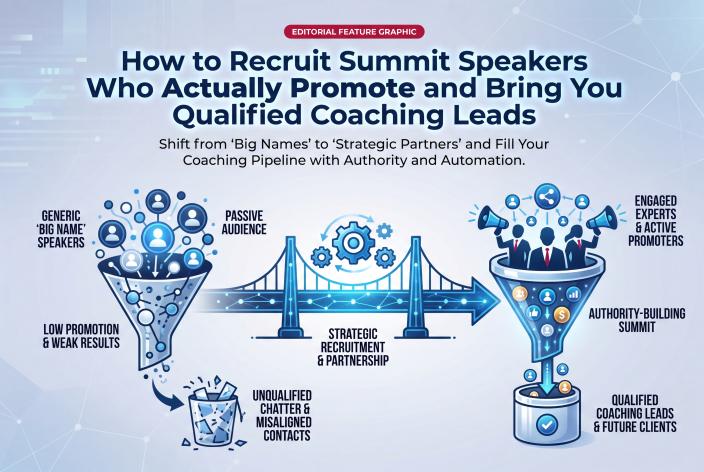
Your speakers are one of the biggest leverage points in your summit. They can help you grow your list, strengthen your credibility, fill the event with better-fit attendees, and create relationships that keep paying off long after the last session airs.
But that only happens when speaker recruitment is handled with strategy, clarity, and follow-up.
Let's walk through how to recruit summit speakers who actually promote and bring you qualified coaching leads.
Your speakers are the engine behind summit momentum
A summit is more than a collection of interviews.
When you build it properly, it becomes an authority stage. You bring together useful voices around a focused problem your audience cares about. You position yourself as the host of the conversation. And you create a reason for partners, prospects, and peers to pay attention.
Your speakers can help with 3 things at once:
- List growth, because they can introduce your summit to their audience
- Authority growth, because their presence helps position the event as worth attending
- Relationship growth, because each speaker is a potential future partner, referral source, affiliate, collaborator, podcast guest, or client
That last point matters.
Some summit hosts only think about attendees. But the speaker relationships themselves can become one of the most valuable parts of the event. Speakers can become clients, collaborators, and referral partners when the host uses the summit to build real trust and learn the language of the market.
So yes, you want speakers who promote.
But you also want speakers who fit the bigger business you are building.
That means your recruitment process needs to do more than collect famous names.
The 3 speaker types you want in your summit
A strong summit usually includes a mix of speaker types.
If you build the whole lineup around one kind of person, you create risk. If everyone is famous but unavailable, promotion may be weak. If everyone has a tiny audience, reach may be limited. If everyone is a promoter but the content is thin, attendees may not trust the event.
You want balance.
1. A-list experts who raise perceived authority
A-list experts can make your summit feel more credible.
These are the people your audience already recognizes, or the people whose credentials, books, platforms, or reputation make the event feel more serious.
They can help you get more yeses from other speakers. They can also help your audience see the summit as worth their time.
But don't build the whole event around celebrity names.
Big names don't always promote. Some have large audiences but packed calendars. Some say yes to speak but don't send much traffic. Some are great for positioning and poor for partnership energy.
Use A-list speakers strategically. Let them support the authority of the event, but don't make your entire promotion plan depend on them.
2. Established promoters with active audiences
These are the speakers who understand partnership marketing.
They may not be the most famous people in your niche, but they have an audience that responds. They email. They show up. They share useful things. They understand that a good summit can be a win for everyone.
This group is often where your registration momentum comes from.
Look for signs like:
- They regularly promote webinars, workshops, podcasts, events, or launches
- Their audience comments, replies, shares, or attends
- They have a clear niche that overlaps with your ideal client
- They understand affiliate or partner promotion
- They follow through on commitments
The word "active" matters here.
A smaller, responsive audience can be more valuable than a huge list that ignores every email.
3. Up-and-coming relationship builders
These speakers may not have the biggest reach yet, but they bring energy, care, and alignment.
They are often willing to promote because the summit is meaningful to them. They may be newer in visibility, but serious about the topic. They may also become some of your best long-term collaborators because you're building the relationship early.
Look beyond big names and find like-minded micro influencers with an audience, then build real relationships with them.
That's good advice.
Up-and-coming speakers can bring:
- Fresh perspectives
- High enthusiasm
- Strong niche alignment
- More personal promotion
- Future collaboration potential
And by the way, if your audience includes coaches, consultants, authors, or service providers, these speakers may also be ideal prospects for your own offer.
Not because you pitch them aggressively.
Because the summit gives you a natural way to learn what they are working on, what problems they are facing, and where your work may genuinely help.
How to qualify speakers before you invite them
Speaker recruitment gets easier when you stop asking, "Is this person impressive?" and start asking, "Will this person help create the right event for the right audience?"
Here are the main filters.
Audience fit
Start here.
Does this person's audience include the kind of people you want in your world?
If you're a health coach for women in midlife, a general productivity expert might sound useful. But a hormone specialist, menopause fitness coach, emotional eating expert, or sleep consultant may bring a much more aligned audience.
Specific beats broad.
A summit source warned against generic "how to build your business" style events because they've already been done. That same principle applies to speakers. Generic lineups create generic audiences.
Ask:
- Who listens to this person?
- What problem does their audience want solved?
- Would their audience naturally care about my summit topic?
- Would some of those attendees be a fit for my offer after the summit?
If the answer is fuzzy, the speaker may still be interesting, but they may not be strategic.
List quality and engagement
List size can help you estimate reach, but it should not be your only filter.
You can plan list potential across the whole lineup without demanding that every speaker personally have a large list. A smaller speaker with the right audience can be more useful than a bigger speaker whose list is only loosely connected to your topic.
That distinction matters.
A speaker with 2,000 highly engaged subscribers may produce better conversations than someone with 50,000 people who no longer open emails.
Look for engagement signals:
- Email consistency
- Comments on posts
- Podcast reviews or community interaction
- Webinar attendance behavior
- Recent collaborations
- Audience specificity
And if you ask about list size, ask respectfully and later in the conversation. Leading with "How big is your list?" makes people feel used.
You want partners, not rented traffic.
Willingness to promote
This is where many hosts get surprised.
They assume speaking equals promoting.
It doesn't.
You need to know whether the speaker is willing to support the event before you count on their audience.
That doesn't mean making the invitation feel transactional. It means being clear.
A simple way to ask:
"We're building this as a collaborative summit, so each speaker helps share the event with their audience. Most speakers send 1 or 2 dedicated emails and share on their preferred social channel. Is that something you'd be comfortable with if the topic feels aligned?"
That question is calm. It respects their choice. And it gives you a real answer early.
Relationship potential
Some speakers bring more than registrations.
They can become:
- Referral partners
- Podcast guests
- Affiliate partners
- Joint venture partners
- Workshop collaborators
- Future summit speakers
- Clients
A summit is a relationship-building asset when you treat it that way.
So as you qualify speakers, ask yourself:
- Would I enjoy staying connected with this person?
- Do we serve adjacent audiences?
- Could we refer to each other?
- Could we build future content together?
- Would this relationship make sense after the summit ends?
If yes, that speaker may be valuable even if their audience is modest.
What to include in your summit one sheet
Your summit one sheet is the speaker's quick decision page.
It should answer, "Why should I say yes, and what exactly am I agreeing to?"
Keep it clean. Keep it specific. Make it easy to forward to an assistant or team member.
Include:
-
Summit name and promise
What is the event called, and what will attendees learn or experience?
-
Who the summit is for
Be specific. "Coaches" is broad. "Established health coaches who want to build a referral-friendly group program" is clearer.
-
Why this topic matters now
Give speakers a reason to care. Connect the event to a real problem in the market.
-
Speaker benefits
Explain the value to them. Visibility, authority association, list growth, affiliate opportunity, relationship building, content exposure, and access to a relevant audience may all matter.
-
Session format and time commitment
Is it a 30-minute interview? A panel? A short training? Live or recorded? How long is the prep?
-
Promotion expectations
State what you're asking for. For example, 1 or 2 solo emails, social posts, and participation in speaker updates.
-
Important dates
Include interview deadline, promotional window, summit dates, and any live sessions.
-
Affiliate details if applicable
If speakers can earn commissions, explain the basics clearly.
-
Next step
Tell them exactly what to do. Book a quick call, reply to the email, or complete the speaker form.
This one sheet also protects you.
When expectations are written down early, you reduce awkward follow-up later.
How to set promotion expectations without sounding pushy
Good speakers don't mind clear expectations.
They mind feeling like they're being mined for their audience.
The difference comes down to tone, timing, and alignment.
Start with the mission of the summit. Explain why their voice belongs in the conversation. Show that you understand their work. Then share how promotion works.
You might say:
"We're curating this as a true partner-driven summit. The goal is to create a useful resource for the audience and make sure every speaker benefits from the visibility. To make that work, each speaker agrees to help promote during the launch window. We provide swipe copy, graphics, links, and reminders so it doesn't become a heavy lift."
That's respectful.
You're not begging. You're not demanding. You're setting the terms of a collaborative event.
You can also offer promotion options:
- 1 dedicated email plus 2 social posts
- 2 dedicated emails plus stories or short video mentions
- Newsletter feature plus community post
- Podcast mention plus email
- Live stream with the host before the event
The best promotion plan is the one the speaker will actually do.
So ask what fits their audience.
Why smaller engaged lists can outperform bigger audiences
This is one of the most important mindset shifts in summit recruitment.
A big list looks exciting on a spreadsheet.
An engaged list fills events, replies to emails, shares with friends, attends sessions, and books calls when the offer fits.
Audience quality and engagement matter more than pure size. First summits may not produce huge lead numbers, and a few hundred right people can still be meaningful when the offer and follow-up are aligned.
That's especially true for coaches.
You don't need every attendee on the internet. You need the right people moving toward trust.
A smaller audience can work well when:
- The summit topic is specific
- The speakers are aligned
- The attendees have the problem your offer solves
- Your post-summit path is clear
- Follow-up continues after the event
The money is rarely in registration alone.
It's in what happens after people register, attend, engage, reply, and book a conversation.
Use agreements, swipe copy, leaderboard updates, and reminders
Once speakers say yes, your job shifts from recruitment to activation.
This is where many summits lose momentum.
They get the speaker. They record the session. Then they assume the speaker will remember to promote.
Most won't.
Not because they're bad partners. Because they're busy.
You need a simple promotion system.
Speaker agreements
A speaker agreement doesn't need to feel heavy, but it should make commitments clear.
Include:
- Session format
- Recording or live attendance expectations
- Promotion commitments
- Affiliate terms if applicable
- Deadlines
- Permission to use their name, bio, headshot, and session content for event promotion
- Contact information for their assistant or team if relevant
Clear agreements reduce confusion.
Swipe copy and graphics
Make promotion easy.
Give speakers email copy, social posts, short blurbs, graphics, registration links, and suggested send dates.
But don't make the copy sound generic.
Sheri Moise, a summit host, recommended taking 15 to 20 minutes after interviews to note the speaker's strongest ideas and language. She used those notes to write better promotional copy and connect each speaker's words back to the summit vision.
That's smart.
When the copy sounds like the speaker and fits the event, they're more likely to use it.
Leaderboard updates
A leaderboard can turn promotion into a friendly game.
You can use leaderboard contests for both leads and sales, with daily updates by email, Facebook group, or a private speaker area. The ranking can show who is generating the most registrations or sales, and the top positions can receive prizes or recognition.
This works best when the tone is fun.
Think encouragement, celebration, and playful competition. Not pressure.
You can run:
- A leads contest before the summit starts
- A sales contest during the summit and final offer window
- Bonus recognition for most creative promotion
- A surprise prize for speaker engagement
If you have 10 speakers, a leaderboard with around 6 visible spots can keep people engaged. If you have 50 speakers, you may want a larger board so more speakers feel they have a real chance to appear.
And if the numbers are lower than expected, you can share rankings without publicly displaying every count.
Friendly reminders
Reminders are not optional.
Your speakers need dates, links, and nudges.
Sheri Moise also emphasized checking in with speakers about the promotion they agreed to and using gentle, friendly reminders.
This can be as simple as:
- "Your first email is scheduled for tomorrow. Here's your link and copy."
- "We're seeing great early registrations. If you haven't shared yet, today is a strong day to send."
- "Your session goes live in 2 days. Here's a short post you can use to invite your audience."
Good follow-up helps good partners follow through.
Common speaker recruitment mistakes that create launch stress
If you want a calmer summit, avoid these mistakes early.
Inviting speakers too late
Summits need breathing room.
One source notes that while some summit coaches talk about getting a summit done in 90 days, taking 4 or 5 months can be more realistic, and a concierge-style process may use 6 months because relationship building and quality take time.
If you recruit too late, everything gets squeezed:
- Speaker research
- Outreach
- Follow-up
- Scheduling
- Recording
- Copywriting
- Promotion
- Tech setup
- Reminders
That squeeze usually shows up as weak promotion.
Choosing speakers only by name recognition
A famous speaker who doesn't promote may still add authority.
But a whole lineup of people who won't share creates a promotion gap.
Choose for content fit, audience fit, and relationship potential.
Making the summit too generic
A generic summit attracts generic interest.
Your topic should feel specific enough that speakers know why they belong and attendees know why they should register now.
Treating speakers like traffic sources
Asking about list size too early, requiring arbitrary list minimums, or making the whole invitation feel like a list grab can damage relationships.
Speakers can tell when they're being valued only for reach.
Build the relationship first.
Failing to plan the post-summit path
Your summit should lead somewhere.
Plan what happens after the summit and align the event with the offer you plan to make afterward.
For a coach, that might mean:
- A post-summit workshop
- A planning call invitation
- A private diagnostic
- A group program application
- A nurture sequence
- A podcast or webinar follow-up
Your speakers can help you fill the room. Your funnel and follow-up help turn that attention into qualified conversations.
How EventRaptor makes speaker recruitment easier
Speaker recruitment has a lot of moving parts.
Research. Outreach. One sheets. Speaker applications. Bios. Headshots. Session details. Promotion links. Swipe copy. Tracking. Reminders. Event pages. Registration flows. Follow-up.
It's a lot to hold in your head while you're still serving clients.
This is where EventRaptor and the broader VirtualSummits.com ecosystem can help.
EventRaptor helps simplify the summit process with speaker listings, templates, tracking, and event setup support. That means you don't have to start from a blank page or duct-tape every piece together yourself.
Depending on your plan and support level, the system can help you organize the practical pieces that make recruitment and promotion easier, such as:
- Speaker listings and visibility opportunities
- Speaker one sheet and outreach templates
- Event pages and registration setup
- Speaker details, schedules, and assets
- Promotion tracking and reporting
- Communication workflows and reminders
- Done-for-you support around setup and execution
And when you connect the event to CRM, follow-up, and booking flows, the summit becomes more than a visibility play.
It becomes part of a client attraction system.
That is the piece many coaches are missing.
They can create attention, but the attention leaks out because there is no clear path from registration to trust to conversation.
Turn speaker relationships into future opportunities
The summit doesn't end when the last session airs.
In many ways, that's when the relationship asset starts becoming more valuable.
After the summit, follow up with every speaker.
Send:
- A thank-you note
- Their session link or replay details
- Performance highlights you can share
- Comments or attendee feedback if available
- A suggestion for staying connected
- A next-step invitation if there is a clear fit
Then look for natural next steps:
- Invite them to your podcast
- Ask about being on their podcast
- Explore a referral partnership
- Offer to co-host a workshop
- Add them to an affiliate campaign
- Invite them to a future summit
- Start a sales conversation if they have a problem you can genuinely solve
This is how a summit becomes a long-term authority and partnership asset.
Not a one-time event you run and forget.
Your next step is to design the right speaker strategy for your business
Recruiting summit speakers who promote starts with a simple shift.
You are not just filling session slots.
You are building an authority stage, a partner network, and a path toward qualified coaching leads.
Choose speakers for audience fit, engagement, alignment, and relationship potential. Give them a clear one sheet. Set promotion expectations with warmth. Support them with swipe copy, reminders, tracking, and friendly competition. Then follow up after the summit like the relationship matters.
Because it does.
And if you want help designing this around your niche, offer, and client attraction goals, the next step is to Book your Client Attraction Planning Call.
On the call, we'll look at what you're building, where your current client flow is inconsistent, and how a summit, funnel, CRM, and follow-up system could work together to bring you more right-fit conversations.
If you're ready to stop piecing this together alone, book your call and let's map out the practical path.