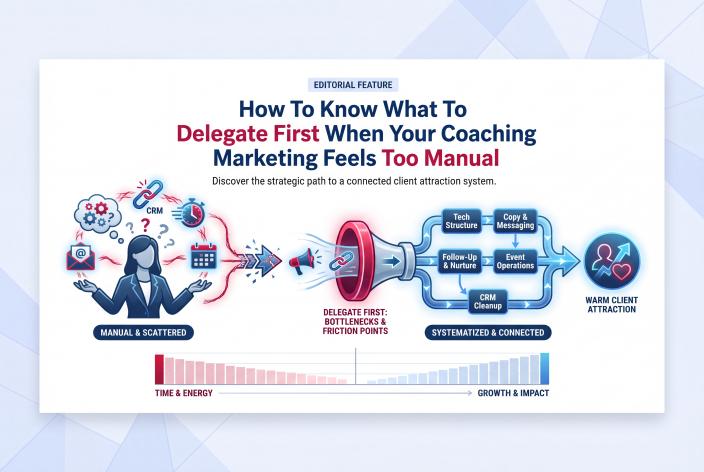
You can be excellent at coaching and still feel buried by the machinery around getting clients.
The landing page needs edits. The email sequence is half-written. The CRM has contacts with no tags. The workshop reminders need to go out. The speaker bio is missing. Someone registered but never got the right link. A promising lead said, "Send me the details," and now that follow-up is sitting in your head somewhere between client calls and dinner.
Sound familiar?
This is the stage where many proven coaches start thinking, "I need help."
And they're right.
But then the next question shows up.
What should I delegate first?
Tech? Copy? Follow-up? Event logistics? CRM cleanup? Social content? Speaker coordination? Funnel pages?
The wrong answer can create more work. The right answer can give you breathing room fast, while protecting the voice, values, and client experience that make your coaching business work.
Let's sort it out.
The First Sign You Need To Delegate Is Usually Friction
Delegation shouldn't start with the task you dislike most.
It should start where friction is slowing down client attraction.
For a coach, that friction usually shows up in 5 places:
- Visibility is happening, but leads are not being captured clearly.
- People register, download, attend, or inquire, but follow-up is inconsistent.
- Your CRM is full of contacts, but you don't know who is warm, cold, ready, or forgotten.
- Events, workshops, webinars, or summits create attention, then the next step gets fuzzy.
- You spend too much time managing tools instead of leading conversations.
You don't need to delegate everything at once.
You need to remove the bottleneck that is making the whole system fragile.
That's the key.
The Most Common Delegation Bottlenecks For Coaches
Most coaching businesses do not break because the coach lacks ideas.
They get stuck because too many important details depend on the coach's memory, energy, and spare time.
Here are the usual pressure points.
Tech Setup And Tool Connections
This includes landing pages, forms, calendars, email software, Zoom links, payment links, event pages, automations, CRM tags, tracking, and integrations.
If you're spending your best thinking time trying to make tools talk to each other, tech is probably the first thing to delegate.
The danger is subtle.
You sit down to improve your message and 90 minutes later you're watching a tutorial about custom fields.
That's not leadership. That's leakage.
A capable implementation partner can build the structure, test the paths, connect the pieces, and document what was done so you're not trapped inside the system every time something changes.
Copy And Messaging Support
Copy is trickier.
Your words matter. Your prospects need to feel your presence, not a generic template wearing your logo.
So should you delegate copy?
Yes, with the right guardrails.
You should keep ownership of:
- Your point of view
- Your client promise
- Your stories
- Your offer details
- Your ethical boundaries
- The way you talk to clients in real life
But you can delegate the drafting, structuring, editing, repurposing, and formatting.
The best copy support does not replace your voice. It helps organize it.
A practical process looks like this:
- You provide raw ideas, call notes, voice memos, client language, or a rough outline.
- The writer turns it into a usable draft.
- You review for accuracy, tone, and promise.
- The final version gets loaded into the funnel, email sequence, event page, or CRM workflow.
That protects your voice while removing the blank-page drag.
Follow-Up And Nurture
This is one of the most expensive places to stay manual.
A prospect registers for your workshop. Someone attends your summit session. A past lead clicks an email. A referral asks for more information. A webinar attendee watches the replay.
Then what?
If the answer is, "I try to remember to follow up," this is a strong delegation candidate.
Follow-up can be delegated in 2 layers:
- The strategy of what should happen next
- The implementation of emails, SMS reminders, CRM tasks, tags, and booking links
You still decide what kind of relationship you want to create. You still approve the message. You still show up for real sales conversations.
But the system can make sure the right people hear from you at the right time.
Good automation is not cold. Sloppy silence is cold.
Virtual Event And Speaker Coordination
Summits, workshops, webinars, giveaways, and speaker-led campaigns can build authority quickly because you're borrowing trust, creating useful conversations, and becoming more visible in your niche.
But the operations can get heavy.
Registration pages. Thank-you pages. Attendee dashboards. Speaker applications. Bios. Headshots. Schedules. Presentation details. Reminder emails. Partner links. Promoter tracking. Zoom access. Follow-up.
That's a lot to hold in your head.
EventRaptor is built for this kind of virtual event management. It helps organize event setup, registration, speaker workflows, event pages, reminders, promoter tracking, attendee data, CRM sync, follow-up, and reporting so the campaign does not have to run through spreadsheets, inboxes, and disconnected tools.
This matters because your event should help you become more visible and trusted, not bury you in admin.
If you're planning a summit or workshop and the logistics are already draining your energy before promotion starts, delegate event operations early.
CRM Management And Pipeline Cleanup
A CRM should help you see who raised their hand, what they care about, what they attended, what they requested, and what should happen next.
But many coaches have a CRM that feels more like a messy closet.
Contacts are duplicated. Tags are inconsistent. Old leads are mixed with clients. Webinar attendees are not segmented. Sales calls are not tracked. Follow-up tasks are unclear.
When the CRM is messy, your follow-up becomes guesswork.
This is a good area to delegate because the work is technical and structured. Someone can clean lists, create stages, apply tags, set up workflows, connect calendars, and build reporting.
You should still decide what the pipeline means.
For example:
- What makes someone qualified?
- What should happen after a workshop registration?
- When should someone be invited to book a call?
- What makes a lead not ready yet?
- What should a past client receive next?
Once those decisions are clear, GHL/CRMRaptor can support the CRM, calendar, funnel, workflow, automation, and follow-up side of the system.
What You Should Keep As The Coach
Delegation works best when you keep the few things only you can truly own.
Don't hand off the soul of the business.
Keep these close.
Your Message And Point Of View
Your team can shape, sharpen, and publish your message.
But the core perspective needs to come from you.
What do you believe about your clients' problem? What are they misunderstanding? What do you refuse to do in your marketing? What kind of transformation do you actually help create?
Those answers make your business distinct.
Your Offer And Client Promise
A strategist can help refine your offer. A copywriter can help explain it. A funnel builder can create the path into it.
But you need to know what you're willing and able to deliver.
If your offer is unclear, delegation gets messy fast because every person you hire has to guess what the funnel is supposed to do.
Your Sales Ethics
This is especially important for coaches.
You need to decide how you sell, what claims you won't make, how you handle urgency, what makes someone a fit, and when you recommend a different path.
A good implementation team should respect those boundaries.
Your Client Insight
You hear the real objections. You know what clients say before they buy. You know where prospects get confused. You know what happens on sales calls.
That information is gold.
Don't disappear from the process. Bring those insights to the team so the system gets smarter.
What You Can Delegate Safely
Once your core decisions are clear, a lot can be handed off.
Here are the areas that are usually safe to delegate with strategy, templates, approvals, and reporting.
| Area | What You Keep | What You Can Delegate |
|---|---|---|
| Funnel Pages | Offer, promise, audience, voice | Page build, formatting, testing, publishing |
| Email Copy | Point of view, tone, boundaries | Drafting, sequencing, editing, loading |
| CRM | Pipeline definitions, qualification rules | Tags, workflows, fields, cleanup, reporting |
| Events | Topic, audience, speaker standards | Pages, reminders, schedules, speaker details |
| Follow-Up | Relationship intent, sales ethics | Automations, tasks, reminders, nurture paths |
| Content | Ideas, stories, expertise | Repurposing, scheduling, formatting, distribution |
The pattern is simple.
You own the meaning. They manage the machinery.
You own the promise. They build the path.
You own the relationship. They help make sure the relationship does not get dropped.
Why Scattered Freelancers Can Create More Work
Hiring help is not the same as building a system.
A designer can build a page. A copywriter can write emails. A VA can upload contacts. A funnel tech can connect tools. A social media person can schedule posts.
All useful.
But without a central client attraction plan, you become the person holding the whole thing together.
You explain the strategy 5 times. You check every detail. You notice the CRM tag is missing. You realize the thank-you page points to the wrong next step. You catch that the emails don't match the offer. You ask who is tracking registrants. You wonder whether anybody followed up with warm leads after the event.
Now you're not just the coach.
You're the strategist, project manager, quality control person, and emergency technician.
That's why delegation should start with the system, not just the task list.
Before you hire another person, answer these questions:
- What is the client attraction path we're building?
- Where does visibility turn into captured interest?
- What happens after someone registers, attends, clicks, replies, or books?
- How will we know which leads are warm?
- Who owns each step?
- What needs my approval before it goes live?
- What reporting will show whether the system is working?
If those answers are missing, every freelancer has to make assumptions.
And assumptions create cleanup.
A Simple Order For Deciding What To Delegate First
If everything feels manual, use this order.
1. Delegate The Bottleneck Closest To Revenue
Start where warm opportunities are being lost.
That might be follow-up after calls, webinar registrations, summit attendance, consultation requests, or referral inquiries.
If someone has already raised their hand, protect that relationship first.
2. Delegate The Work That Repeats
Anything you do over and over is a strong candidate.
Examples:
- Loading email sequences
- Creating event pages
- Sending reminders
- Updating speaker details
- Tagging contacts
- Building calendar links
- Preparing replay emails
- Exporting attendee lists
Repeated tasks are perfect for templates, checklists, and implementation support.
3. Delegate The Work That Requires Precision
Some tasks are not emotionally important, but they break the experience when done poorly.
Wrong links. Missed reminders. Bad tags. Broken forms. Confusing calendar times. Missing Zoom access.
These details matter because prospects judge the experience before they ever become clients.
4. Delegate The Work That Drains Your Best Energy
You have limited high-quality attention.
Use it for coaching, selling, relationship building, offer decisions, client insight, and authority building.
If a task consistently leaves you foggy, irritated, or behind, it may be costing more than it looks like.
5. Keep The Work That Shapes Trust
You should still be involved where trust is created.
That includes your core message, key sales pages, signature talks, webinar promise, summit positioning, high-touch follow-up, and sales conversations.
You do not have to build every asset yourself to stay present in the process.
The Better Goal Is A Client Attraction System
The goal is not to become a better delegator of random tasks.
The goal is to build a clearer path from authority to attention to trust to conversation.
For many coaches, that path includes:
- A clear niche and offer
- Authority-building content or events
- Registration or lead capture pages
- Email and SMS reminders
- A CRM that tracks the relationship
- Follow-up that continues after the event or inquiry
- A booking path for qualified prospects
- Reporting that shows what happened
EventRaptor can help manage the event side: registration, pages, speakers, reminders, attendee data, promoter tracking, and follow-up workflows.
GHL/CRMRaptor can support the CRM side: contacts, tags, calendars, funnels, workflows, automation, and follow-up.
Together, they support a more connected process, so your visibility has somewhere useful to go.
And that's the real relief.
You stop trying to remember everything. You stop rebuilding the same campaign from scratch. You stop letting warm interest fade because the next step wasn't ready.
You get to lead the business again.
Your Next Delegation Decision
If your coaching marketing feels too manual, don't start by asking, "Who can take this off my plate?"
Ask a better question.
Where is my current client attraction path breaking down?
If the answer is unclear, that's where planning matters.
Maybe you need CRM cleanup before a bigger campaign. Maybe you need a follow-up sequence before driving more visibility. Maybe your next move is a workshop, summit, webinar, or partner campaign. Maybe the offer and message need tightening before implementation.
You don't have to guess alone.
If you want help mapping the next practical implementation step for your coaching business, Book your Client Attraction Planning Call.
On the call, we'll look at where your client flow is getting stuck and what kind of authority, funnel, CRM, follow-up, event strategy, or done-for-you support could make sense next.